

Yield Management Best Practices for Programmatic Publishers
Yield management best practices for programmatic publishers come down to coordinating price, demand, inventory quality, UX, and measurement so the revenue lift holds up under review. The working order is straightforward: audit the inventory, isolate one lever, run a clean control, then scale only when eCPM, fill, viewability, and user signals move in the right direction together.
Key takeaways
- Yield work is broader than floors; inventory quality, demand mix, and UX change the result just as much as price.
- A CPM lift means little if fill drops or your impression mix shifts toward weaker placements.
- Test one variable at a time with a real holdback, or you won’t know what actually moved revenue.
- Shared governance helps multi-property publishers, but floors, refresh, and placement rules still need property-level exceptions.
- The fastest way to damage yield is to chase revenue changes without checking viewability, latency, and user behavior together.
What yield management covers beyond pricing
Programmatic yield management includes every lever that can change monetizable value across Google Ad Manager, AdX, header bidding, and PMP deals. That means pricing, allocation, ad density, refresh, viewability, placement quality, page type, device, geo, and the amount of demand pressure hitting the impression.
The old yield management idea is still useful: match limited inventory to the right demand at the right price and the right time. You see the same framing in revenue management writing, including hospitality examples where inventory is fixed and demand shifts by season, segment, and timing AltexSoft. For publishers, the fixed inventory is not “rooms.” It is eligible impressions, each with its own chance of being seen, bid on, filled, and accepted by users.
Price floors matter, but they are only one layer of the stack. A US$3.00 floor on a highly viewable in-article unit is doing different work than that same floor on a below-the-footer slot with weak engagement. If the second unit loses fill, pricing may not be the real problem. Quality may be. If the first unit clears without resistance, the floor may still be too low for the demand behind it.
Why floor changes can lie
A floor change can look like a win because CPM rises while impressions quietly disappear. It can also look like a loss because CPM drops after you move your best inventory into a PMP package and leave weaker open-auction impressions in the report. The dashboard did not lie. The mix changed.
That is why eCPM by itself is risky. If a homepage takeover changes page engagement, a new lazy-loading rule changes which impressions become eligible, or refresh fires more often on long sessions, your CPM trend may be describing traffic composition more than buyer appetite.
Why multi-property publishers need policy with exceptions
A publisher running several properties needs shared governance, but shared rules should not flatten performance. A finance site, a local news property, and an entertainment gallery can sit inside the same GAM network and still need different price floors, refresh thresholds, ad unit maps, and PMP packaging.
The right model is central control with local proof. Set naming conventions, experiment rules, floor governance, and reporting views centrally. Then let the data decide whether a 300x250 on a recipe article belongs in the same policy bucket as a sticky unit on a market-news page.
A yield optimization checklist you can run this week
A useful yield audit starts with five review blocks: inventory quality, demand mix, user experience, measurement hygiene, and test discipline. Keep that order. You want structural problems fixed before you tune price floors or decide the issue must be buyers.
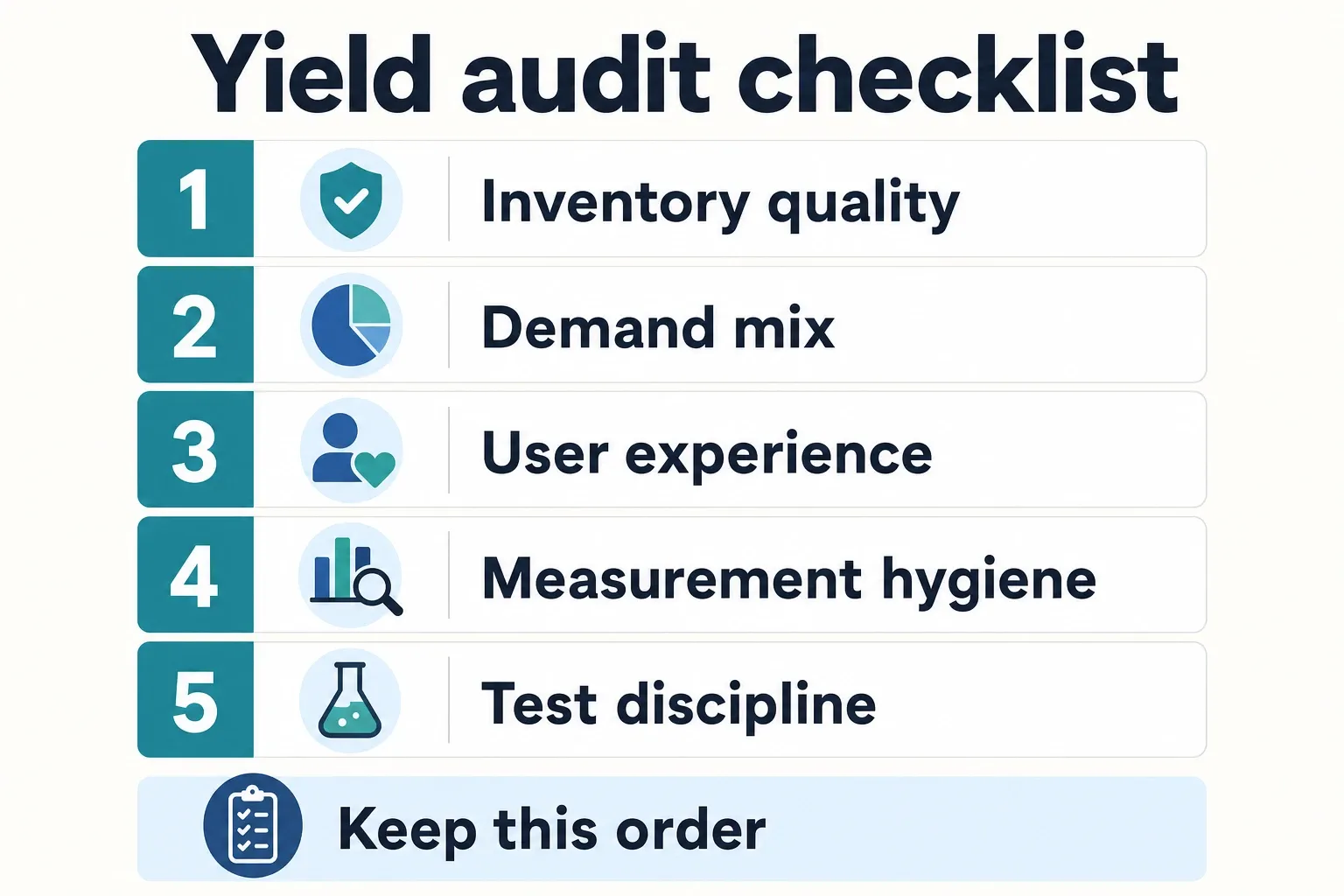
- Inventory quality block: Pull ad unit, page type, device, geo, viewability, fill, render rate, and unfilled impression data from Google Ad Manager. Flag slots where demand is crowded into a few premium placements while other units create low-value impressions. Look for units with high request volume, weak viewability, and low buyer competition; those are usually placement or eligibility problems before they are pricing problems.
- Demand mix block: Review AdX, header bidding, and PMP deals separately. Open auction weakness, bidder timeout issues, and under-delivering PMP line items require different fixes. If AdX is winning because header bidding partners are timing out, floor strategy will not solve the root issue. If PMP deals are underbid because the packaged inventory is too broad, the deal needs tighter supply definition.
- User experience block: Inspect ad refresh timing, ad density, layout shifts, sticky behavior, lazy-loading thresholds, and page-speed impact. A revenue lift created by firing more auctions per session can be valid only if session quality does not deteriorate. Treat refresh eligibility as a UX rule as much as a monetization rule.
- Measurement hygiene block: Segment every yield view by ad unit, device, geo, page type, traffic source, and demand source before approving a change. A blended revenue line can hide mobile web losses behind desktop gains or make a single high-volume article template look like a network-wide improvement.
- Test discipline block: Write the test hypothesis, control group, treatment group, excluded inventory, success metrics, and rollback trigger before implementation. If the change cannot be isolated, do not label the result a yield lift. Put it in the backlog until you can measure it cleanly.
- Priority setting block: Rank issues by revenue exposure, implementation effort, and measurement clarity. A broken high-volume ad unit with obvious unfilled demand outranks a complicated floor model on a low-volume section. The best first test is the one likely to explain the current revenue pattern, not the one that is easiest to ship.
That sequence also stops a common mistake: optimizing the visible symptom. A Price Floor Strategy in Programmatic review belongs after you understand supply quality, pressure from each demand path, and whether the reporting view is clean enough to trust. Broader yield management guidance says the same thing in non-advertising terms: price changes work best when inventory and demand segments are evaluated together Marketopia.
Balancing UX, viewability, and revenue goals
Revenue gains only count if they respect viewability, page experience, and session quality. A monetization setup that creates more auctions while damaging layout stability, scroll behavior, or premium content consumption is pulling value out of another part of the business.
Viewability is a real constraint because buyers price attention. A low-viewability slot can still generate impressions, but it usually weakens buyer confidence and pushes bids lower or demand narrower. Raising floors on that slot may simply speed up impression loss.
Page experience is another constraint because ad behavior changes user behavior. A sticky unit that covers content, a late-loading creative that shifts text, or an aggressive refresh rule can push users out before the session has enough depth to monetize properly.
Ad refresh needs eligibility rules, not hope
Ad refresh can lift revenue when it is tied to time in view, user activity, and placement quality. It becomes a yield problem when refresh fires on units the user no longer sees, or when the timing teaches buyers to distrust the inventory.
The test question is not “did refresh increase revenue?” Ask whether the refreshed impressions kept acceptable viewability, fill, latency, and session behavior. If revenue rises because you created more low-quality impressions, the gain is fragile and can damage direct or PMP packaging later.
Different page types deserve different monetization rules
Article pages, galleries, homepages, and long-scroll feeds do not behave the same way. An in-article unit on a 1,200-word story has a different viewability curve than a mid-gallery unit shown after rapid image clicks. A homepage slot may still carry premium brand value even when session depth is shallow.
That is why one refresh policy or one density rule across every page type usually underperforms. Long-scroll inventory may support refresh after clear engagement signals. A premium article template may deserve fewer units because the value is tied to reader trust, subscription conversion, or high-quality PMP positioning.
Lower immediate revenue can still be the right call
A placement with lower short-term revenue can still be the better business call if it protects crawlability, content readability, or a premium sponsorship experience. This matters more for publishers selling branded content, newsletters, events, commerce, or subscriptions alongside programmatic ads.
The operating rule is simple: do not judge a slot only by the money it produces on its own. Judge what it does to the page. If a bottom-of-article unit adds incremental revenue without changing behavior, keep testing. If an intrusive mid-content unit lifts CPM while hurting scroll depth or product goals, that is not clean yield.
What to test first: floors, refresh, placement, or demand mix
Your first yield test should be the lever most likely to explain the current revenue pattern with the least measurement noise. If supply quality is unstable, test placement or eligibility before floors. If buyer pressure is uneven, test demand mix before you redesign the page.
| Lever | Best first use case | Main risk | Measurement clarity | Decision rule |
|---|---|---|---|---|
| Price floors | CPM is weak on stable, high-viewability inventory with consistent fill and steady traffic mix. | Fill drops and revenue loss are hidden behind a higher CPM. | Medium, if segmented by ad unit, device, geo, and demand source. | Test floors after inventory quality is stable and the same supply is exposed to comparable demand. |
| Ad refresh | Long-session pages have viewable placements and user activity that support additional auctions. | More impressions dilute quality, increase latency, or weaken session behavior. | Medium to low, unless refreshed impressions are separated from initial impressions. | Test refresh only with eligibility rules for time in view, activity, and placement type. |
| Placement changes | A high-request unit has poor viewability, weak fill, or clear layout problems. | Template changes affect UX, SEO, and multiple ad units at once. | Low to medium, because page behavior changes alongside ad metrics. | Fix placement before floors when the unit quality is the obvious constraint. |
| Demand mix | AdX, header bidding, and PMP deals show different win patterns, timeouts, or underdelivery. | Changes shift competition and make blended CPMs hard to interpret. | Medium, if each demand path is reported separately. | Test demand mix before layout changes when buyer access or deal packaging explains the gap. |
| PMP packaging | Premium inventory is being sold too broadly or deals are missing the supply buyers actually want. | Over-packaging starves the open auction or creates delivery conflicts. | Medium, if deal IDs, line items, and inventory packages are clean. | Prioritize PMP cleanup when direct buyer demand exists but delivery, targeting, or packaging is weak. |
Floor tests get overused because they are easy to change in GAM or an SSP interface. Easy does not mean useful. If the site just changed lazy loading, launched a new article template, or shifted traffic from search to social, floor results will be noisy because supply quality moved at the same time.
Demand-mix tests should move up the list when the symptom is uneven competition. If AdX wins most impressions on a premium unit while header bidding partners barely participate, check timeout settings, bidder coverage, and consent or targeting differences before touching layout. If PMP deals underdeliver on inventory that open-auction buyers clear easily, review deal targeting and package composition before raising floors.
How to test yield changes with proper control groups
A reliable yield test changes one variable, protects a comparable control group, and defines success before launch. Without that structure, the result might be a day-of-week effect, a campaign pacing artifact, a traffic-source shift, or a reporting mix issue.
- State the hypothesis in one sentence and choose the primary metric. Example: “Raising the floor on the top in-article unit for US desktop article pages will increase net revenue per thousand pageviews without reducing fill beyond the rollback threshold.” Pick the primary readout before anyone sees the result.
- Choose the split that reduces contamination. Page type, ad unit, device, geo, or traffic slice can work, but the control and treatment need comparable demand exposure. Avoid mixing homepage inventory with evergreen article inventory unless that is the actual decision you plan to make.
- Hold every other lever steady. Do not change floors, refresh, bidder timeouts, line-item priorities, and layout in the same window. If product ships a template change during the test, document it and assume the readout is compromised until proven otherwise.
- Run the test long enough to absorb normal volatility. A same-day read can be useful for outage detection, but it is weak evidence for a yield policy. Day-of-week behavior, campaign pacing, and traffic composition can move results even when your setup is unchanged.
- Check the full scorecard before rollout: revenue, eCPM, CPM, fill, unfilled impressions, viewability, latency, bid participation, win rate, refreshed versus initial impressions, and session behavior. A higher CPM with lower filled impressions may still lose money.
- Document exclusions and overlap. List the ad units, pages, geos, devices, bidders, deals, and line items excluded from the experiment. Hidden overlap is where control groups break, especially in GAM networks with shared targeting keys and multi-property inventory.
- Set a rollback trigger before launch. The trigger can be a measurement condition rather than a universal number: material fill loss on priority ad units, unacceptable latency movement, viewability deterioration, or a session-quality decline on the tested page type. Finance, product, and revenue should know the rule before the test starts.
The cleanest control groups are usually boring. No clever modeling required, just discipline. If treatment inventory and control inventory are comparable, and the rest of the stack stays still, the conversation moves out of opinion and into evidence.
A regular cadence for reviewing yield performance
Yield review cadence should match how programmatic demand actually moves: daily checks catch breakage, weekly analysis finds patterns, monthly reviews change policy, and quarterly planning handles seasonality, layout shifts, and stack design.
- Daily exception checks: Look for sudden drops in requests, fill, CPM, eCPM, bidder participation, AdX competition, viewability, and revenue by property. This is outage work, not strategy work. A broken key-value, blocked creative type, bad floor rule, or misfiring placement should not wait for the weekly meeting.
- Weekly segmented analysis: Review ad unit, device, geo, page type, traffic source, and demand source. The point is to catch patterns while they are still small enough to fix. A mobile article unit losing fill in one geo tells you more than a blended network CPM trend.
- Monthly policy decisions: Adjust floor policy, refresh eligibility, placement priorities, PMP packaging, bidder timeout rules, and direct/programmatic allocation based on test results. This is the right window for Price Floor Strategy in Programmatic work because monthly data gives more context than a short CPM swing.
- Quarterly seasonality review: Compare current demand patterns with Seasonal CPM Trends and the publisher’s own historical pacing. Q4 strength, January softness, election cycles, sports calendars, and major retail periods affect buyer pressure differently by category. The decision is whether to pre-plan rules or keep the stack conservative and react as data arrives.
- Quarterly stack fit review: Ask whether the current header bidding partners, GAM rules, floors, consent setup, identity configuration, and PMP structure still match the traffic mix. A property that grew mobile social traffic may need different latency tolerance and placement rules than it used when search-heavy desktop traffic dominated.
- Escalation rules: Roll back immediately for broken delivery, severe fill loss on priority inventory, obvious UX damage, or a bad rule affecting multiple properties. Use a full test cycle for ambiguous CPM movement, isolated bidder shifts, or changes that require product tradeoffs.
Cadence also prevents executive whiplash. If daily reporting is for exceptions, weekly reporting is for diagnosis, and monthly reporting is for decisions, every CPM move does not become a fire drill. The team can still move quickly when something actually breaks.
The mistakes that quietly break yield programs
Most yield programs fail quietly because the team reacts to blended CPM movement, applies one rule to uneven inventory, or changes several variables at the same time. You end up with a confident story and weak evidence behind it.
Overreacting to short-term CPM swings
Short CPM windows are noisy. Campaign pacing, buyer budgets, traffic mix, weekend behavior, and one high-volume article can move the line without proving anything about your stack. Raising floors after a brief CPM spike often turns temporary demand into permanent fill risk.
Use short windows for detection, not policy. If CPM collapses on one unit, investigate it. If the whole network softens for a day, check demand source, geo, device, and page type before changing rules. Seasonal CPM Trends belong in planning, not panic.
Applying one floor policy to unlike inventory
Uniform floors are tidy for administration and messy for economics. A top-of-article unit with strong viewability, frequent buyer competition, and stable traffic can support a different floor than a low-engagement sidebar unit on the same site. Same ad size does not mean same value.
The better policy is grouped, not universal. Group inventory by measurable traits: viewability range, page type, device, geo, demand pressure, and role on the page. Then test floors inside those groups. Governance stays manageable without pretending every impression is interchangeable.
Trusting dashboards without checking what disappeared
A dashboard can show a clean revenue trend while hiding impression loss, latency, layout damage, or refresh abuse. If revenue rises because more auctions fire while initial impressions weaken, the trend needs context. If CPM rises because low-value impressions disappeared, the outcome may be good or bad depending on total revenue and UX.
Always ask what left the auction. Lost fill, excluded impressions, timeout-related demand loss, and lower viewability often explain the result better than buyer behavior does. Blended reporting is a useful place to start, but it should not be the decision surface.
Changing too much and explaining it later
The fastest way to ruin a yield test is to change floors, refresh rules, bidder settings, and placements in the same release. You may get a revenue increase, sure. But you will not know what caused it, which means you cannot repeat it confidently across another property.
The habit that prevents most failures is operational restraint: isolate the lever, measure the right scorecard, then scale. Keep a backlog of tempting changes, but ship one meaningful test at a time. Programmatic yield management rewards teams that can say “leave this alone” as often as they say “optimize it.”
Your next decisions depend on where the evidence is weakest. Start with inventory quality if viewability or fill is uneven, demand mix if AdX, header bidding, and PMP deals behave differently, or test discipline if leadership no longer trusts the readouts. Pick the first experiment by measurement clarity. Pick the rollback rule by the business metric you refuse to trade away.
Frequently asked questions
Is yield management only about price floors?
No. Floors matter, but they’re only one lever in the stack. Inventory quality, placement, demand mix, refresh rules, and viewability can move revenue just as much, and a US$3.00 floor behaves very differently on a highly viewable in-article unit than on a weak below-the-footer slot.
How often should publishers review yield performance?
Check exceptions daily, review performance weekly by key segments, and make larger policy calls monthly or quarterly based on traffic volume and seasonality. That keeps you close enough to catch broken delivery, timeout issues, or sudden mix shifts without overreacting to normal day-to-day noise.
What should I test first in a yield program?
Start with the lever most likely to be creating measurement noise: floor policy, ad refresh behavior, or a placement change. Test one variable at a time with a control group, and write down the hypothesis, success metric, and rollback trigger before you touch the setup.
Why do floors sometimes lower revenue?
Because a floor that looks right in isolation can cut bid rate, shrink eligible demand, or reduce fill on inventory that already has weak viewability or low competition. The dashboard may show higher CPM, but if impressions disappear or the mix shifts toward weaker inventory, total revenue can still fall.
How do I balance revenue and UX?
Use UX and viewability as guardrails, not afterthoughts. If a change lifts revenue but creates layout shifts, heavier ad density, worse refresh behavior, or lower session quality, it’s a trade-off, not a clean win. Keep the change only if the revenue lift holds up alongside stable user signals.
How we researched this
Sources consulted for this article:
- Yield Management: A Complete Guide to Maximizing Revenue from...
- Yield Management: What It Is and The Best Strategies
- Hotel Revenue Management: Strategies, Tools, and Best Practi
- Yield Management in Hospitality: Components and Strategies
- Hotel Yield Management: Maximizing Revenue
- What Is Yield Management in the Hotel Industry?