

Supply Path Optimization (SPO): A Practical Guide for Publishers
Your GAM query has the same 300x250 impression moving through three SSPs, two resellers, and a private deal path. Supply path optimization is the day-to-day work of deciding which routes should get access, which ones need a real test, and which ones are adding fees, latency, or auction noise without bringing useful demand.
Key takeaways
- SPO on the publisher side is a routing decision: keep paths that add real demand, not just more bid requests.
- Audit paths at the impression level by device, format, geo, SSP, reseller, and deal type before you cut anything.
- Measure efficiency with overlap, timeout behavior, win rates, and revenue by path, not with one blended SSP report.
- Preferred paths and curated access can lift yield, but only if you keep control of pricing, reporting, and buyer access.
- Don’t optimize for fewer paths alone; preserve the routes that protect demand diversity and category coverage.
What supply path optimization means on the publisher side
Publisher-side SPO means you control how your inventory gets to buyers instead of waiting for a DSP to decide which of your paths stays in the mix. Buyer-side writeups usually talk about efficiency. The publisher issue is sharper: equal access to the same impression can create murky routing, hidden fee impact, and messy bid competition.
The buyer framing is legitimate. AdExchanger describes SPO as buyers finding efficient connections and using those routes to transact with sellers. Digiday frames it as a DSP-side approach to streamline how demand works with SSPs. That matters because DSP choices can change your revenue mix even when you haven’t touched the wrapper.
For publishers, the practical question is more direct: should this SSP, reseller, endpoint, or deal ID still see the impression? That call shows up in header bidding setup, Google Ad Manager line-item structure, Prebid adapter settings, SSP account management, sellers.json hygiene, ads.txt authorization, and deal packaging.
Cleaner routing can help. It can hurt, too. Cut a path because it looks duplicative in the rollup, and you may remove the only route that wins on a certain device, content vertical, or buyer seat. The goal is not a prettier supply chain. The goal is less waste while keeping real auction pressure.
Where redundant paths usually come from
Redundancy usually builds up after years of incremental monetization decisions. You add an SSP for video, keep an older display partner because it still pays on a few placements, open a reseller relationship for extra demand, then create PMP access through a separate seat. Each move made sense when it happened.
The stack gets harder to read once those routes compete for the same impression. One buyer may see your inventory through a direct SSP integration, a reseller hop, an exchange package, and a curated marketplace. On your side, revenue is split across demand channels. On the buyer side, the same impression can look fragmented.
That fragmentation is why publisher-side supply path optimization has to be operational, not theoretical. You need path-level evidence before you cut anything. A reseller path with heavy overlap and weak reporting belongs on the cut list. A path with similar inventory access but a distinct DSP relationship, stronger video demand, or unique deal terms may be worth keeping under stricter rules.
A quick comparison of the paths you should keep, test, or cut
Before you change production traffic, classify supply paths by incremental demand, transparency, operational burden, overlap, and demand-diversity risk. The table below is a publisher-side decision aid. It treats SPO as a routing audit, not a blanket order to remove every indirect or duplicated path.
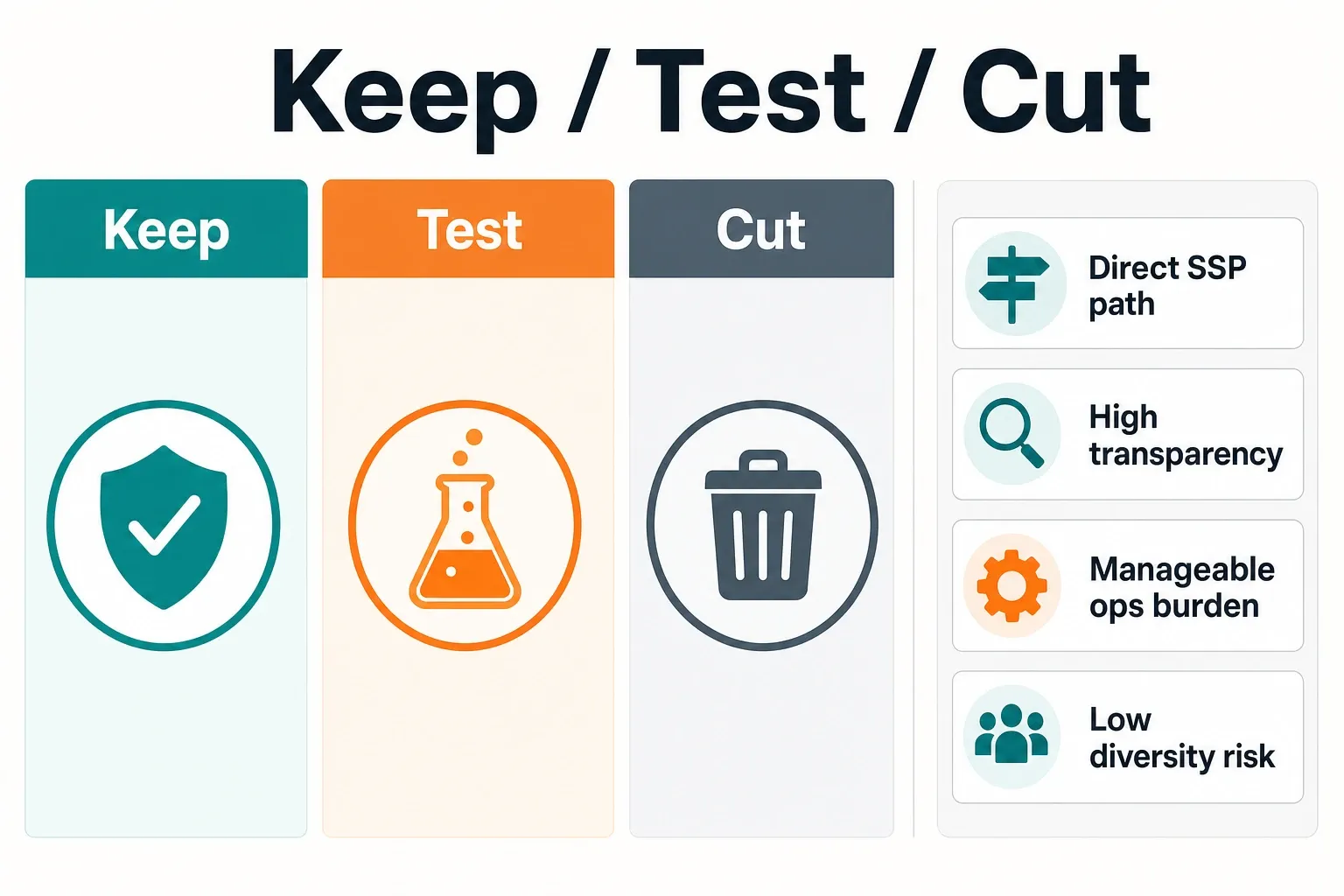
| Supply path pattern | Default call | Publisher-side criteria to check | Why it matters | Action |
|---|---|---|---|---|
| Direct SSP path with clear reporting and material wins | Keep | High transparency, measurable wins by ad unit, manageable ops burden, acceptable overlap, low diversity risk | SPO is meant to favor efficient routes, and Wurl identifies duplicate inventory and unnecessary intermediaries as core inefficiencies to reduce. | Keep access, but require path-level reporting and review by property instead of treating the SSP as universally valuable. |
| Direct SSP path that rarely bids or times out heavily | Test | Low bid rate, low win rate, timeout drag, no unique deals, high wrapper cost | A path can be direct and still inefficient if it consumes auction time without adding demand. | Reduce call volume on low-value inventory clusters before cutting networkwide. |
| Resold path with unclear fee chain and the same buyers as a direct route | Cut candidate | Low transparency, high overlap, high operational burden, no visible incremental demand | SPO is often described as removing unnecessary intermediaries; AI Digital ties the discipline to reducing hidden fees and simplifying programmatic supply chains. | Pause or remove after confirming the direct route covers the same buyers, deal types, and geos. |
| Resold or curated path with unique DSP access | Keep or test | Moderate transparency, lower overlap, distinct buyer seats, useful PMP packaging, manageable diversity risk | Yahoo’s DSP documentation frames SPO around buying the right inventory from the right sources; Yahoo DSP is a reminder that buyers may intentionally prefer specific routes. | Keep with constraints: isolate deal IDs, cap duplicate open-auction access, and ask for buyer-seat reporting. |
| Duplicate endpoint from the same SSP or wrapper integration | Cut | No incremental demand, identical auction access, extra timeout risk, reporting confusion | Duplicate inventory is one of the clearest SPO problems because it adds noise without improving competition. | Remove the duplicate endpoint or consolidate it under one adapter, then monitor fill and revenue per thousand impressions. |
| Niche path that wins on one segment only | Keep under rules | Weak aggregate performance, strong segment performance, low overlap in a specific geo, device, format, or content category | Aggregate SPO cuts can starve small but valuable inventory pools if segment-level reporting is ignored. | Restrict to the segment where it proves value; do not give it full-site access by default. |
The key distinction is the default call. “Keep” does not mean unlimited access. “Cut candidate” does not mean delete it today. Use the table as triage: what to test first, where to push for better reporting, and where to stop sending bid requests that are not earning their auction slot.
How to audit redundant SSP paths without breaking demand
A safe SPO audit starts with mapping routes at the impression level, then separating true duplication from segment-specific value. Do the work in Google Ad Manager, wrapper logs, SSP reports, and deal exports before making cuts. The bigger risk is not missing overlap; it is labeling useful demand as waste.
- Create a path inventory by property, ad unit, format, device, geo, SSP, reseller, endpoint, and deal type. In Google Ad Manager, pull revenue, impressions, unfilled impressions, line-item or yield group detail where relevant, and key-values that identify bidder, placement, and wrapper configuration.
- Add wrapper data that GAM does not show cleanly. You need bid requests, bid responses, timeouts, bid CPMs, winning bids, and no-bid behavior by adapter. If your wrapper analytics cannot show this by ad unit and device, fix the reporting gap before making SPO decisions.
- Group paths that expose the same inventory to the same demand. A direct SSP open-auction route, a reseller route, and a curated package may all touch the same impression, but they are not equivalent unless they reach the same buyer set under similar terms.
- Mark obvious duplicates first. Duplicate endpoints, stale adapters, duplicated aliases, and redundant reseller access with no unique deals are cleaner test candidates than strategic SSP relationships. This is where supply path optimization produces quick wins without overhauling your commercial stack.
- Identify paths that look redundant but behave differently. A partner with low total revenue may win on connected TV clips, iOS Safari, a specific content category, or a non-U.S. traffic pocket. That is not a reason to give it full access, but it is a reason to avoid a blind cut.
- Separate open auction, PMP, preferred deal, programmatic guaranteed, and curated marketplace activity. A reseller path that is weak in open auction may still support a buyer-specific package. Do not judge deal revenue by the same rule you apply to broad bidstream duplication.
- Check authorization and seller identity. Make sure ads.txt and sellers.json reflect the routes you actually want buyers to use. SPO fails when buyers see a cleaner path in theory but your public supply-chain signals still authorize confusing alternatives.
- Build a change log before testing. Record the current partner status, adapters, timeout settings, floors, deal IDs, target inventory, expected risk, and the metric that will decide success. Without a change log, every revenue dip becomes a guessing exercise.
The best audits usually surface a boring truth: a path is rarely good or bad everywhere. More often, it has too much permission. That is why the first fix is usually restriction, not deletion. Move a bidder from networkwide access to the inventory where it actually earns the call.
The collision pattern to look for
The most expensive duplication is not two SSPs bidding on the same page. That is normal competition. The real problem is the same buyer seeing the same impression through several near-equivalent routes and choosing the easiest, cheapest, or DSP-preferred path instead of the route that sends the strongest net revenue back to you.
The ANA Programmatic Media Supply Chain Transparency Study is useful because it puts a concrete shape around the waste problem. As summarized by AI Digital, only 41 cents of every dollar entering a DSP reached consumers through brand-safe, viewable, non-MFA inventory, with $22 billion in efficiency gains available across the open web programmatic marketplace. Publishers cannot control every leak, but they do control which paths get invited to compete for their impressions.
How to measure path efficiency and win rates that actually matter
A useful SPO scorecard combines bid rate, win rate, timeout rate, revenue per thousand impressions, and incremental demand by segment. One metric will fool you. A path can bid constantly and lose, win rarely at strong CPMs, or generate revenue while slowing down the auction.
Use win rate as a diagnostic, not a verdict
Win rate tells you whether a path is competitive after it decides to bid. It does not tell you whether the path is strategically useful. A high win rate on remnant inventory may point to underpriced floors or weak competition. A low win rate on premium placements may still be fine if the bids create pressure and sometimes clear at strong CPMs.
Bid rate gives you the missing context. If an SSP gets a large volume of requests but rarely responds, you may be paying a latency tax for very little auction pressure. If it bids selectively and wins profitable impressions, broad bid-rate averages will underrate it. Segment the readout before changing permissions.
Timeout rate is the metric ad ops teams often discount until page performance or auction density starts to suffer. A partner that times out at a noticeable rate on mobile web can reduce its own value and disrupt the rest of the auction. The fix might be a shorter timeout, server-side routing, format restriction, or removal from the affected inventory.
Revenue per thousand impressions needs a denominator you trust
RPM can answer “what did this path contribute per thousand opportunities?” only if you define the opportunity the same way every time. Use eligible impressions or bid requests on purpose. Do not compare a partner called on every display impression with one called only on high-value video inventory as if the denominator were the same.
For supply path optimization, the useful view is path performance by ad unit, device, geo, format, browser, and deal type. Desktop homepage display, mobile article pages, in-stream video, and U.S. sports content should not be rolled into one decision unless the partner is truly configured the same way across all of them.
A lower win rate can still justify a path if it brings net-new demand. For example, a partner that wins only on high-viewability ad units with a handful of DSP seats may look weak in total volume but still protect CPMs in a premium cluster. Cut the broad access if you need to. Keep the proven use case.
Do not ignore the auction mechanics around the metric
Floor prices, bid shading, first-party data packaging, and deal priority can all warp path comparisons. If one SSP gets access to higher-floor inventory while another sees the full long tail, their reported win rates are not comparable. The same problem applies when one partner carries PMP activity and another is open auction only.
The cleanest read is an apples-to-apples test. Same property, same ad unit cluster, same floor logic, same timeout window, same period, same device mix. If you cannot isolate those variables perfectly, document the mismatch and treat the result as directional, not final.
Preferred paths, curated access, and how to work with DSPs
Preferred paths work when they give buyers cleaner access to your inventory without making your revenue depend on one pipe. Your job is to ask DSPs and SSPs for path-level reporting, fewer resold hops, clear direct-seat visibility, and deal structures that reward the route you actually want used.
Start with the buyer-side reality. DSPs already use supply path optimization to favor routes that look efficient to them. Avenga describes SPO as finding the shortest and most profitable path to inventory for demand-side platforms. If you do not define your preferred access, the DSP may solve its cost problem while your yield problem stays untouched.
What to ask the DSP or agency trading team
Ask which SSP seat they prefer for your domain or app, whether they see duplicate access to the same inventory, and which paths their DSP suppresses. Push for reporting at the seller, exchange, seat, deal ID, and inventory-package level where available. If the buyer cannot show path-level behavior, their SPO feedback is less useful for your routing decisions.
Ask whether their buying rules distinguish direct publisher paths from reseller paths. If they prefer a reseller because it is already bundled into their buying setup, you need to know that before you remove it. A supply chain that looks clean on paper can underperform if the buyer’s actual spend is committed somewhere else.
What to ask the SSP
Ask the SSP to break out direct demand, reseller demand, curated marketplace activity, PMP spend, and open-auction demand in reporting. Ask which DSPs are bidding through that path and where the SSP sees overlap with your other partners. For a mid-to-large publisher stack, “we are incremental” is not a sufficient answer.
Ask for routing controls as well. Can the SSP be limited to certain ad units, formats, geos, or deal IDs? Can reseller access be disabled while direct exchange demand stays active? Can curated packages be separated from open auction? SPO becomes far more useful when the partner can be tuned instead of simply switched on or off.
Where curated access helps
Curated marketplaces and preferred path deals can work when they match how the buyer actually operates. If a DSP seat wants one clean SSP route for premium article inventory, video placements, or audience-qualified impressions, giving that route priority can reduce confusion and improve deal execution.
The tradeoff is optionality. A preferred route that concentrates spend can turn into a weak point if the DSP changes bidding logic, the buyer pauses, or the SSP runs into reporting or payment problems. Treat preferred paths as commercial commitments with guardrails, not permanent replacements for demand diversity.
Balancing SPO with demand diversity
SPO should simplify the stack only as far as auction pressure, resilience, and buyer access remain healthy. The cleanest path is not automatically the highest-yielding path, especially for publishers with multiple properties, mixed formats, and demand that behaves differently by content type.
The common mistake is optimizing for elegance. A revenue lead sees five SSPs touching the same display unit and wants the cleanest two. That may be right for a high-volume U.S. desktop placement. It may be wrong for mobile web, niche content, or video inventory where one “messy” route reaches a buyer your direct SSPs do not.
Set guardrails before you cut
Use revenue concentration as a practical guardrail, even if you do not set one fixed threshold for every property. Look at how much revenue comes from the top SSPs, top DSPs, top deal IDs, and top buyer seats after the proposed cut. If one partner becomes the default route for too much of a property, you have reduced redundancy and increased dependency.
Protect smaller inventory pools, too. A network-level analysis will naturally favor high-volume properties and formats. If a path is the only consistent bidder on tablet traffic, local news pages, CTV clips, or a specific vertical channel, do not let a broad average wipe out that signal.
Latency guardrails matter as well. Cutting a slow partner can improve auction health, but shifting all demand to the remaining bidders can put more pressure on those integrations. Watch timeout behavior after the change, not only before it.
When a messy path deserves to stay
Preserve a path when it supplies demand you cannot replace through cleaner routes. That might be a DSP seat active only through a specific SSP, a PMP that spends through a reseller setup, a video buyer tied to one exchange workflow, or a content-category buyer that does not appear anywhere else.
The right compromise is scoped access. Keep the path for the segment where it wins, remove it from inventory where it duplicates better routes, and revisit the decision once the buyer or SSP can support cleaner access. Supply path optimization should narrow permissions, not turn the stack into a fragile monoculture.
This is where publishers should push back on one-sided SPO requests. If a DSP asks you to route through one preferred SSP, ask what happens to deal priority, reporting, fee transparency, troubleshooting, and fallback demand. A buyer’s efficient route is useful only if it still works commercially for the seller.
A publisher SPO rollout checklist
A controlled SPO rollout changes one routing variable at a time, holds back a comparison segment, then reviews revenue, fill, bidder diversity, and latency before expanding. Treat the work like yield engineering, not vendor cleanup.
- Start with one property, one format, or one inventory cluster. A display-only test on a single large property is easier to read than a networkwide change across display, video, native, and app inventory.
- Define the hypothesis in plain language. Example: “This reseller path duplicates direct SSP access on U.S. desktop article pages and does not add unique demand.”
- Freeze unrelated changes during the test window. Do not adjust floors, refresh rules, lazy loading, timeout settings, and demand permissions at the same time unless the SPO change specifically requires it.
- Hold back a control segment. Keep one comparable ad unit group, property slice, or traffic cohort on the existing setup so you can separate market movement from routing impact.
- Change one routing variable. Remove one duplicate endpoint, restrict one SSP by ad unit, disable one reseller route, or move one deal to a preferred path. Bundled changes make diagnosis slow.
- Monitor revenue and fill together. A revenue-neutral change with lower fill may still be risky if it reduces buyer competition; a fill-neutral change with lower RPM may indicate lost auction pressure.
- Review bidder diversity. Check whether remaining revenue concentrates into fewer SSPs, DSPs, buyer seats, or deal IDs. Cleaner routing should not create avoidable single-partner exposure.
- Check latency and timeout behavior after the change. Removing a bidder can improve the wrapper, but shifting more auction weight to remaining paths can expose new bottlenecks.
- Look at segment-level results before declaring success. Confirm the change by ad unit, device, geo, format, and deal type so one large placement does not hide damage elsewhere.
- Document the decision. Record what changed, why it changed, what metric supported the decision, and what would trigger rollback. SPO becomes repeatable only when each cut or restriction leaves a trail.
- Share preferred-path decisions with SSP and DSP contacts. If you want buyers to use a cleaner route, make sure the commercial teams, deal IDs, and platform settings all point the same way.
- Schedule the next review. Supply paths drift as buyers change DSP settings, SSPs add demand, and properties launch new formats. Put the audit on a recurring operating calendar instead of treating it as a one-time purge.
The strongest publisher SPO position is selective, not severe: keep paths that prove incremental demand, restrict paths that work only in specific segments, and cut routes that add overlap without transparency. If a partner cannot explain who it reaches, where it wins, and why that access differs from your cleaner route, it should not get default access to your impressions.
Frequently asked questions
Is supply path optimization only for advertisers and DSPs?
No. Publishers feel SPO directly through SSP routing, duplicated demand, and the transparency they get from partners. On the publisher side, the practical question is whether a given SSP, reseller, endpoint, or deal ID should still see the impression, because DSP choices can change your revenue mix even if you never touch the wrapper.
What is the fastest way to find redundant SSP paths?
Start with impression-level path mapping and look for the same inventory reaching the same demand through multiple routes. The quickest red flags are duplicate endpoints, stale adapters, redundant reseller access, and paths that show overlap in GAM but add weak revenue, low win rate, or timeout problems in wrapper logs.
Should publishers always cut the longest supply path?
No. A longer path can still be worth keeping if it brings incremental demand, a distinct DSP relationship, stronger video demand, or buyer seats you would otherwise miss. The article’s point is to cut paths that add fee, latency, or auction noise without adding real auction pressure, not to remove every indirect route.
How does SPO affect header bidding?
It changes which wrappers, SSP connections, and reseller paths you keep in the auction, so the header auction becomes cleaner and easier to measure. In practice, that means using GAM, Prebid adapter settings, and SSP account structure to reduce duplicated demand while keeping the paths that still win on specific devices, verticals, or deal types.
What metric matters most for SPO decisions?
There is no single metric that tells you what to cut. You need path efficiency, win rate, revenue contribution, and demand diversity together, plus enough impression-level data to tell real duplication from segment-specific value. A path that looks inefficient in a rollup may still be your only route to a useful buyer set.
How we researched this
Sources consulted for this article:
- What is supply path optimization in programmatic advertising? | Wurl
- Supply-Path Optimization (SPO) Explained | Avenga
- WTF is supply path optimization? - Digiday
- What's Supply Path Optimization (SPO) in Programmatic Advertising
- Supply Path Optimization Targeting - Yahoo DSP
- AdExplainer: What Is Supply-Path Optimization (SPO)? - AdExchanger