
Setting Up a Unified First-Price Auction Across Demand Sources
A unified first-price auction setup makes Prebid.js key-value demand, Open Bidding, and AdX compete in one comparable ad decision instead of giving any path a privileged first look. Your job is to align eligibility, timing, floors, and reporting so a win reflects buyer value, not setup bias.
Key takeaways
- A unified auction only works when every demand path is comparable in GAM, not just present in the wrapper.
- First-price mechanics make floor logic and timeout discipline more important, because messy setup gets priced into the result.
- Duplicate demand routes can make supply look healthier than it is, while actually adding noise and latency.
- Bid shading is normal after launch; bad signals from floors, timeouts, or duplicate paths are what create bad outcomes.
- Report on revenue, fill, and timeout behavior by inventory slice so you can see what actually changed after cutover.
Comparison table: the moving parts you must line up before launch
Comparison table: the moving parts you must line up before launch.
Prebid.js row: launch complexity is medium to high because adapters, consent, key-values, line items, and analytics must match; control is high because you set bidders, price buckets, floors, and timeouts; latency sensitivity is high because client-side calls compete with page load; pricing and floor interaction depends on Prebid price granularity, GAM line-item mapping, and unified pricing rules; reporting visibility is strong if hb_bidder, hb_pb, hb_adid, timeout, and analytics are passed cleanly; operational risk is duplicate SSP paths, stale price buckets, and missed targeting keys.
Open Bidding row: launch complexity is medium because exchange setup happens inside GAM; control is medium because GAM handles server-side auction participation; latency sensitivity is lower on the page but still tied to server-side response behavior; pricing and floor interaction runs through GAM pricing rules and exchange settings; reporting visibility is good in GAM but less granular than wrapper-level bidder logs; operational risk is assuming server-side demand is unique when the same exchange or buyer also appears through Prebid.
AdX and Google demand row: launch complexity is low if the account is already active; control is medium through protections, pricing rules, and yield settings; latency sensitivity is low relative to client-side header bidding; pricing and floor interaction is tightly tied to GAM unified pricing rules and auction eligibility; reporting visibility is strong in GAM but still needs segmentation by ad unit, device, deal type, and pricing rule; operational risk is allowing AdX to look stable while wrapper demand is under-mapped or timed out.
Direct and deal traffic row: launch complexity is medium because sponsorship, standard, Programmatic Guaranteed, Preferred Deal, and private auction behavior must be validated against auction demand; control is high for guaranteed delivery and negotiated terms; latency sensitivity is usually low because the decision is made in GAM; pricing and floor interaction depends on line-item priority, deal terms, and whether price floors apply to the eligible auction; reporting visibility is strong if line-item type and deal IDs are included; operational risk is displacing guaranteed or negotiated demand by changing eligibility without checking delivery and pacing. Note: these criteria are editorial synthesis based on GAM and Prebid documentation, not a vendor scorecard.
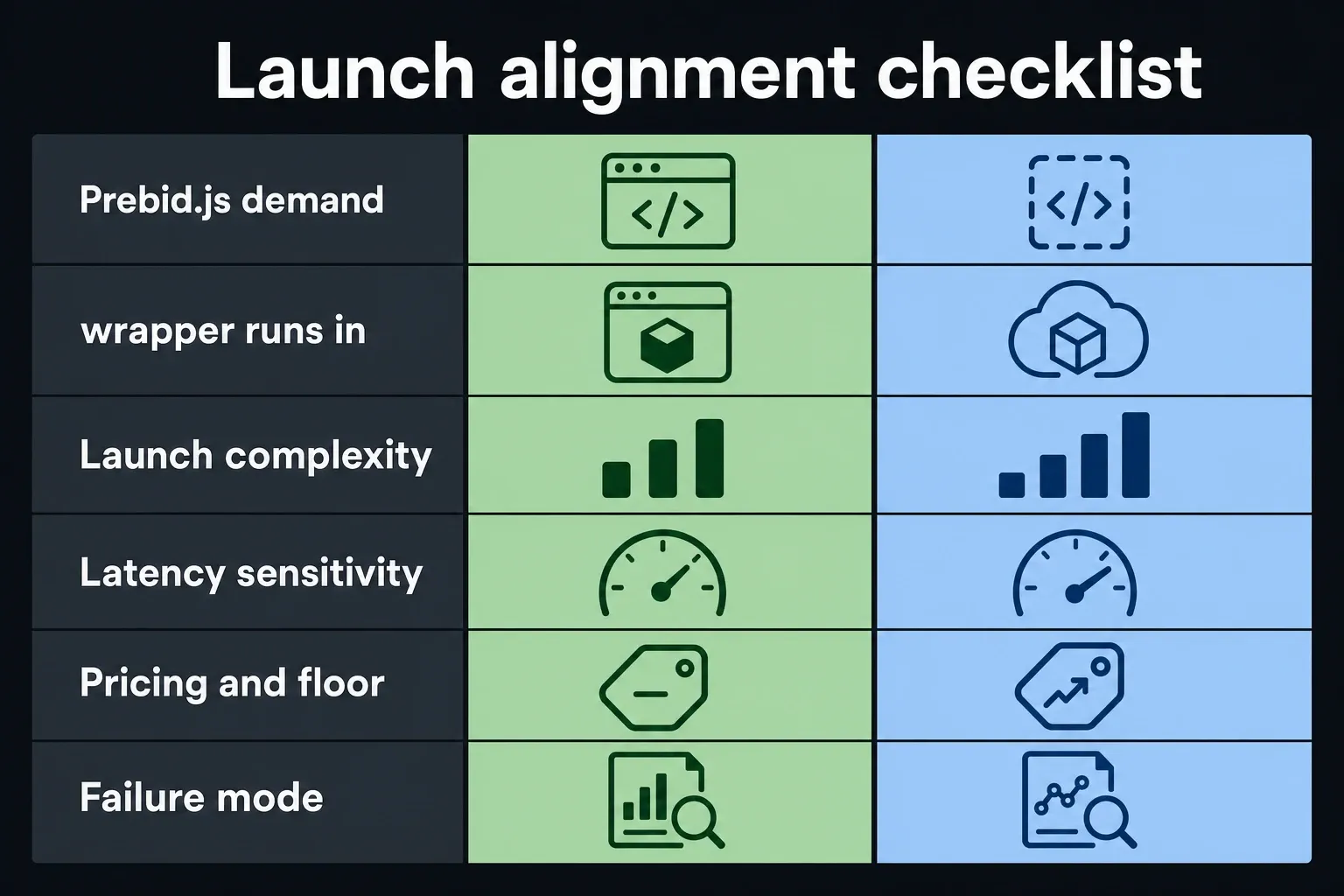
| Demand path | Where auction logic sits | Launch complexity and control | Latency sensitivity | Pricing and floor interaction | Reporting visibility and failure mode to check |
|---|---|---|---|---|---|
| Prebid.js demand, including Index Exchange, Magnite, PubMatic, Xandr, and Criteo adapters | The wrapper runs in the browser, collects bids, then passes targeting such as hb_pb into GAM line items. Prebid documents this ad server targeting flow in its Prebid.js documentation. | Highest control. You own bidder list, timeouts, price granularity, key-values, floors modules, and line-item mapping. Highest setup burden because one wrong key or stale creative can suppress a bidder. | Very sensitive. A 900 ms client-side timeout behaves differently from a 1,500 ms timeout on mobile Safari with heavy page weight. | Floors can exist in Prebid, SSP dashboards, and GAM unified pricing rules. If they conflict, the bidder may shade around one floor while another blocks the impression. | Best bidder-level visibility if you log bid request, bid response, timeout, and no-bid reasons. Common failure: wrapper returns bids that never match an eligible GAM line item. |
| Exchange Bidding / Open Bidding | Google runs the server-side auction inside GAM with participating exchanges. Google describes Open Bidding as a server-to-server auction that competes with Ad Exchange and other eligible demand in Google Ad Manager Help. | Lower setup burden than client-side Prebid once partners are approved. Less granular control over request behavior and bidder diagnostics than a wrapper you operate directly. | Less exposed to page latency because calls are server-side, but still affected by eligibility, partner response behavior, and GAM decision timing. | GAM pricing rules apply, but partner-side floors can still affect bid density. Treat it as a separate demand path, not a magic equalizer for every SSP. | Good GAM-level reporting, weaker low-level debugging. Common failure: assuming Open Bidding participation means the same SSP should also run through Prebid on the same inventory without path rules. |
| Google AdX demand in GAM | AdX competes inside GAM according to eligible demand, line-item priority, pricing rules, protections, and deals. Google’s first-price auction guidance is covered in Google Ad Manager Help. | Operationally simple if your AdX setup is mature. Control lives in GAM pricing rules, protections, deal setup, and inventory taxonomy rather than wrapper code. | Stable from a page-load standpoint because the demand path is native to GAM. Latency issues usually come from the surrounding page and competing header bidding calls. | Unified pricing rules can affect open auction, private auction, and first-look style behavior depending on configuration. Bad floor segmentation can suppress AdX demand and make Prebid look stronger than it is. | Strong GAM reporting, but you still need dimensions that isolate AdX from open bidding and header bidding line items. Common failure: reading total Ad Exchange revenue without separating deals, open auction, and dynamic allocation effects. |
| Amazon Publisher Services | APS is usually run as a separate server-side demand path or through publisher-specific integrations rather than as a standard Prebid.js adapter. APS provides publisher products through Amazon Publisher Services. | Moderate operational burden, often involving commercial approval and account-specific setup. Control differs by integration and is less interchangeable than adding another Prebid adapter. | Server-side execution reduces browser pressure, but eligibility and integration timing still matter. Do not assume it has the same timeout profile as client-side bidders. | Floor interaction depends on the integration and the rules you enforce in GAM. Keep it out of duplicated SSP paths unless you can identify the demand cleanly. | Visibility varies by contract and integration. Common failure: counting APS lift as incremental while the same buyers shift spend from another route. |
Why unified auctions replaced waterfall setups
Sequential waterfalls failed because access order could beat price. A simple example shows the problem: a US$4.00 network tag placed above a US$7.00 exchange opportunity can win if the lower tag responds first and the impression never reaches the later buyer. The same structure also created passback tags, priority exceptions, and reports that mixed true buyer value with the position of each call in the chain.
In GAM terms, unified means the eligible sources reach the same decision layer under rules you can compare. That requires more than turning on demand. Prebid has to send consistent key-values, GAM line items must be eligible for the intended price buckets, Open Bidding exchanges must be allowed on the same inventory, and AdX must sit under the same unified pricing logic where the rule applies.
The old waterfall problem was control, not nostalgia
A legacy waterfall can still look tidy in a trafficking sheet: sponsorship, standard, preferred demand, network tags, then remnant. The auction is not tidy if the setup lets a non-guaranteed tag win because it was called earlier, while a higher offer times out or never gets requested. For deal traffic, check line-item priority and pacing before cutover so Programmatic Guaranteed or direct-sold delivery is not accidentally exposed to a new remnant competition pattern.
The bad migration is to replace the old chain with a long bidder list and call the result unified. If Magnite, PubMatic, Index Exchange, Xandr, and Criteo are all present, check whether each path brings distinct demand. The same SSP can appear through Prebid and Open Bidding, and the same buyer can reach you through multiple exchanges. That is not incremental demand by default; it can be duplicate path inflation unless ads.txt, sellers.json, seat IDs, and GAM demand-channel reporting show otherwise.
What a first-price unified auction changes in practice
A first-price unified auction changes the clearing logic: the winning buyer generally pays its own bid rather than a second-price-style amount. Google documented its move toward first-price auction dynamics for Ad Manager and Authorized Buyers in its first-price auction guidance. The practical consequence is simple: sloppy floors, inconsistent eligibility, and hidden duplicate paths become more expensive because buyers can shade bids against the signals you expose.
| Auction mechanic | What clears the impression | Buyer behavior you should expect | Publisher operating implication |
|---|---|---|---|
| Second-price-style auction | The winner historically paid a price tied to the next eligible bid, subject to floors and auction rules. | Buyers could bid closer to their full value because the final price was often lower than the submitted bid. | Revenue could look stable, but the clearing price was harder to map to true market value across stacked demand paths. |
| First-price auction | The winner generally pays the bid it submitted, assuming it clears the applicable rules. | Buyers often use bid shading to reduce bids based on expected clearing price, inventory quality, floor history, and competition. | You need cleaner floors and fewer contradictory rules because buyers react directly to what they observe. |
| First-price unified setup | Prebid, Open Bidding, and Google AdX demand compete under a more comparable pricing model inside or alongside GAM. | Bidders may adjust bids differently by path, especially if they see duplicate supply or unstable floor signals. | Revenue predictability comes from segmentation and monitoring, not from assuming the auction format will optimize itself. |
Bid shading is not automatically bad. It is normal buyer behavior in a first-price environment. It becomes a publisher problem when the shading model reads unstable signals, such as a homepage floor that changes every day, a mobile web setup where Prebid responses miss the configured timeout, or duplicate exchange routes where the same impression appears cheaper through one supply path than another.
Where the tradeoff lands
First-price mechanics remove some hidden auction logic, but they punish messy operations. A clean publisher setup has stable ad unit names, floors that match inventory value, one intentional route per exchange seat, and GAM targeting keys that do not collide. A messy setup has hb_pb mapped to one bucket in the wrapper and another in GAM, overlapping SSP seats, and deal traffic competing in places where it should have been protected.
How to connect Prebid and Exchange Bidding in GAM without breaking yield
The practical launch sequence is eligibility, timing, floors, then buyer behavior. Use a defined inventory slice, such as one section, one device class, or one group of ad units, and do not expand until the checks pass. In GAM, confirm the intended line items are eligible, unified pricing rules apply to the selected inventory, Open Bidding partners are enabled only where expected, and AdX is not winning simply because Prebid demand failed to target into the auction.
- Audit the current GAM structure before changing demand. Confirm ad units, sizes, device splits, and inventory naming are stable. If your top leaderboard exists as /news/home/top on desktop and /news/homepage/top on mobile, reporting will blur the auction result before you start.
- Standardize Prebid key-values and line items. Use consistent price buckets, active creatives, and targeting keys for hb_pb, hb_bidder, hb_adid, and any custom analytics keys you actually report on. Do not carry old line items forward unless they still match the wrapper output.
- Map Open Bidding partners separately from Prebid adapters. If PubMatic or Magnite appears in both paths, decide whether both routes are intentional. Duplicated demand is not always wrong, but unmanaged duplication makes bid density look healthy while net competition may not improve.
- Align timeout policy by page type. A desktop article page can tolerate a different Prebid timeout than a mobile infinite-scroll page. Set the timeout based on your page performance budget, then check bidder timeout rates instead of copying a default value from another property.
- Keep GAM pricing rules consistent with Prebid floor logic. If Prebid floors reject bids below US$1.50 while GAM unified pricing blocks the same inventory below US$2.00, you have created a hidden gap. Buyers will adapt to the stricter signal, but your reports may blame the wrong layer.
- Protect direct and deal traffic explicitly. Programmatic guaranteed, sponsorships, preferred deals, and private auctions should have clear priorities and eligibility. A unified auction setup should not let open auction demand steal impressions that were supposed to satisfy a contracted campaign.
- Run a production test on a narrow but meaningful segment. Use one property, one device class, or a defined percentage of traffic with enough volume to expose timeouts, no-bids, and line-item mismatches. A test with only fringe inventory will not predict homepage or article-page behavior.
- Document the rollback path before full launch. Keep the previous line-item set, bidder configuration, and pricing rules available until the new setup survives multiple traffic patterns. A clean rollback is an operations requirement, not a sign that the launch failed.
How to avoid bid shading mistakes after launch
The practical diagnostic order starts with whether the bid could compete at all. If the GAM line item is not eligible, the key-value is missing, or the bid arrives after timeout, do not blame bid shading. After eligibility and timing pass, inspect floor rules. Only then compare buyer strategy, because a lower first-price bid can be rational when the buyer sees cleaner supply or a more predictable floor.
- Compare bid rate and win rate together. If bid rate stays steady while win rate drops after a floor change, the floor may be too aggressive. If bid rate also drops, bidders may be opting out because the request no longer looks worth pricing.
- Read clearing price distribution, not only average CPM. Averages hide the difference between a healthy shift toward efficient bids and a cliff where bids cluster just below a floor. Look at price buckets by ad unit and device.
- Check participation by bidder and path. If Criteo remains active through Prebid but the same inventory weakens through Open Bidding partners, the issue may be path-specific eligibility or duplicated supply, not shading itself.
- Stabilize floors before changing bidder rosters. Frequent floor edits train buyers on volatility and make post-launch analysis muddy. Use controlled floor tests by segment, then leave the rule long enough to read behavior.
- Separate deal effects from open auction effects. Private marketplace and preferred deals can change open auction pressure. If a new deal takes premium impressions out of competition, open auction CPM may fall without indicating a broken unified setup.
- Watch mobile web differently from desktop. Mobile browser latency can make client-side bids arrive late while server-side demand appears stronger. That is a timing issue first; shading analysis comes after the bid opportunity is actually comparable.
- Avoid punishing the wrong bidder. A bidder submitting lower but more consistent bids may be responding rationally to inventory value. A bidder with sporadic high bids and frequent timeouts may look attractive in top-line CPM while hurting auction reliability.
The practical diagnostic order
Diagnostic matrix: Symptom: low win rate immediately after a floor change; likely layer: pricing rule and bid bucket mapping; report to check: GAM pricing-rule performance, ad unit by device, hb_pb distribution, and bid rate versus win rate; first fix: roll the floor back on the affected rule or narrow it to the inventory where clearing price supports it.
Symptom: mobile revenue drop after launch; likely layer: latency and timeout; report to check: Prebid analytics by device and browser, timeout status, bid response count, and GAM fill by mobile ad unit; first fix: reduce slow bidders on mobile, review the Prebid timeout, and verify lazy-load timing.
Symptom: duplicate SSP path inflation; likely layer: demand path governance; report to check: demand channel by bidder or exchange, ads.txt seller IDs, Open Bidding partner wins, and Prebid adapter wins for the same SSP; first fix: choose the intentional path per SSP seat or separate paths only when the buyer demand is demonstrably different.
Symptom: deal traffic displacement; likely layer: GAM priority and deal eligibility; report to check: line-item delivery, deal ID performance, Programmatic Direct delivery, and private auction win share before and after cutover; first fix: restore deal targeting, priority, or inventory exclusions before changing remnant floors.
How to report on unified auction performance without misleading yourself
Post-launch reporting cuts: ad unit should show stable fill and explainable CPM movement; failure looks like one placement losing fill while sitewide revenue hides it. Device should show mobile, desktop, and tablet behaving according to timeout and layout differences; failure is mobile web dropping while desktop rises.
Browser should be checked because Safari, Chrome, and Firefox can behave differently under consent, storage, and lazy-load conditions; failure is one browser losing bid density. Demand path should show intentional shifts between Prebid, Open Bidding, AdX, and direct; failure is the same SSP winning through a cheaper path.
Bidder should show normal participation and win share; failure is a bidder with high bid rate and near-zero wins after a mapping change. Floor rule should show clearing prices above the intended threshold without a large fill collapse; failure is a rule that lifts CPM but destroys eligible impressions.
Deal type should separate open auction, private auction, Preferred Deal, Programmatic Guaranteed, and direct; failure is negotiated demand losing delivery after remnant changes. Timeout status should show whether bids arrived in time; failure is strong bids missing the auction.
Line-item eligibility should show that the expected GAM line items matched; failure is bids returned but no eligible line item available to serve them.
- Build the baseline before launch. Pull at least one comparable pre-launch window by property, ad unit, device, and U.S. geography if that is your core market. Do not compare a Monday sports traffic spike with a Sunday lifestyle baseline and call the auction better.
- Separate demand contribution. Report Prebid line items, Open Bidding yield groups or partners, Google AdX open auction, AdX deals, and direct-sold priority separately. Blended programmatic revenue can rise while one demand path quietly cannibalizes another.
- Use RPM and fill together. RPM shows revenue per thousand pageviews or sessions depending on your internal standard; fill shows whether eligible impressions are monetizing. A CPM lift with lower fill may still reduce total revenue on high-volume ad units.
- Track bid rate, timeout rate, and no-bid rate outside GAM where possible. GAM sees the ad decision; the wrapper sees request-level behavior. Prebid analytics adapters or server logs can explain why GAM never received a bid that an SSP dashboard claims it had available.
- Monitor clearing price by bucket. If bids pile up just below GAM floors, floor design is probably constraining demand. If high buckets disappear after adding new paths, buyers may have found a cheaper duplicated route.
- Break out U.S. traffic from international traffic. A mid-to-large U.S. publisher can distort its auction read by mixing domestic direct demand, U.S. programmatic budgets, and lower-priced non-U.S. remnant traffic in the same report.
- Tag test and production traffic cleanly. Use labels, key-values, or reporting dimensions that let you isolate the rollout segment. If the test cohort disappears into normal line items, the only available story will be anecdotal.
- Review latency with revenue. A setup that adds incremental CPM but slows viewable ad rendering can lose value through lower viewability, weaker engagement, or fewer downstream ad opportunities. Auction performance is revenue plus delivery quality, not CPM alone.
What a successful rollout looks like in the data
Rollout readout: what changed and what it means. Sample logic, not a benchmark: before cutover, the /sports/top_300x250 desktop ad unit shows 100,000 eligible impressions, US$4.20 AdX eCPM, US$3.80 Prebid eCPM, 2.1 average Prebid bids per auction, and 94% fill.
After cutover, the same slice shows US$4.35 AdX eCPM, US$4.10 Prebid eCPM, 2.4 average Prebid bids per auction, 93% fill, and no single SSP gaining share at a lower clearing price. That is a healthy readout because competition improved without a fill break or obvious path leak.
A bad readout would be US$4.60 eCPM with fill falling to 86% and one Open Bidding exchange taking share from the same SSP that used to win through Prebid; that points to floor pressure or routing drift, not clean yield gain.
Launch checklist
Before cutover: confirm GAM unified pricing rules cover the selected ad units and inventory types; confirm Prebid key-values match GAM line-item targeting; confirm Open Bidding partners are enabled only on intended inventory; confirm AdX and deal eligibility are visible in GAM reporting; confirm direct and Programmatic Guaranteed delivery is on pace.
During test: monitor ad unit, device, browser, demand path, bidder, floor rule, deal type, timeout status, and line-item eligibility daily; compare clearing price and fill together, not separately; pause expansion if a deal misses delivery, mobile timeout spikes, or a single duplicate path gains share.
After rollout: archive the final Prebid config, GAM pricing rules, line-item targeting, and partner eligibility; set a recurring report for the same cuts used during test; review duplicate SSP paths after any adapter, Open Bidding, or reseller change.
- Confirm Prebid.js sends the exact key-values targeted by active GAM line items.
- Verify Open Bidding partners are approved, active, and reported separately from AdX.
- Identify duplicated SSP paths across Prebid, Open Bidding, Amazon Publisher Services, and direct integrations.
- Align Prebid floors, SSP-side floors, and GAM unified pricing rules by ad unit and device.
- Set timeouts by page type, then monitor bidder timeout rates after launch.
- Keep direct campaigns, guaranteed deals, preferred deals, and PMPs protected with explicit priority and eligibility rules.
- Build pre-launch baselines by ad unit, device, geography, demand path, and deal type.
- Label test traffic so post-launch reporting can isolate the rollout cohort.
- Review clearing price distribution, bid rate, fill, RPM, and demand contribution before changing bidder lists.
- Create a rollback plan with the prior GAM line items, pricing rules, and wrapper configuration ready to restore.
Frequently asked questions
What is a unified auction setup in GAM?
FAQ: What is a unified first-price auction in GAM? It is a GAM setup where eligible demand competes at the same decision point instead of being sold one route at a time. In practice, Prebid.js, Open Bidding, AdX, and eligible deal demand must be lined up through comparable timing, floor, priority, and reporting rules so the winning path reflects value rather than access order.
Is first-price auction the same as unified auction?
FAQ: Is a unified auction the same thing as a first-price auction? No. Unified describes how demand is brought into competition. First-price describes how the winning bid is priced. A publisher can discuss both in the same migration because Google demand, Open Bidding, and Prebid often need to be evaluated together, but auction structure and clearing-price logic are separate controls.
Do I need Prebid to run a unified auction setup?
FAQ: Do you need Prebid to run a unified auction? Not always. GAM can evaluate AdX, Open Bidding, direct, and deal demand without Prebid. Prebid is common because it brings client-side header bidding into the GAM decision through key-values and line items, which makes comparison against AdX and Open Bidding more direct. If you skip Prebid, you still need equivalent controls for timing, floor policy, and demand-path reporting.
Why do CPMs sometimes fall after moving to a unified auction?
FAQ: Why can revenue dip after moving away from a waterfall? The waterfall may have been hiding weak pricing, duplicate access, or priority bias. After cutover, buyers can respond to clearer first-price signals, floors may block impressions that previously cleared, and slow bidders may miss the auction. Check the dip by ad unit and device first; a sitewide revenue line will not show whether the issue is a floor rule, timeout, or deal-displacement problem.
What should I watch first after launch?
FAQ: What should you check first after launch? Start with clearing price, win rate, timeout behavior, line-item eligibility, and demand-source mix by ad unit. If bids are not eligible or do not arrive on time, buyer strategy is irrelevant. Sources: Google Ad Manager Open Bidding; Google Ad Manager unified pricing rules; Google Ad Manager first-price auction guidance; Prebid.js key-values; Prebid timeouts.