

Seasonal CPM Trends: What Publishers Should Expect Throughout the Year
Seasonal CPM trends are rarely a neat “Q4 good, January bad” line. Treat them as a planning signal for floors, deal reviews, content timing, and traffic allocation. U.S. publishers should expect heavier buyer pressure near year-end, softer demand after the holidays, and mixed summer results based on audience, device, and category mix.
Key takeaways
- Q4 usually carries the strongest pricing pressure, but only your best inventory should get tighter floors.
- January and summer softness often come from budget timing, not a broken setup.
- Different sections, devices, and traffic sources can follow different seasonal curves inside the same GAM account.
- Floor changes should follow bid depth and viewability, not a sitewide calendar rule.
- Traffic and content planning can amplify seasonal demand if you time them against buyer spending cycles.
Why CPMs move by quarter
Quarterly CPM movement is mostly about budget timing. Advertisers spend differently as planning cycles, retail moments, and fiscal deadlines shift. Red Volcano describes seasonal programmatic changes as predictable enough to shape publisher revenue planning, with swings that can be meaningful inside a single quarter Red Volcano.
Q4 usually brings the hardest demand pressure because retail, consumer tech, travel, finance, and year-end brand budgets are all chasing the same quality impressions. You’ll usually see it first in AdX bid density, private marketplace pressure, and direct-sold pacing. Open auction CPMs follow later, assuming the demand stack is working properly.
The weak periods are not all weak for the same reason
Q1 weakness usually starts with the post-holiday reset. Budgets come back slowly, brand plans get re-forecast, and buyers often run smaller tests before they scale. If you drop every floor on January 2, you may save fill, but you also risk letting low-value demand reset pricing on inventory that could have held stronger.
Summer softness is its own issue. Audience habits change, some B2B categories slow, travel and lifestyle demand may stay firm, and desktop weekday inventory can move very differently from mobile weekend traffic. Mile Technologies treats CPM seasonality as recurring enough for publishers to tune their programmatic stack around weaker months instead of reading every dip as random noise Mile Technologies.
The same property can have multiple seasonal curves
A national news homepage, a fantasy football subdomain, a recipe section, and a mobile app can all move in different directions inside the same GAM network. Audience intent, geography, device, ad unit size, viewability, refresh behavior, and content category all affect how seasonal demand actually shows up in CPM.
Traffic volume matters, but don’t over-read it. Publisher CPM seasonality is usually driven by buyer budget timing, category demand, and competitive pressure. Sessions can rise while qualified demand falls. When that happens, revenue per thousand sessions can still get squeezed.
Q4 demand spikes: how to capture them without leaving money on the table
Q4 is the time to tighten monetization controls before demand peaks, not after the best days have already passed. The goal is straightforward: let premium inventory compete harder, while making sure weaker placements don’t get blocked by floors they can’t realistically support.
- Tighten floors selectively. Start with ad units that already show healthy bid depth, high viewability, and stable fill in GAM reporting. A sticky leaderboard with consistent U.S. desktop demand can usually tolerate more pressure than a low-viewability below-the-fold unit on mixed international traffic.
- Check deal delivery before open auction pricing. Underpacing sponsorships, stale deal IDs, and PMP terms that no longer match current inventory value can quietly cap upside. In Q4, a buyer that committed to premium access should not be losing impressions because the deal was never refreshed or the targeting no longer maps to the right ad units.
- Audit line item pacing and priority. If direct-sold campaigns are underdelivering while AdX clears at strong rates, you may have a trafficking or forecasting problem, not a demand problem. Look at delivery by placement, device, and creative size before changing network-wide floors.
- Protect the placements buyers actually want. High-viewability, above-the-fold, video, and contextually strong pages deserve different handling from remnant inventory. If a page drives consistent deal demand, do not let broad floor experiments spill into it without a rollback rule.
- Separate durable inventory from fragile inventory. Durable inventory keeps bid depth after a price increase; fragile inventory loses auctions quickly when the floor moves. Run changes by placement cluster instead of treating every 300x250 or 728x90 as interchangeable.
- Look for missed demand in the wrapper. Lazy timeout settings, inactive bidders, broken consent signals, and stale bidder adapters can matter more during peak competition because every lost bid has a higher opportunity cost. HeaderBidding.co’s seasonality guidance ties weaker and stronger periods back to stack optimization, which is the right lens for Q4 readiness HeaderBidding.co.
The summer and Q1 CPM slump: what’s happening and what to do
Treat Q1 and summer slumps like controlled pressure releases, not emergency fire sales. You need to protect fill where demand is thin, but you also don’t want to teach the auction that your premium inventory suddenly clears cheap.
Q1: reset pricing without resetting your whole market
Once holiday campaigns close, buyers often restart with smaller tests, fresh budgets, and revised KPIs. That can thin out bid density across open auction demand, especially on inventory that leaned heavily on Q4 retail and gifting budgets.
A temporary floor cut makes sense when a placement is losing fill, bid depth has thinned, and the inventory is not core to your premium package. It’s harder to justify on ad units tied to direct renewals, high-viewability sponsorships, or category pages where a lower clearing price could weaken deal conversations later in the quarter.
Summer: shift the mix before cutting the price
Summer softness usually isn’t evenly spread, so traffic and content mix matter. A publisher with strong travel, outdoor, home improvement, entertainment, or sports-adjacent content may still find pockets of demand that don’t line up with the broader slowdown.
Check geography and device splits before deciding demand has disappeared. U.S. mobile traffic on timely lifestyle content may not behave like desktop traffic on work-hour B2B pages. If one segment is still holding bid depth, isolate it. Don’t drag it into a broad floor cut by default.
Upperate’s CPM seasonality coverage treats weaker months as a reason to optimize the stack, not as a reason to accept lower revenue as inevitable Upperate. For publishers with meaningful AdX volume, that means checking whether the dip came from weaker buyer pressure, lower traffic quality, a broken demand path, or inventory changes from editorial or product teams.
When lower floors help, and when they hurt
Lowering floors helps when auctions are failing because price is the real constraint. After the change, you should see fill recover, bid participation stay acceptable, and revenue improve at the placement level. If those signals don’t show up, price probably wasn’t the main problem.
Lowering floors hurts when the underlying issue is weak demand quality, poor viewability, over-refreshing, heavy ad density, or traffic buyers simply don’t value. In that scenario, cheaper impressions may lift filled impressions while pulling down the average value of inventory you actually need to protect.
Original comparison: which seasonal action belongs in which quarter?
The right seasonal move depends on advertiser pressure in that quarter, not on a fixed annual floor rule. Use the table below as an operating plan. Pricing, deal focus, inventory priority, and traffic timing should move together, instead of being adjusted in separate meetings.
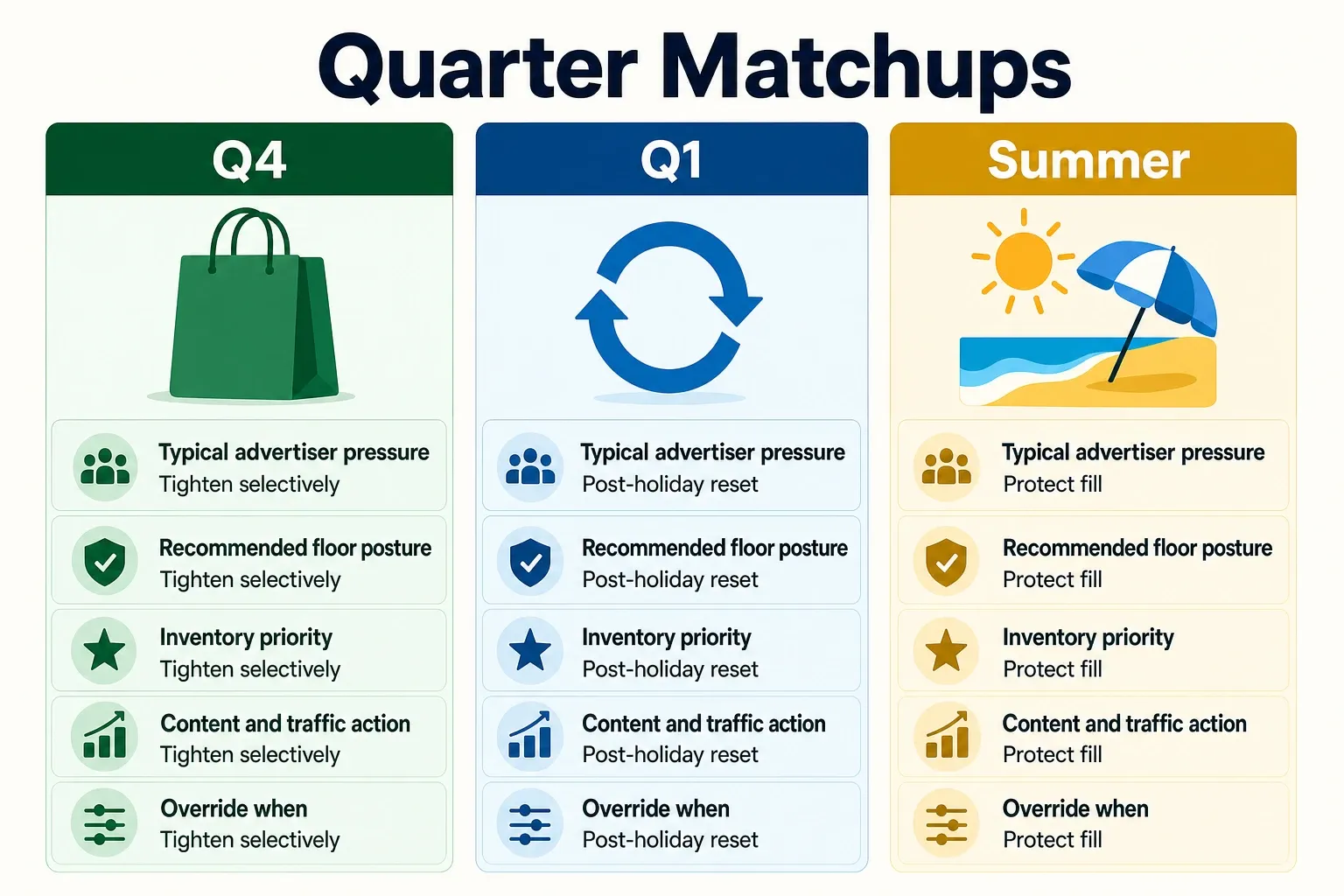
| Quarter | Typical advertiser pressure | Recommended floor posture | Inventory priority | Content and traffic action | Override the playbook when | Evidence context |
|---|---|---|---|---|---|---|
| Q4 | Highest competitive pressure, especially around retail and year-end budget use. | Tighten selectively on high-bid-depth placements; avoid blanket increases on fragile units. | Premium, high-viewability, video, sponsorship-friendly pages, and strong U.S. audience segments. | Push commercial evergreen content, buyer-intent pages, newsletters, and promotion windows while demand is strongest. | Do not raise floors if deal delivery is underpacing or if bid depth falls after the first adjustment. | Red Volcano identifies seasonal ad trends as a major driver of publisher revenue swings Red Volcano. |
| Q1 | Lower pressure after holiday campaigns close and new budgets restart slowly. | Relax only where fill and bid depth prove the floor is blocking demand. | Keep premium packages protected; use softer pricing on remnant or low-viewability placements first. | Lean on evergreen content, recurring utility pages, and loyal direct traffic to stabilize monetized sessions. | Do not reset premium pricing just because the first two weeks of January are soft. | Mile Technologies describes CPM fluctuations as recurring and important for publisher revenue planning Mile Technologies. |
| Q2 | Recovery and testing period as buyers scale plans after Q1 resets. | Move from defensive floors to controlled tests by placement, device, and format. | Identify which ad units regained bid density and which still need fill protection. | Prepare seasonal packages and content hubs before summer behavior changes. | Do not assume recovery is uniform across site sections, especially if audience intent differs by vertical. | Monetization Guy frames CPM seasonality as predictable fluctuations that affect publisher and advertiser strategy Monetization Guy. |
| Q3 | Mixed pressure: summer softness can continue, but late-quarter planning may improve for back-to-school and pre-Q4 campaigns. | Keep floors flexible; tighten only on segments proving durable demand. | Prioritize clean, high-quality inventory and avoid pushing weak placements into premium packages. | Build and test Q4 content, audience segments, sponsorship inventory, and newsletter calendars before peak demand lands. | Do not wait until October to fix wrapper settings, deal setup, or inventory taxonomy. | HeaderBidding.co connects CPM seasonality to programmatic stack optimization for publishers HeaderBidding.co. |
How to adjust floors and inventory ahead of seasonality
Seasonal floor changes work best when they’re staged before the demand shift and measured at the placement level. Change global floors, bidder timeouts, refresh rules, and deal targeting in the same week, and you won’t know which lever actually moved the numbers.
- Set a review calendar around known pressure changes. For Q4, start readiness checks before the holiday buying window, not after Cyber Week traffic has landed. For Q1 and summer, schedule reviews before the expected dip so your team is not making pricing decisions during a revenue panic.
- Pull placement-level and device-level baselines. In GAM, compare ad unit, device, geography, creative size, viewability band, fill rate, AdX revenue, and bid density where available. Network averages hide the exact placements that need different treatment.
- Group inventory by behavior, not by ad size alone. A 300x250 in a high-intent article body can clear differently from the same size in a low-engagement rail slot. Build clusters around demand quality, viewability, and delivery importance.
- Change one control at a time. If you raise AdX unified pricing rules, keep wrapper timeouts, refresh logic, and bidder lists stable during the first read. If you update header bidding settings, do not treat the same period as a clean floor test.
- Define rollback guardrails before launch. Use practical triggers such as sharp fill loss, reduced bid participation, underdelivery on direct campaigns, or revenue deterioration on the tested placement group. The exact threshold should match your risk tolerance and deal obligations.
- Stage changes in GAM and the wrapper so impact is isolated. Apply a pricing rule to a named inventory group, document the start date, exclude sensitive sponsorship inventory where needed, and avoid overlapping the test with a site redesign, consent-platform change, or major traffic acquisition push.
- Read results against the season, not against last week only. A Q1 floor test should be judged against comparable weak-period behavior, while a Q4 floor test should be judged against the opportunity cost of stronger demand. Monetization Guy’s seasonality framing is useful here because it treats CPM movement as a planning input rather than a surprise Monetization Guy.
Planning content and traffic around seasonal demand
Content and traffic planning should track advertiser demand windows because the same session can be worth more or less depending on when it’s monetized. If editorial, audience, and ad ops calendars don’t line up, you can end up buying or promoting traffic during weaker CPM periods while under-supporting peak windows.
- Prioritize commercial-intent content before peak months. Gift guides, product comparisons, personal finance explainers, travel planning, home projects, and shopping-adjacent evergreen pages can attract stronger buyer categories when Q4 demand is active.
- Schedule owned-channel pushes around monetization windows. Newsletter sends, homepage modules, push notifications, and social distribution should support pages that can clear strong demand, not just pages with the highest click-through expectation.
- Use evergreen content to reduce weak-period dependency. In Q1 and summer, evergreen utility pages can help stabilize revenue because they are less tied to one news spike or campaign cycle. The goal is a steadier base of qualified sessions while buyers are less aggressive.
- Keep timely content ready for category-specific demand. Sports schedules, tax deadlines, back-to-school planning, travel seasons, and entertainment releases can create pockets of advertiser interest even when broad market CPMs are softer.
- Tie acquisition spend to yield, not sessions alone. Paid traffic that looks efficient on a cost-per-visit basis can still be unattractive if it lands during a low-demand period, skews to weak geographies, or produces low-viewability impressions.
- Give sales and ad ops enough runway. If Q3 is when you package Q4 sponsorships, the inventory taxonomy, forecastable sections, audience segments, and deal IDs need to be clean before buyers are ready to commit. Waiting until Q4 turns preventable setup work into lost yield.
- Treat seasonal content plans as monetization inputs. HeaderBidding.co, Upperate, Mile Technologies, and Red Volcano all discuss CPM seasonality as something publishers can plan around; the practical move is to connect that planning to what you publish, when you promote it, and which inventory you protect.
Build the year around controlled aggression. Tighten only where demand proves it can carry the price, defend fill where the market is thin, and shift content or traffic before blaming every CPM dip on floors. The publishers that handle seasonal CPM trends best aren’t guessing quarter by quarter. They decide ahead of time which inventory deserves pressure and which inventory needs protection.
Frequently asked questions
Which quarter usually has the highest CPMs for publishers?
Q4 usually brings the strongest CPMs because retail, consumer tech, travel, finance, and year-end brand budgets all compete for the same quality impressions. You’ll often see the pressure show up first in AdX bid density, private marketplace activity, and direct-sold pacing, with open auction CPMs following behind if the stack is healthy.
Why do CPMs often drop in January?
January CPMs often fall because budgets reset after year-end, buyer urgency drops, and a lot of demand was pulled forward into Q4. Buyers also tend to re-forecast and test smaller before they scale again, so pricing can soften even when traffic looks normal.
Should publishers raise floors in Q4?
Usually, but only on inventory that can support it. The article’s advice is to tighten floors selectively on placements with healthy bid depth and stable fill, because broad floor increases can crush weaker units faster than they improve total revenue.
Is summer always a bad CPM period?
No. Summer is often softer, but the article makes clear that results depend on your audience, device mix, and category mix. B2B inventory may slow, while travel, lifestyle, desktop weekday traffic, and some niche segments can hold up much better than the sitewide average.
How far in advance should publishers plan for seasonality?
Plan at least several weeks ahead of major quarters, and earlier if you depend on direct demand, guaranteed deals, or a small group of high-value placements. The point is to adjust floors, pacing, and deal reviews before the seasonal swing shows up in revenue, not after it has already hit.
How we researched this
Sources consulted for this article:
- Seasonal Advertising Trends: When to Expect Your Highest and Lowest CPMs | Red Volcano Blog
- CPM Seasonality – Everything Publishers Need to Know
- Seasonality Trends and Economic Impact on Publisher Revenue
- CPM Seasonality – Everything Publishers Need to Know
- CPM Seasonality – Everything Publishers Need to Know
- CPM Seasonality: Navigating Advertising Costs Throughout the...