
Reducing Latency in Server-to-Server Header Bidding
Server-to-server header bidding reduces browser workload; it does not remove auction latency. The slow point moves to the request path: Prebid.js prepares the call, the browser reaches the server endpoint, Prebid Server fans out to bidders, waits until responses or timeouts, returns targeting, and the page still has to hand that targeting to GAM before render.
Key takeaways
- Server-side auctions still pay for browser setup, network travel, server processing, and bidder response time.
- A faster auction log does not guarantee a faster render; placement-level timing tells you where users actually feel the delay.
- Start with the bottleneck you can prove, not the one that looks worst in aggregate reporting.
- Regional routing can help U.S. traffic, but inconsistent configs across regions can create worse yield problems than the latency they solve.
- The first fixes should usually be timeout cleanup, endpoint geography, and bidder-level triage, in that order if the data supports it.
Where latency comes from in S2S setups
Server-to-server header bidding latency has four main sources: browser setup, network round trip, server-side auction processing, and bidder response time. Treating those as one blended “auction duration” number leads to blunt fixes. You tighten every timeout, cut partners, or buy routing capacity when the actual drag may be one adapter, one U.S. region, one device class, or one lazy-loaded placement.
The browser still starts the work in many Prebid Server deployments. Prebid.js builds the auction request, includes ad unit and bidder parameters, sends the server-side request, receives bids or targeting data, and then passes key-values into the ad server. Prebid’s own documentation for server-to-server header bidding with Prebid.js shows that the S2S flow still depends on client-side orchestration, including examples that can run beside Microsoft Monetize Ad Server Prebid documentation.
The four places delay gets introduced
Browser-side overhead includes the JavaScript that prepares the ad unit request, attaches user IDs or first-party data, evaluates labels, handles consent state, and runs any client-side bidders left in a hybrid wrapper. Moving bidder calls to the server can reduce work in the browser, a point made in vendor discussions from OpenX and PubMatic, but treat that as a directionally useful benefit, not a guaranteed placement-level benchmark OpenX PubMatic. For implementation behavior, anchor your assumptions in the Prebid flow itself Prebid documentation.
Network round-trip time is the distance and routing problem. A user in Los Angeles hitting an auction endpoint in Northern Virginia pays for that path before OpenX, PubMatic, Sovrn, or any other bidder sees the request. Add consent signals, identity modules, analytics tags, and lazy-load triggers on the same page, and your server log can show a clean auction while the slot still appears late in the browser.
Server processing time is what your Prebid Server host does after receipt: request validation, account config lookup, bidder parameter mapping, privacy enforcement, currency logic, floor logic, bidder fan-out, response normalization, and cache handling for formats that need it. Prebid’s server-side model moves bidder execution off the page, but those server tasks still sit between browser request start and the GAM handoff Prebid documentation.
Bidder response time is the piece publishers blame most often, and sometimes that is the correct read. If OpenX, PubMatic, Sovrn, or another partner responds after your effective cutoff, the auction either waits until the configured boundary or drops the late bid. AdMonsters’ practical advice still holds: if a partner repeatedly times out, take the evidence to the partner instead of treating the delay as generic wrapper noise AdMonsters.
Why healthy server logs can still hide page pain
Use this triage matrix immediately after you split the four latency sources. Bottleneck: browser setup. Metric that proves it: large gap between page event or ad slot trigger and outbound Prebid Server request start.
Test first: defer nonessential modules, review hybrid client-side bidders, and check lazy-load trigger timing. Demand risk: low if you do not remove bidder access. When not to use the fix: when the browser sends the request promptly but the server receives it late.
Bottleneck: network routing. Metric that proves it: large gap between browser request timestamp and Prebid Server receive timestamp, concentrated by geography, ISP, or device class. Test first: route traffic to a closer healthy endpoint or validate CDN origin selection.
Demand risk: low to medium, because regional configs can drift and change bidder eligibility. When not to use the fix: when server receive time is fast and the delay starts after fan-out. Bottleneck: server processing.
Metric that proves it: server receive to bidder fan-out or response normalization is slow across bidders. Test first: review account config complexity, floor/currency processing, host capacity, and concurrency settings. Demand risk: medium if you reduce fan-out to protect infrastructure.
When not to use the fix: when only one bidder has a long response tail. Bottleneck: bidder response. Metric that proves it: one bidder’s timeout rate or tail response distribution is materially worse than peers on the same placement and region.
Test first: isolate that bidder by placement, route, timeout, or inclusion rule. Demand risk: high if the bidder contributes pressure on premium ad units even with low win count. When not to use the fix: when the bidder looks slow only because the overall endpoint route is slow.
Auction completion time is not render time. Your seller-side logs may show Prebid Server finishing inside the configured timeout while the slot still renders late because the browser began the auction late, the request took a poor route, GAM response time stretched the handoff, or the creative loaded heavy assets after the auction had already returned. This is an operational measurement recommendation, not a sourced benchmark: keep auction timing and render timing separate.
Placement-level timing is the diagnostic layer that prevents false wins. A sticky footer, an above-the-fold leaderboard, and an in-article lazy-loaded unit can report the same server auction time and create very different user impact. Instead of repeating “server logs hide page pain” in every meeting, put request start, server receive, server return, GAM call start, GAM response, and creative render into one placement view.
Server location and CDN considerations
A useful trace does not require perfect distributed tracing on day one. Start with seven timestamps: placement eligible or lazy-load trigger, Prebid Server request start in the browser, Prebid Server receive time, bidder fan-out or bidder wait window, response returned to the browser, GAM call start, GAM response, and creative render. Prebid documentation establishes the S2S request and return path; your own instrumentation has to connect that path to GAM and render timing Prebid documentation.
| Hosting or routing choice | Best fit | Latency upside | Operational tradeoff | What to watch | Evidence anchor |
|---|---|---|---|---|---|
| Centralized U.S. hosting | National publishers that want one Prebid Server endpoint, one account configuration path, and simpler release control | Predictable behavior and simpler debugging, but users far from the host can pay extra round-trip time | Lowest infrastructure complexity; easier log correlation across properties | Regional skew in auction start-to-response timing, especially West Coast versus East Coast traffic | PubMatic notes the browser-work reduction from moving execution server-side, but the network path still exists PubMatic |
| Regional U.S. hosting | Publishers with meaningful traffic concentration across multiple U.S. regions or properties with different audience geography | Shorter user-to-auction-server trips when routing is correct | More deployment, monitoring, and configuration discipline; account changes must stay consistent | Endpoint selection errors, uneven bidder performance by region, and mismatched floor or timeout configs | consult.tv emphasizes measuring latency in the server-side path before applying fixes consult.tv |
| CDN-assisted routing | Stacks that need traffic steered toward the nearest healthy endpoint without hard-coding regional hostnames in every property | Can reduce bad routing and improve failover if edge rules are clean | Adds another layer to debug; CDN logs, origin logs, and browser timings must be reconciled | Extra hops, stale routing rules, TLS behavior, and cases where the CDN hides the slow origin | Operational synthesis based on CDN routing behavior; validate with your own request timing by region |
| Direct browser-to-origin routing | Teams that value transparent troubleshooting and have a small number of stable auction endpoints | Removes CDN ambiguity and makes timing easier to attribute | Less graceful failover and potentially longer paths for users far from the origin | DNS decisions, origin health, and regional round-trip time | OpenX frames server-side movement as a latency reduction tactic, not a guarantee that every route is efficient OpenX |
Hosting location matters because every S2S auction begins with a network trip from the user’s browser to the auction endpoint. For U.S. inventory, the first routing question is concrete: are West Coast users, Mountain states, Midwest users, and East Coast users hitting an endpoint that makes sense for their location? Regional endpoints can shorten the path, but only if they run the same bidder, privacy, floor, and account rules as the main endpoint.
For a mid-to-large U.S. publisher, the decision is usually East-only versus multi-region, not “CDN or no CDN” in the abstract. Segment latency by broad geography before adding infrastructure: West, Central, East, and outlier traffic that does not map cleanly. If a regional rollout creates inconsistent bidder parameters or floor rules, you may get better timing charts and worse yield analysis because the auction population changed.
Parallelizing bidder calls without creating noise
A CDN helps when it fixes a request-path problem you can prove. The evidence is a slow browser-to-server path that improves when requests reach a closer healthy auction service. It helps much less when Prebid Server receives the request quickly and then waits on bidder responses or server-side processing. In that case, caching and edge routing add another system to inspect without reducing the auction wall-clock.
- Map the real auction flow before changing concurrency. Identify which demand calls happen client-side, which go through Prebid Server, which formats use cache, and where GAM is called. A hybrid setup can have two latency profiles on the same page: browser-side bidders competing alongside server-side bidders.
- Separate serial dependencies from independent calls. Most bidder requests should be independent once the server receives the auction payload, but privacy checks, identity enrichment, floor resolution, and account-level settings can still happen before fan-out. If a shared dependency is slow, parallelizing bidder calls only makes the waiting period look more crowded.
- Set fan-out guardrails at the server level. The goal is enough concurrency to let OpenX, PubMatic, Sovrn, and other partners respond in the same auction window, not unlimited simultaneous calls for every ad unit, format, and property. Watch CPU, memory, outbound connection behavior, and timeout spikes after any increase.
- Group bidders by behavior instead of treating every adapter the same. Start with high-contribution SSPs and partners that have consistent response patterns, then isolate long-tail or experimental demand into a different test band. This keeps one slow adapter from defining the timeout policy for the whole auction.
- Test batching strategy by page type and format. A homepage with several above-the-fold units may benefit from a different request shape than an article page with lazy-loaded in-content units. Batching can reduce repeated setup work, but a large batch can also make every placement wait for the slowest segment of the request.
- Use timeout bands rather than one universal cutoff. A bidder that often wins premium display inventory may deserve a different threshold than a low-fill partner on remnant placements. Build the bands from your own response-time distribution and win contribution, not from a vendor’s default setting.
- Re-check server saturation after each change. If concurrency goes up and timeout rate also rises across unrelated bidders, the issue may be host capacity or outbound connection pressure rather than partner behavior. That is the point where adding demand calls starts creating measurement noise.
Parallel bidder calls reduce auction wall-clock because the server waits on the slowest relevant response inside the timeout window instead of waiting for partners one after another. The tradeoff is fan-out pressure. More simultaneous calls can increase load on the auction host, make bidder endpoint problems more visible, and muddy diagnostics if you change concurrency at the same time as floors, demand mapping, or GAM targeting.
Monitoring latency by bidder
The common mistake is treating parallel execution as free. It is faster than serial waiting, but it still consumes server capacity and bidder endpoint capacity. Test concurrency on one defined property, region, device class, or bidder group while holding floor rules, ad unit mapping, consent handling, and GAM setup constant. If timeout rates rise after the change, you did not remove latency; you moved it into failure handling.
- Track response-time percentiles by bidder and region. A bidder with a stable median and a long tail creates a different problem than a bidder that is consistently late. Percentiles also prevent one bursty incident from distorting the whole month’s average.
- Record timeout rate next to no-bid rate. A partner that times out often and rarely bids belongs in a different conversation from a partner that responds late but wins valuable impressions. Removing both with the same rule is blunt yield management.
- Measure win contribution by placement. A bidder may be weak on standard desktop display and still matter on mobile web, video, or a high-viewability ad unit. GAM reporting by ad unit and key-value can help connect auction behavior to booked revenue outcomes.
- Flag adapter-level changes. Prebid Server adapter updates, account parameter changes, endpoint migrations, and privacy setting changes can alter latency without any intentional yield test. Keep release dates visible in the same report used by AdOps and revenue teams.
- Compare bidder behavior by traffic source and geography. A partner that looks slow on all U.S. traffic is a different issue from one that degrades only for West Coast mobile users. Regional hosting and CDN changes should be judged with this cut visible.
- Separate chronic latency from weak demand. A bidder that responds within the timeout but produces mostly no-bids is not a latency problem. A bidder that bids competitively after your cutoff is a timeout policy problem, a routing problem, or a partner escalation candidate.
- Create an escalation threshold before pruning. AdMonsters’ practical advice to ask partners what is causing repeated timeouts applies here: bring a bidder-specific report to OpenX, PubMatic, Sovrn, or any partner instead of sending a vague complaint about slowness AdMonsters.
Bidder-level monitoring should put response-time distribution, timeout rate, no-bid rate, bid CPM bucket, win contribution, and placement revenue in the same view. Do not stop at the average. A bidder with a small median and a long tail can still break the auction window; a bidder with a low win rate can still create clearing pressure in a first-price auction if it bids on valuable impressions.
Trade-offs between latency and demand coverage
The diagnostic sequence should start from the user-visible symptom, not the server dashboard. Example: an above-the-fold leaderboard appears late on mobile article pages. Step one: compare the placement’s render timestamp with the browser’s Prebid Server request start.
If the gap is already large before the request leaves the page, inspect lazy-load rules, consent gating, identity modules, and any hybrid client-side bidders. Step two: compare browser request start with Prebid Server receive time. If that gap is concentrated in West Coast mobile traffic, routing or endpoint geography is the first lever.
Step three: compare Prebid Server receive time with bidder response distributions by bidder, region, and placement. If one partner owns the tail, change that partner’s timeout, routing, or inclusion rule before touching the whole stack. Step four: if all bidders slow down together after fan-out, check host capacity, concurrency, account config complexity, and batching.
Step five: only after the auction returns on time should you inspect GAM response and creative render as separate post-auction causes.
| Optimization choice | What gets faster | Demand coverage risk | Best use case | Use caution when | Primary metric to judge |
|---|---|---|---|---|---|
| Lower the global S2S timeout | Auction completion becomes more predictable across all server-side bidders | Late but valuable bids can be excluded before they compete | Pages where user-visible delay is clearly tied to auction waiting | Premium placements rely on a partner that often bids near the cutoff | Revenue per session and timeout rate by bidder |
| Apply bidder-specific timeouts | Slow partners stop dictating the ceiling for faster partners | Misclassified bidders may lose auctions they would have won | Stacks with clear response-time and win-contribution differences by partner | Reporting cannot distinguish timeout from no-bid cleanly | Bidder win contribution after timeout change |
| Reduce partner count | Fewer outbound calls and less server fan-out complexity | Auction depth shrinks if removed partners contribute incremental wins | Low-contribution bidders with high timeout rates and weak bid density | The partner wins specific formats, geographies, or high-value ad units | Net revenue by placement, not just average auction time |
| Split policy by page type | Above-the-fold and revenue-critical placements can use different latency budgets | More configuration paths to maintain and explain | Publishers with different behaviors across homepages, articles, galleries, and video pages | Ad unit naming or key-value governance is inconsistent | Placement-level RPM and render timing |
| Protect special formats separately | Display latency changes do not accidentally damage video or high-impact packages | Format-specific demand may be cut by a display-oriented rule | Video, sponsorship-heavy, or high-impact inventory sold with stricter delivery expectations | Sales commitments depend on formats with heavier creative or different auction timing | Delivery pacing, fill, and user-visible render delay |
A useful report does not need fifty columns. It needs the joins that prevent bad reads: bidder, placement, ad unit, property, region, device class, browser family, timeout status, bid status, CPM bucket, winning status, Prebid Server receive time, response return time, GAM call start, GAM response, creative render, and page timing bucket. If those fields live in different systems, standardize one weekly export before building alerts. The export is boring. It is also what stops a “slow bidder” call from turning into guesswork.
When faster usually wins
A faster auction improves revenue only when the saved time lifts viewability, completion, user experience, or GAM delivery without removing meaningful bid pressure. This latency-benefit discussion should lean on measured publisher data, not vendor promises. Consult.tv’s guide frames the work around measuring latency and reducing delays without chasing vanity metrics, which is the right operating principle for S2S tuning Consult.tv.
Sovrn’s knowledge base states the tradeoff plainly: fewer partners can reduce latency, but using fewer partners can also hurt ad performance by reducing competition Sovrn. Put that sentence next to every timeout and partner-pruning proposal. The question is not “can we make the auction faster?” The question is “which demand disappears, on which inventory, and what happens to GAM revenue for that ad unit?”
When lower latency masks a revenue problem
Faster usually wins on pages where the ad starts late enough to miss useful attention. Above-the-fold display on article pages is the practical case: if the leaderboard waits behind a slow S2S auction, a tighter timeout or cleaner route can improve the chance that the impression appears while the user is still near the top of the page. That is an operational recommendation; validate it with your render timing, viewability reporting, and ad-unit revenue.
Faster can also win when a bidder is slow and commercially weak. The evidence should be specific: high timeout rate, long response tail, low bid participation, low win contribution, and little or no pressure on the placements you care about. Make the call by property and ad unit. A bidder that looks irrelevant across the site can still matter on a business vertical, video placement, or high-CPM sponsorship-adjacent page.
Original comparison: which latency fix to use first
Lower latency can hide a revenue problem when reporting stops at auction duration. If total S2S timeout rate drops after you cut partners, the chart will look cleaner. If GAM revenue by ad unit drops at the same time, the auction got faster because you removed competition. Keep the success criteria paired: placement render timing improved, timeout behavior improved, and net revenue did not deteriorate on the affected inventory.
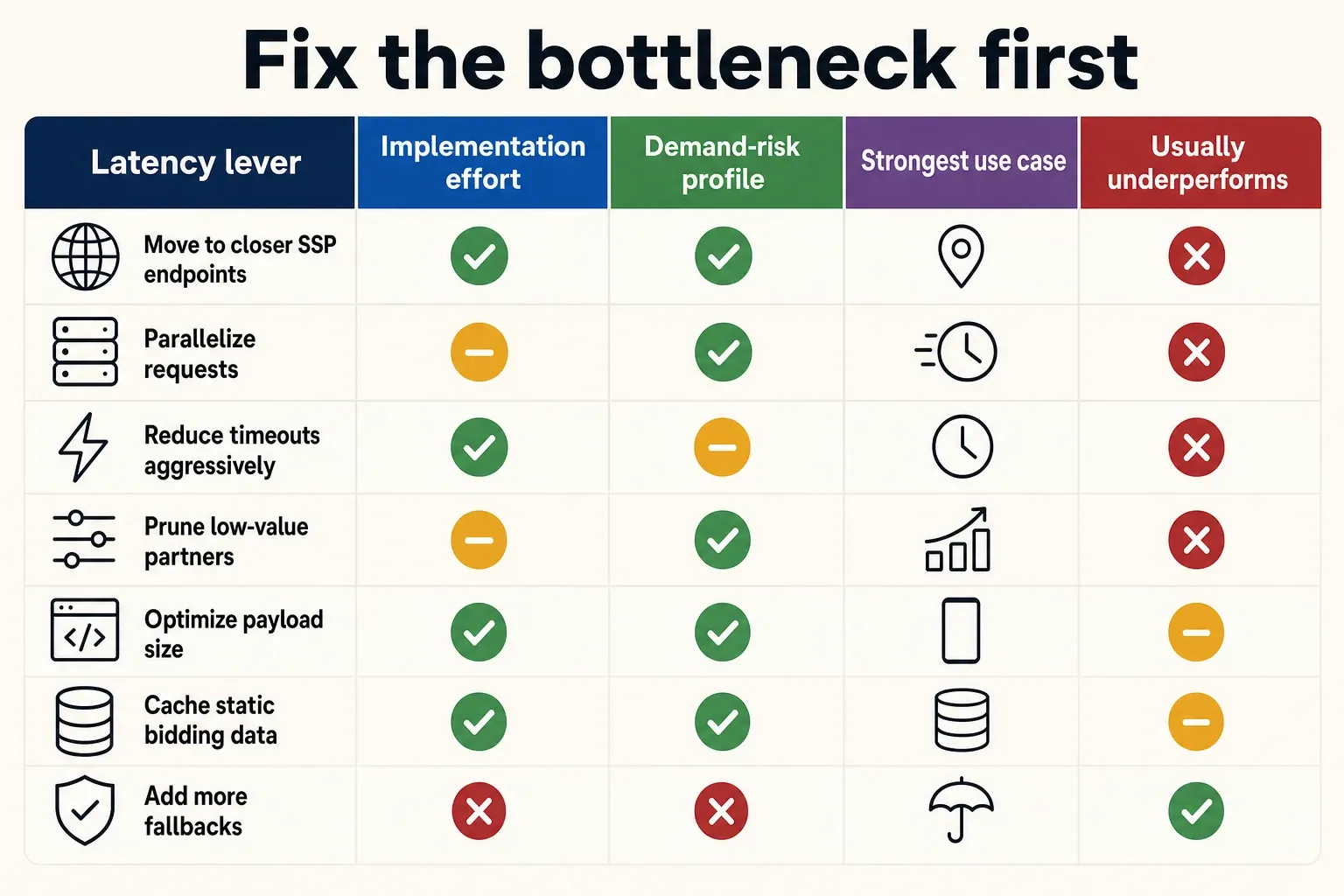
| Latency lever | Expected impact | Implementation effort | Demand-risk profile | Strongest use case | Usually underperforms when | Evidence anchor |
|---|---|---|---|---|---|---|
| Regional Prebid Server hosting | High when users are far from the auction endpoint or traffic is nationally distributed | Medium to high; requires deployment discipline, config parity, and region-aware monitoring | Low direct demand risk, but misconfiguration can create uneven bidder access | Large U.S. audience with visible regional timing gaps | Most delay comes from bidder response time rather than user-to-server travel | consult.tv prioritizes measuring the S2S path before selecting reduction tactics consult.tv |
| CDN routing to healthy endpoints | Medium when DNS or origin selection sends users to a poor route | Medium; CDN, origin, and browser logs must be tied together | Low demand risk if routing is correct; operational risk if the CDN obscures failures | Multi-region endpoints that need cleaner failover and routing control | The CDN adds a hop without changing the slow bidder or server processing segment | Operational synthesis; validate with edge timing plus Prebid Server receipt timing |
| Bidder concurrency and batching adjustments | Medium to high when auctions still behave like sequential waits or request shapes are inefficient | Medium; needs controlled testing by bidder group, format, and page type | Medium; excessive fan-out can increase timeouts and server pressure | Hybrid or growing S2S stacks where new partners were added without revisiting request shape | The host is already saturated or one shared dependency blocks all bidder calls | Prebid’s S2S documentation shows the server-side auction pattern initiated through Prebid.js Prebid documentation |
| Bidder-level timeout tuning | High when a few partners define the auction ceiling | Low to medium; reporting must separate timeout, no-bid, and win contribution | Medium to high if late bidders are commercially valuable | Partners with clear latency tails and low incremental contribution | You lack placement-level revenue reporting after the change | AdMonsters recommends addressing repeated partner timeout issues directly AdMonsters |
| Partner pruning | Variable; can be high for server load, modest for user-visible render time | Low technically, high commercially | Highest demand risk because bid density and auction pressure can fall | Bidders with weak wins, weak bids, and chronic timeout behavior across placements | The removed partner contributes to premium units, video, or specific geographies | Sovrn warns that fewer partners can reduce latency but damage ad performance Sovrn |
This gets especially touchy in first-price auction dynamics. A bidder does not have to win often to affect clearing pressure. If it pushes the eventual winner higher on high-value impressions, removing it can reduce revenue even when its direct win count looks small. Use bid landscape and winning-price analysis where you have it; if you do not, run the change on a limited placement set before applying it globally.
The first latency fix should attack the measured bottleneck with the least risk to useful demand. In most mid-to-large U.S. publisher stacks, measurement and routing fixes should come before broad partner pruning because they preserve auction competition while showing whether the delay comes from infrastructure, bidder behavior, timeout policy, or the GAM handoff.
A practical tuning sequence for the next 30 days
Use the decision matrix as a triage sheet, not a universal ranking. If West Coast traffic takes longer to reach the auction endpoint, regional routing beats timeout tinkering. If one adapter drives the response-time tail, bidder-level policy beats a CDN project. If server pressure climbs after adding demand, concurrency and batching deserve the first test. If GAM response or creative render is the delay, S2S tuning will make the auction look better without fixing the visible slot.
- Days 1–3: build the baseline. Capture auction request start, Prebid Server receipt, bidder response timing, timeout status, response returned to browser, GAM request start, GAM response, and render timing for the placements that matter most commercially.
- Days 4–6: segment the baseline. Break the report by bidder, ad unit, device class, U.S. region, page type, and format. Mark which bidders are server-side, which remain client-side through Prebid.js, and which placements carry sponsorship or video considerations.
- Days 7–10: identify the dominant delay. If the user-to-server trip is the visible gap, test regional hosting or CDN routing. If one bidder owns the response tail, test bidder-level timeout policy. If the server slows down after fan-out, test concurrency and batching.
- Days 11–15: run one controlled change. Keep floor rules, bidder list, ad unit mapping, and GAM line-item setup steady unless the test requires that specific change. A clean latency win is measurable only when the rest of the stack is not moving.
- Days 16–20: check demand impact. Compare timeout rate, no-bid rate, bid density, win contribution, and revenue by placement. Do not accept a faster auction as a win until the revenue view agrees or the user-experience gain justifies the tradeoff.
- Days 21–25: escalate with evidence. Send bidder-specific timing and timeout reports to slow partners such as OpenX, PubMatic, Sovrn, or any other adapter in the problem group. Ask for endpoint, account, or configuration review using the exact placements and regions where the delay appears.
- Days 26–30: lock the policy and document exceptions. Keep the setting that improved both latency and commercial outcome, revert the one that only made the auction look faster, and write down which page types, formats, and bidders use different timeout bands so the next wrapper change does not erase the work.
Frequently asked questions
Does server-to-server header bidding always reduce latency?
The weakest first move is broad partner removal without bidder-level revenue context. It is easy to do in a wrapper or account config, so it feels decisive. It is also the change most likely to make latency charts look better while the yield team later has to explain thinner competition. Remove or isolate demand only after you know its timeout behavior, bid participation, win contribution, and placement-level revenue impact.
What’s the fastest way to lower latency in a server-side setup?
A 30-day server-to-server header bidding latency project should run in this order: measure placement timing from browser start to creative render; segment by U.S. geography, device class, property, and ad unit; isolate bidder response distributions and timeout rates; choose one lever, such as routing, timeout, concurrency, or partner inclusion; test it on a controlled slice; monitor GAM revenue, timeout behavior, bid density, and render timing; then roll back, expand, or refine.
Do not change floors, bidder eligibility, and timeout policy in the same test unless you want an inconclusive read.
Should I use a CDN for server-to-server header bidding?
FAQ: Does server-to-server header bidding eliminate latency? No. It usually reduces browser-side work, but the auction can still slow down in the network round trip, server processing, bidder response window, GAM handoff, or creative render. A fast client wrapper with a bad endpoint or one slow adapter can feel worse than a cleaner client-side setup.
Is it better to cut bidders or raise timeouts?
FAQ: What should you check first when S2S latency is high? Start with placement timing, bidder timeout analysis, and regional request path. Check whether the browser starts the auction late, whether U.S. traffic is bouncing to a distant host, and which bidders miss the effective cutoff. This is an operational recommendation, not a sourced universal benchmark; your first proof should be timestamp evidence from your own stack.
How we researched this
Sources consulted for this article:
- Measuring and Reducing Latency in Server-Side Header Bidding
- Moving Header Bidding To The Server Side Reduces Latency - OpenX
- How Moving to Server-Side Header Bidding Reduces Latency
- Latency in Header Bidding: What Kind of Latency Are We Talking? - AdMonsters
- Server Side Header Bidding Explained | Knowledge Base - Production
- Video Intro to Server-Side Header Bidding with Prebid.js for Header Bidding