
Programmatic Guaranteed: When It Makes Sense for Your Site
Programmatic guaranteed deals aren’t a shortcut to better CPMs. They’re a reservation call. Use them only when the fixed CPM, guaranteed impression volume, and tighter advertiser control are worth more than what those same ad units would likely earn in open auction or PMP during that exact window.
Key takeaways
- Guaranteed deals work best when you need certainty on a scarce, well-forecast inventory slice.
- The fixed CPM is only attractive if it beats the likely auction value for the same dates and placements.
- Do not approve volume commitments that depend on optimistic traffic assumptions.
- In GAM, structure guaranteed line items so they do not crowd out higher-value demand.
- Judge the deal after delivery by comparing what you earned to what that inventory would likely have cleared elsewhere.
What programmatic guaranteed deals are, and how they differ from PMP and open auction
Programmatic guaranteed is a programmatic direct sale: fixed CPM, committed impression volume, and a defined campaign period. Operationally, it behaves much more like reserved direct than auction-based yield management. AI Digital describes the core structure as an advance agreement on price and guaranteed delivery, rather than real-time price discovery AI Digital.
| Deal type | Price and delivery | How the deal starts | What is automated vs. manual | Publisher yield implication |
|---|---|---|---|---|
| Open auction | Price clears dynamically; no guaranteed delivery for a specific buyer. | No publisher proposal is required; buyers compete through exchange demand. | Auction execution is automated, but floor rules, blocks, and demand path controls still need publisher oversight. | Best for liquid inventory where competition can set the price and you do not need to reserve supply. |
| Private Marketplace (PMP) | Buyer gets access to selected inventory, usually with deal-level controls, but impressions still compete unless the setup says otherwise. | Publisher and buyer agree on deal access, targeting, and terms; the buyer can choose whether to bid. | Workflow is more controlled than open auction, but it still depends on buyer bid behavior and auction pressure. | Useful when you want buyer preference or curation without committing a fixed impression count. |
| Programmatic Guaranteed | Fixed CPM plus guaranteed impressions over a campaign window; inventory is effectively reserved for the buyer. | Negotiation can begin with a publisher proposal or a buyer RFP in Display & Video 360 Display & Video 360 Help. | Ordering, deal negotiation, and transaction flow are more automated, but targeting, forecasting, creative checks, and pacing still require ad ops work. | Best when certainty, control, and advertiser relationship value outweigh the upside of auction competition. |
The real distinction is reservation versus competition. PMP still leaves auction logic in play. Programmatic guaranteed replaces that with a commitment, which changes the revenue question from “Can this buyer pay a high CPM?” to “Should this buyer get first claim on this specific slice of supply?”
Google Ad Manager presents Programmatic Guaranteed as a way to modernize direct buying with a more automated transaction process Google Ad Manager. Fine. But that doesn’t remove operational judgment; it moves the decision earlier, before you’ve committed the impressions.
When programmatic guaranteed deals make sense for a mid-size publisher
Programmatic guaranteed deals make sense when inventory is scarce, the buyer needs certainty, and your forecast is reliable enough to reserve impressions without hurting higher-value demand elsewhere. For a mid-size U.S. publisher, the strongest candidates are planned packages across known sections, seasonal traffic peaks, and premium ad units where buyer control actually matters.
Use it for inventory a buyer cannot easily replace
A homepage takeover package, a high-viewability leaderboard on a tentpole content hub, or a sponsorship tied to a recurring sports, finance, entertainment, or holiday guide can justify guaranteed execution. The buyer isn’t only paying for impressions. They’re paying for placement certainty, brand suitability, and confidence that the campaign plan will hold.
StackAdapt frames programmatic guaranteed as a way for media buyers to secure premium, brand-safe inventory and guaranteed impressions through more efficient programmatic execution StackAdapt. That’s the buyer-side case. Your publisher-side test is tougher: are you comfortable pulling those impressions out of auction pressure before the real-time bids show up?
Use it when advertiser timing matters
Launch campaigns, product drops, political campaigns, theatrical releases, and retail events usually run on fixed windows. If a buyer is planning around one specific week, guaranteed delivery may matter more than finding cheaper impressions through auction pipes.
That’s where programmatic guaranteed can beat a PMP. A PMP gives the buyer access, but it doesn’t make the buyer win enough impressions unless bidding behavior, floors, budgets, and pacing all line up. If the advertiser’s internal plan depends on committed delivery, PMP can leave unnecessary risk in the system.
Avoid it when your auction is already doing the work
Don’t approve a guaranteed deal just because the CPM looks tidy in the proposal. If the same ad units regularly clear well through open auction or PMP, a fixed CPM can cap your upside. That’s especially true for above-the-fold, high-viewability inventory during Q4, major news cycles, or category-specific peaks.
The less confidence you have in the forecast, the more conservative the commitment should be. A publisher with multiple properties and meaningful AdX volume may have enough depth to carve out a safe package. A site with volatile traffic, frequent editorial spikes, or thin supply in the requested segment should push for fewer impressions, broader targeting, or a shorter test window.
Negotiating rates, volume commitments, and the hidden tradeoff behind the fixed CPM
The fixed CPM is only one lever. The actual economics come from price, committed impressions, and campaign timing working together. A US$18 CPM can be a solid deal on remnant mid-article inventory and a poor reservation on scarce homepage inventory if the auction would probably clear higher over the same dates.
- CPM: Anchor the rate to the exact ad units, placements, devices, geography, and viewability profile requested. Do not price a broad run-of-site guarantee the same way you price a premium section package.
- Impression volume: Commit below your comfortable forecast, not at the optimistic edge. If the buyer asks for 5 million impressions and your forecast shows that number only when traffic is strong, renegotiate the package before the order is approved.
- Campaign window: Shorter windows increase delivery pressure. A four-day launch buy needs more conservative targeting than a four-week awareness campaign because you have less time to recover from approval delays, creative issues, or traffic softness.
- Make-goods: Define what happens if delivery falls short before the campaign starts. Options can include extending dates, broadening inventory, substituting comparable ad units, or issuing credit, but the acceptable remedies should be clear to sales and ad ops.
- Pacing: Watch whether the buyer-side platform is actually spending against the deal. A guaranteed commitment can still create problems if creative approval, budget activation, or buyer-side pacing lags behind the plan.
- Opportunity cost: Compare the proposal against expected open auction and PMP value for the same ad units and dates. A fixed CPM that looks premium in isolation may underperform if it consumes inventory that usually attracts stronger competition.
- Inventory quality: Protect the placements that consistently drive your best yield. If the guarantee requires your highest-performing supply to hit volume, the buyer should pay for that privilege.
The negotiation mistake is treating programmatic guaranteed like a rate card exercise. Treat it like inventory allocation instead. You’re deciding whether a known buyer should get reserved access to supply that your wrapper, AdX, PMP buyers, and direct campaigns would otherwise compete for.
How to set up guaranteed line items in GAM without boxing out better demand
GAM setup needs to protect the delivery commitment without unnecessarily suppressing stronger demand, so targeting and priority decisions have to be made before the deal goes live. The worst version of programmatic guaranteed is a broad line item that reaches too far, steals flexible inventory, and still creates pacing pressure.
- Define the inventory package first. Lock the ad units, placements, devices, geography, audience rules, and exclusions before assigning priority. If the sales package says “business section,” confirm whether that means one property, a content vertical across properties, or a custom key-value set.
- Run the forecast against the exact dates and targeting. Use the conservative read, especially if the campaign overlaps a holiday, traffic-dependent editorial package, or another reserved campaign. If delivery only works after broadening targeting, renegotiate before signing.
- Set priority to match the commitment, not the buyer’s preference. Guaranteed line items need enough priority to deliver, but they should not be configured so broadly that they block premium direct, sponsorship, or higher-value reserved demand outside the agreed package.
- Check overlapping line items. Look for conflicts with sponsorships, roadblocks, competitive exclusions, frequency-capped campaigns, and house or fallback campaigns. Overlap is where a clean proposal becomes an operational mess.
- Coordinate the deal workflow with Display & Video 360 when DV360 is the buying platform. Google’s DV360 documentation notes that negotiation can begin from a publisher proposal or a buyer RFP, so both sides need the same deal terms before activation Display & Video 360 Help.
- Approve creatives and rules before the start date. Confirm creative sizes, SSL compliance, landing page rules, category blocks, competitive separation, and any rich media behavior. A guaranteed campaign that starts late because approval was incomplete still has to catch up.
- Set fallback behavior for delivery lag. Decide whether you will broaden targeting, extend dates, increase priority within the agreed scope, or alert sales before taking action. Do not let an ad trafficker solve underdelivery by opening inventory that was never priced into the deal.
- Monitor pacing daily at launch, then reduce frequency if delivery stabilizes. The first 48 hours tell you whether the buyer, creatives, and GAM setup are aligned. If pacing starts behind, solve the cause instead of immediately expanding supply.
The operational goal is controlled reservation. Programmatic guaranteed should hold back the inventory you meant to sell, not turn into a vacuum that pulls every eligible impression away from competitive demand.
Original decision framework: the opportunity-cost check before you approve a guaranteed deal
Approve a programmatic guaranteed proposal only when its fixed revenue, delivery certainty, and advertiser value beat the likely auction or PMP outcome for the same inventory window. Use that screen before signing the publisher proposal, then run it again when the renewal request comes in.
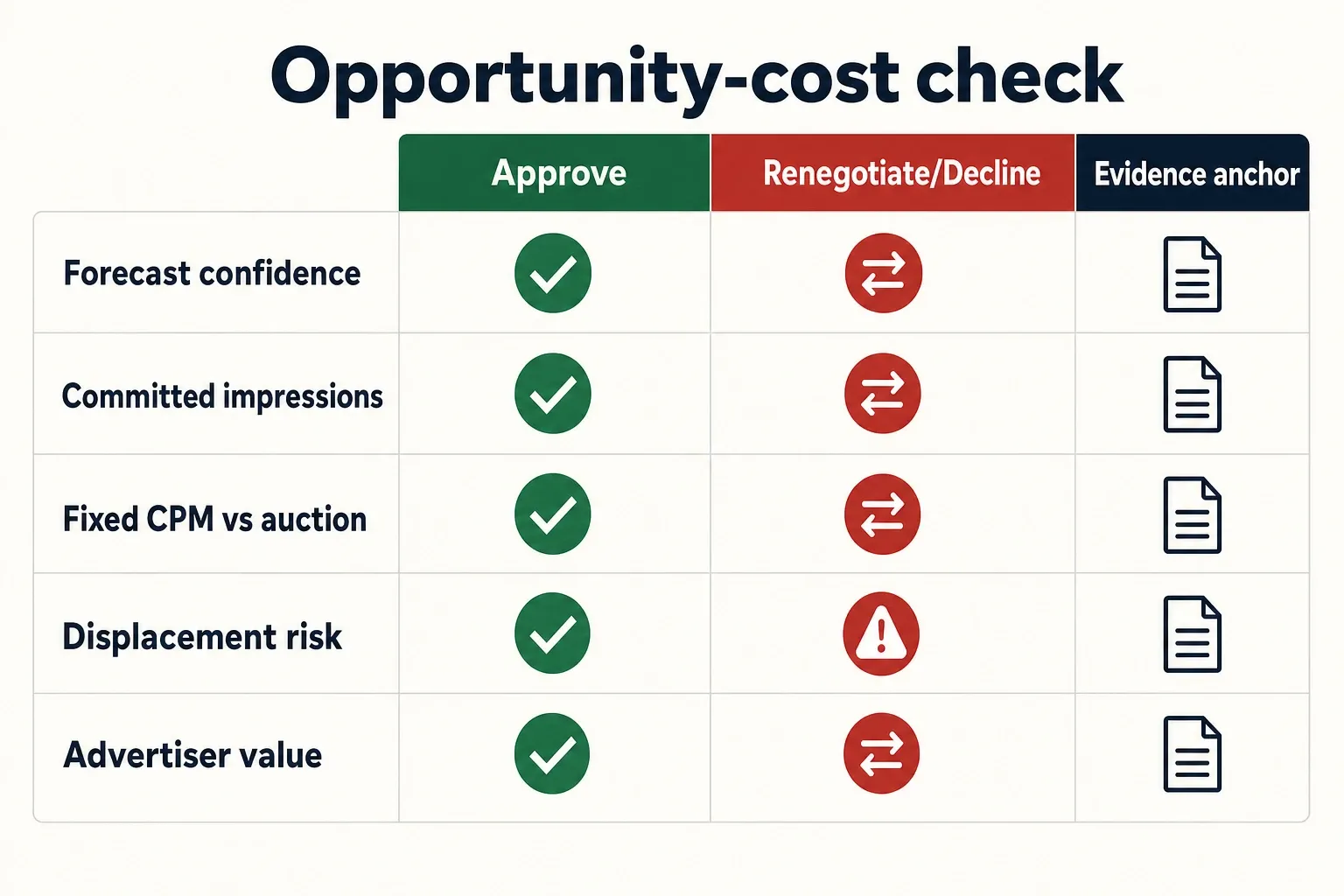
| Decision criterion | Approve | Renegotiate | Decline | Evidence or operational anchor |
|---|---|---|---|---|
| Forecast confidence | Forecast comfortably supports the committed impressions with the exact targeting and dates. | Forecast works only if targeting expands, dates extend, or lower-priority supply is included. | Forecast depends on optimistic traffic or conflicts with existing reserved campaigns. | Programmatic guaranteed requires a fixed number of impressions over a defined period AI Digital. |
| Inventory scarcity | The package uses scarce inventory the buyer specifically values, and the CPM reflects that reservation. | The buyer wants premium placements but prices them like broad run-of-site supply. | The deal consumes your best-performing units without paying for scarcity. | StackAdapt emphasizes premium, brand-safe inventory as a core buyer reason for using guaranteed execution StackAdapt. |
| Auction strength | Open auction and PMP benchmarks for the same ad units suggest the fixed CPM is safely above expected value. | Benchmarks are close enough that a shorter test, lower volume, or higher CPM is needed. | Auction or PMP demand is already strong during the requested window. | PMP and open auction are separate programmatic deal paths with different control and competition dynamics Verve. |
| Advertiser strategic value | The advertiser is likely to renew, expand, sponsor content, or bring direct budget that would not otherwise reach you. | The buyer has category value but no clear renewal path or relationship upside. | The deal is a one-off request with no strategic value and heavy restrictions. | DV360 supports workflows that can start from publisher proposals or buyer RFPs, which makes relationship quality relevant to deal flow Display & Video 360 Help. |
| Operational overhead | Targeting, creatives, approvals, and reporting are standard for your team. | The deal needs custom reporting, unusual creative handling, or frequent manual monitoring. | The workload would distract from higher-value campaigns or create delivery risk across properties. | Google Ad Manager describes Programmatic Guaranteed as automating parts of direct buying, but trafficking and delivery management still sit with the publisher workflow Google Ad Manager. |
| Buyer control requirements | Brand safety, placement certainty, and delivery guarantees are central to the advertiser’s campaign. | The buyer wants control but can likely achieve the goal through PMP access and bid discipline. | The buyer mainly wants cheaper access while asking for guaranteed treatment. | Publift places programmatic guaranteed within the broader set of publisher monetization deal types, separate from open auctions and private auctions Publift. |
This table belongs in the approval process, not buried in a postmortem deck. Sales can still make the case for the deal, but the yield owner should require a same-window comparison: same ad units, same dates, same geography, same device mix, and the closest available auction or PMP benchmark.
If two criteria land in “decline,” the deal shouldn’t move forward without a material change. If most criteria land in “renegotiate,” the answer usually isn’t “no.” It’s smaller volume, a narrower commitment, a higher CPM, a longer campaign window, or a PMP structure instead of guaranteed delivery.
How to measure whether the deal was worth it after delivery
A delivered programmatic guaranteed deal was worth it only if realized value beat the likely alternative after displacement, delivery risk, and operational work are accounted for. Raw revenue is too blunt. A guaranteed campaign can look good on its own while quietly replacing stronger auction or PMP demand.
Compare against the inventory you actually reserved
Measure realized CPM against forecasted open auction and PMP value for the same ad units, dates, countries, devices, and placement class. Don’t compare a premium guaranteed package with sitewide average CPM. That masks the cost of pulling high-quality impressions out of competition.
Also check whether the deal affected fill or unfilled impressions in nearby inventory. If delivery pressure forced broader targeting late in the flight, the final report should split planned delivery from rescue delivery. Those are different economic outcomes, and they should be treated that way.
Look for pressure on adjacent demand
Look at what happened to PMP spend, open auction revenue, direct campaign pacing, and high-priority sponsorships during the flight. A guaranteed deal can be profitable on its own line item and still reduce total yield if it pushes flexible demand into weaker inventory.
For publishers managing multiple properties, break the analysis out by property and ad unit. A blended network-level result can hide that one site carried the delivery burden while another kept the revenue upside. That matters before renewal, especially if the advertiser wants the same package again.
Decide the renewal action before the next proposal
Keep the deal if it delivered cleanly, beat the same-window alternative, and avoided unnecessary operational drag. Renegotiate if the buyer value was real but the terms were loose. Retire it if the fixed CPM capped upside, delivery required too much intervention, or the buyer could have been served through PMP access.
The best renewal notes are short and specific: raise CPM on two premium ad units, cap volume on mobile web, remove one low-supply section, require creative approval 48 hours before launch, or move the buyer to PMP for non-scarce inventory. That gives sales a path forward without giving away reservation rights by default.
What to do next
Treat programmatic guaranteed as a controlled reservation product inside your yield stack, not a nicer label for premium programmatic. The next decision should be mechanical enough that sales, ad ops, and revenue leadership all reach the same answer from the same inputs.
- Pull the last 30 to 90 days of open auction and PMP performance for the exact ad units most often requested in guaranteed proposals.
- Create a pre-approval sheet with forecast confidence, auction strength, scarcity, advertiser value, and operational overhead as required fields.
- Set minimum deal terms by inventory class, including CPM floor, maximum committed volume, campaign window, and make-good rules.
- Run one controlled programmatic guaranteed test only where the opportunity-cost check supports approval.
- After delivery, compare realized value against the same-window alternative before offering the buyer more inventory.
Frequently asked questions
Are programmatic guaranteed deals better than PMP deals?
Only when you need guaranteed delivery, a fixed buy structure, or tighter advertiser control over a specific slice of supply. PMP is usually the better fit when you want controlled demand without reserving impressions at a hard commitment, especially if the same inventory can still compete well in auction.
Do programmatic guaranteed deals always pay a higher CPM?
No. A higher CPM on paper can still underperform if that inventory would have cleared better in open auction or PMP during the same dates. The real test is total opportunity cost, not just the guaranteed rate.
When should a publisher avoid programmatic guaranteed deals?
Avoid them for liquid inventory, uncertain supply, or placements that already perform well in auction and do not need reservation. The risk is giving up upside on inventory that would likely earn more if you let demand compete in real time.
Who usually negotiates programmatic guaranteed deals?
The publisher and buyer usually negotiate the terms directly, often through a proposal or RFP process, then the deal is trafficked in GAM and, when relevant, DV360. The key terms are the fixed CPM, the committed volume, and the campaign window.
What is the biggest mistake publishers make with guaranteed deals?
They commit too much inventory without checking what that same ad unit earns in auction over the same time window. A fixed CPM only looks good until you compare it against the revenue you gave up by reserving scarce supply too early.
How we researched this
Sources consulted for this article:
- What Is Programmatic Guaranteed? How It Works — AI Digital
- Programmatic Guaranteed deals - Display & Video 360 Help
- Programmatic Guaranteed: How It Works and When to Use It
- What Is Programmatic Guaranteed? - Publift
- Guide to programmatic deals | Verve
- How Programmatic Guaranteed Works - Google Ad Manager