

Price Floor Strategy in Programmatic: A Data-Driven Approach
Google Ad Manager completed its move to a unified first-price auction in 2019 Google Ad Manager. A workable price floor strategy in programmatic separates floors by placement value, demand source, and U.S. geo signal, then judges each segment on fill and revenue per 1,000 eligible ad opportunities, not blended CPM.
Key takeaways
- One floor across all inventory usually hides the real bid spread and leaves money on the table.
- A useful floor test compares revenue per thousand opportunities, not just CPM.
- Keep a holdback cell in every meaningful test so you can separate lift from normal market movement.
- Dynamic floors help when demand shifts fast, but hard floors are still cleaner for premium inventory.
- If a floor raises CPM but cuts fill too hard, it probably looks better than it performs.
A worked example: one homepage slot, three demand buckets, two geo tiers
Key takeaways: • Do not optimize floors on CPM alone; compare revenue per 1,000 eligible opportunities. • Keep a holdback on the old floor for every material change. • Segment by demand source before geo when AdX, APS, Prebid, and direct programmatic clear differently. • Roll back any cell that misses the guardrail you set before launch.
A worked example: use one 970x250 desktop homepage placement in Google Ad Manager, split U.S. traffic into Tier A DMAs such as New York, Los Angeles, Chicago, Dallas-Fort Worth, and the San Francisco Bay Area, with the rest of U.S. traffic in Tier B. This is a hypothetical calculation template, not a benchmark. Current baseline floor: US$2.00 across all eligible buckets. Holdback: 10% of eligible opportunities on the baseline floor.
| Demand bucket | U.S. geo tier | Current floor | Test floor | Why this setting | How to judge the readout |
|---|---|---|---|---|---|
| AdX | Tier A top DMAs | US$2.00 | US$3.25 | AdX usually has broad buyer density and strong auction pressure on premium homepage inventory, so the first test can be more assertive. | Keep only if revenue per thousand ad opportunities rises while fill loss stays inside your guardrail. |
| AdX | Tier B rest of U.S. | US$2.00 | US$2.50 | Demand is still national, but bid depth is usually less concentrated outside top markets; the floor should move, but not as far. | Keep if CPM lift offsets any lost impressions versus the 10% holdback. |
| OpenX, Magnite, Index Exchange, PubMatic via Prebid.js | Tier A top DMAs | US$1.75 | US$2.75 | Major SSPs can compete hard on premium U.S. users, but each adapter may see different buyer coverage and timeout behavior. | Review bidder-level bid rate and win rate, not only blended header bidding revenue. |
| OpenX, Magnite, Index Exchange, PubMatic via Prebid.js | Tier B rest of U.S. | US$1.75 | US$2.15 | A smaller lift protects fill where the bid landscape is thinner and avoids pricing out marginal auctions. | Keep if unfilled impressions do not rise faster than the price gain. |
| Amazon Publisher Services | Tier A top DMAs | US$2.25 | US$3.00 | APS demand often behaves differently from open SSP demand, so group it separately rather than forcing the same Prebid floor. | Compare APS win rate and downstream AdX competition before declaring the floor successful. |
| Amazon Publisher Services | Tier B rest of U.S. | US$2.25 | US$2.40 | The starting floor is already higher than the open SSP bucket, so a smaller move is the cleaner test. | Keep only if total slot revenue improves, not just APS CPM. |
| Preferred deals or programmatic guaranteed in GAM | Both tiers | Deal-specific | Do not change in this test | Deal pricing and delivery rules should not be contaminated by open auction floor experiments. | Exclude from the experiment and monitor delivery pacing separately. |
Calculate each cell the same way: revenue per 1,000 opportunities equals fill rate multiplied by CPM.
Example rows: AdX Tier A, 100,000 eligible opportunities, 90,000 test and 10,000 holdback, baseline US$2.00, test US$3.25, holdback fill 82%, holdback CPM US$3.10, holdback revenue per 1,000 opportunities US$2.54, test fill 78%, test CPM US$3.65, test revenue per 1,000 opportunities US$2.85, keep.
AdX Tier B, 80,000 eligible, baseline US$2.00, test US$2.50, holdback 75% fill at US$2.35 for US$1.76, test 73% fill at US$2.70 for US$1.97, keep.
APS Tier A, 60,000 eligible, baseline US$2.00, test US$3.00, holdback 70% fill at US$2.95 for US$2.07, test 66% fill at US$3.20 for US$2.11, keep if your fill guardrail allows a four-point drop.
APS Tier B, 50,000 eligible, baseline US$2.00, test US$2.40, holdback 63% fill at US$2.10 for US$1.32, test 56% fill at US$2.55 for US$1.43, roll back if the pre-set fill guardrail was five points.
Continue the same readout for the remaining buckets: Prebid Tier A, 70,000 eligible, baseline US$2.00, test US$2.75, holdback 68% fill at US$2.80 for US$1.90, test 64% fill at US$3.05 for US$1.95, keep.
Prebid Tier B, 65,000 eligible, baseline US$2.00, test US$2.25, holdback 60% fill at US$2.00 for US$1.20, test 50% fill at US$2.45 for US$1.23, roll back because the CPM lift barely offsets a large fill loss.
Direct programmatic Tier A, 20,000 eligible where floor rules are applicable, baseline US$2.00, test US$4.00, holdback 90% fill at US$4.10 for US$3.69, test 90% fill at US$4.20 for US$3.78, keep.
Direct programmatic Tier B, 15,000 eligible, baseline US$2.00, test US$3.00, holdback 84% fill at US$3.00 for US$2.52, test 80% fill at US$3.25 for US$2.60, keep if the deal terms do not set a different contractual price.
Why static floors leave revenue on the table
Why static floors leave revenue on the table: the failure condition is a segment where one blended floor hides materially different fill, CPM, or revenue per 1,000 opportunities across placements, bidders, devices, or U.S. geos. Google’s unified pricing rules set pricing for indirect demand in Google Ad Manager, but they do not decide which inventory deserves a separate floor Google Ad Manager.
The first failure mode is underpricing premium inventory. A homepage leaderboard, a high-viewability in-article unit, and a refreshed sidebar unit can sit under the same floor because they share an ad unit prefix or placement group. If the leaderboard clears at US$3.00 and the refreshed sidebar clears near US$0.80, the blended rule protects the weaker slot and discounts the stronger one.
The second failure mode is overpricing the long tail. Raise the sitewide floor to protect premium pages and you can price out mobile web traffic, lower-density U.S. regions, or a bidder that only wins in less crowded auctions. CPM can rise because the remaining paid impressions are more expensive, while monetized impressions and revenue per 1,000 opportunities fall.
The operational trap
Static floors go stale when teams treat them as launch settings instead of yield settings. A floor set during a wrapper migration, GAM cleanup, or Q4 push can be wrong by the next quarter if bidder density changes, timeouts move, the homepage sends less traffic, or advertiser mix shifts from branded demand to lower-priced performance demand.
This matters more under first-price auction mechanics because, in general, the winning buyer pays the price it submitted rather than a second-price amount. Google describes the Ad Manager first-price transition in its official auction documentation Google Ad Manager. In that environment, a floor changes who can compete and where bidder bid-shading systems may choose to land.
The fix is controlled segmentation, not daily hand-editing. Split where the bid landscape produces a different decision, keep segments grouped when the signal is thin, and preserve a holdback so you can see whether the floor improved revenue or only made the CPM column look cleaner.
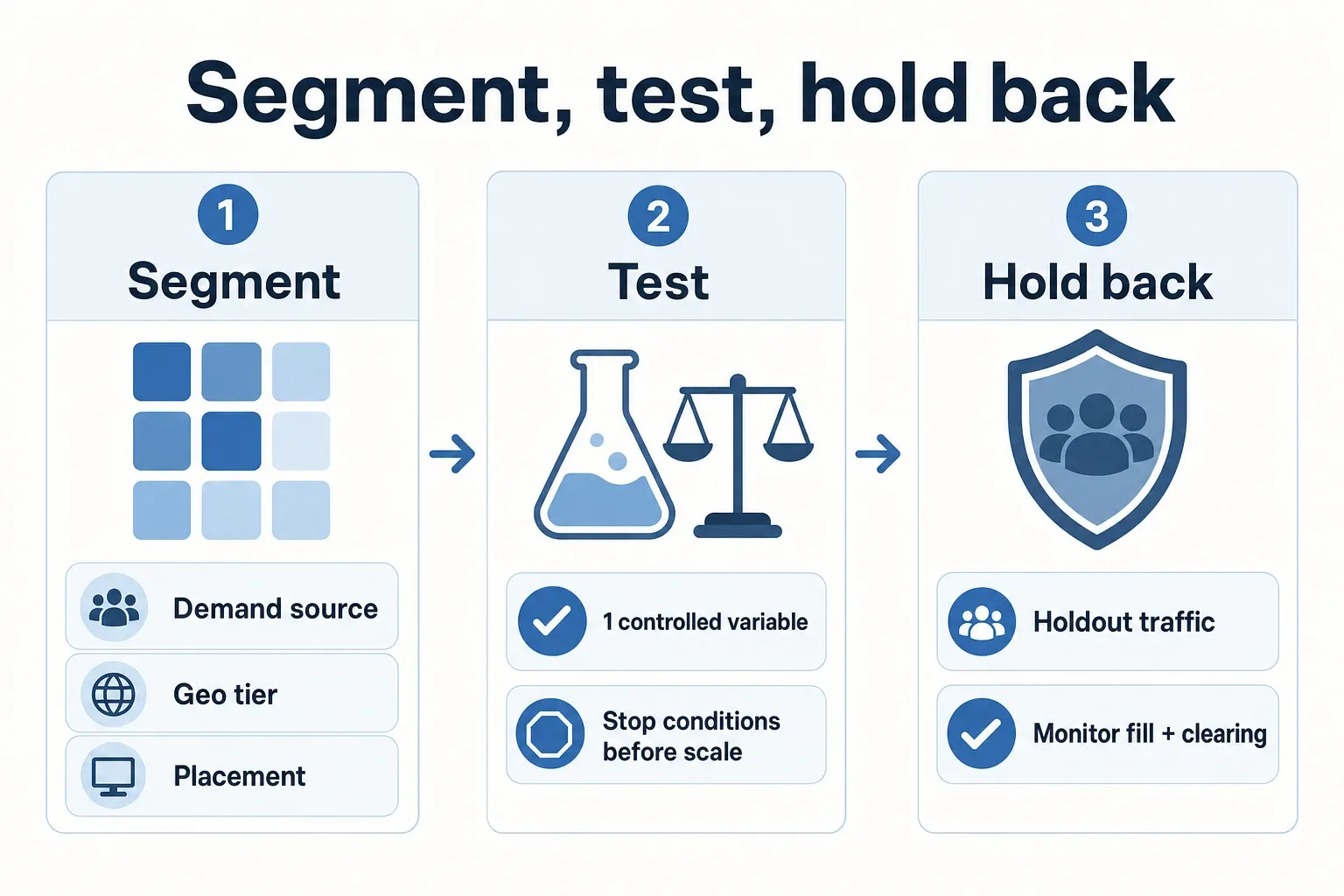
The original floor-setting framework: segment, test, and hold back
How to decide what deserves its own floor: a segment earns a separate rule only when it has different buyer behavior, enough eligible opportunities to read, and a clear operator who will keep or roll it back. If you cannot explain why the segment clears differently, the split is maintenance cost pretending to be optimization.
| Segmentation axis | When to split it | When to keep it grouped | Practical signal to check | Operational decision |
|---|---|---|---|---|
| Demand source | Split AdX, major Prebid SSPs, Amazon Publisher Services, and deal demand when each bucket shows different bid rate, win rate, or clearing behavior. | Keep smaller SSPs grouped if volume is too low to read without several weeks of data. | Bid rate, win rate, timeout rate, and clearing CPM by source. | Start here for mid-to-large publishers because demand behavior usually varies more than sitewide averages show. |
| Ad unit or placement | Split homepage, high-viewability article units, video, sticky units, and refresh-enabled placements. | Group low-volume ad units with similar layout and viewability profiles. | Revenue per thousand ad opportunities, viewability, unfilled impressions, refresh behavior. | Use separate floors for inventory that buyers already treat as premium. |
| U.S. geo | Split national U.S. traffic from top DMA or state clusters only when bid density differs enough to change the floor decision. | Do not create dozens of state rules if each cell has unstable volume. | Clearing CPM, bid density, and fill by DMA, state, or metro grouping. | Use geo segmentation sparingly; it is powerful when demand is concentrated, noisy when overcut. |
| Device | Split desktop, mobile web, and tablet when layout, viewability, and bidder participation differ. | Keep device grouped for placements where demand and fill move together. | Device-level bid rate, viewability, page speed, and timeout pressure. | Mobile often needs more conservative floors because latency and screen layout affect competition. |
| Time period | Split seasonal or event-driven windows such as Black Friday week, major sports coverage, or election-night traffic. | Avoid hourly rules unless the site has very high volume and predictable demand shifts. | Daypart revenue, advertiser pacing behavior, and auction density. | Use temporary overrides, then expire them. Permanent daypart floors become hard to maintain. |
| Audience or content value | Split logged-in, high-intent, or premium content sections if privacy rules and sales policy allow it. | Do not split sensitive categories or tiny audience pools just to chase higher CPM. | Consent rate, buyer participation, deal eligibility, and content taxonomy quality. | Coordinate with privacy, sales, and ad product teams before changing price exposure. |
The practical decision rule is blunt: create a separate floor only when the segment can produce an action you would take. “AdX Tier A homepage should keep US$3.25 while Prebid Tier B should roll back to US$2.00” is actionable. “Mobile Midwest looks different sometimes” is not.
Hold back a slice of traffic at the old floor for every material test. Without that control cell, a floor change gets mixed with normal demand movement, quarter-end budget behavior, holiday traffic, or a homepage referral spike. In the worked example, the 10% holdback is what makes the keep-or-rollback decision defensible.
Dynamic vs. hard floors explained
Hard floors versus dynamic floors: use hard floors where the commercial floor must be predictable, and use dynamic floors only where auction volume is large enough to support frequent adjustment. Prebid’s floors module supports dynamic floor data, schema-based rules, and enforcement logic, which is useful only if someone monitors the extra layer Prebid.js.
| Floor type | Best use case | Control level | Operational burden | Fill-rate risk | Where it can fail |
|---|---|---|---|---|---|
| Hard floor | Premium placements, sponsorship-adjacent inventory, direct-sold conflict protection, and floors tied to sales policy. | High. The floor is explicit and predictable. | Low to moderate, depending on how many rules you maintain. | Medium if set too aggressively, but easy to diagnose. | Can become stale when demand rises or falls and nobody updates the rule. |
| Dynamic floor | High-volume open auction inventory where bid patterns shift by geo, device, season, or buyer mix. | Medium. Rules react to inputs, but the logic may be less transparent to sales and ad ops. | High. You need QA, reporting, and exception handling. | Medium to high if the model overreacts to noisy data. | Can chase short-term CPM and suppress fill before the revenue impact is obvious. |
| Hybrid floor | Core inventory with hard minimums plus dynamic adjustments for open exchange demand above that baseline. | Medium-high. You preserve guardrails while allowing optimization. | High at launch, moderate after reporting is stable. | Lower than pure dynamic if the minimums and caps are sane. | Can become too complex if every segment gets custom logic and no owner. |
Where hard floors still win
Use hard floors when the inventory has a commercial reason to protect price. A homepage takeover companion slot, a high-viewability article unit packaged for direct sales, or a finance vertical with strong advertiser demand should not be pushed around by a model reacting to yesterday’s sparse bid sample.
Hard floors also help when finance, sales, and ad ops need the same number. If a seller is using a premium placement in a preferred deal or PMP conversation, a visible minimum such as US$4.00 for Tier A homepage demand is easier to defend than a floor that changes by bidder, hour, or schema row.
Where dynamic floors earn their keep
Dynamic floors make more sense for large, repeatable pools of open-auction supply with steady auction volume: standard article units, national U.S. traffic, multiple bidders, and enough daily opportunities to read a result. Do not use a low-volume microsite, one-day event hub, or rarely requested size as the proving ground.
The biggest mistake is allowing dynamic floor logic to optimize toward CPM alone. Your review needs CPM, fill, revenue per 1,000 eligible opportunities, bid participation, and unfilled impressions in the same readout. If the model raises CPM while eligible demand disappears, it is not improving the auction.
Setting floors by demand source and geo
Implementation order in GAM and Prebid: define the placement and demand-source buckets first, then add U.S. geo tiers only where the bid-density difference changes the floor decision. In GAM, keep rule names readable, target the specific ad units or placements, and avoid overlapping pricing rules that make the winning floor hard to audit. In Prebid, align floors schema fields with how you actually review results: ad unit, size, media type, bidder, and geo where supported by your setup.
- Create demand-source buckets before editing floors. Separate AdX, Amazon Publisher Services, major Prebid SSPs such as OpenX, Magnite, Index Exchange, and PubMatic, and direct programmatic demand in GAM. Do not mix preferred deals into open auction tests because pacing and delivery rules can distort the readout.
- Pull the same reporting fields for every bucket. At minimum, read bid rate, win rate, fill, unfilled impressions, timeout rate, clearing CPM, and revenue per thousand ad opportunities. If a bidder has high CPM but low bid rate, a higher floor may reduce already-limited competition.
- Group small demand sources until they earn their own line. A bidder that contributes thin volume should not get a custom rule unless it is strategically important or behaves very differently from the rest of the stack. Otherwise, you will create a reporting grid nobody trusts.
- Build two U.S. geo tiers first. Use a top-DMA tier for markets where demand is concentrated and a rest-of-U.S. tier for everything else. Move to state-level rules only when the volume is large enough and the result would change the floor you set.
- Apply the geo split to one placement family at a time. Do not launch different floors by geo across homepage, article, video, and refresh inventory in the same week. If revenue moves, you will not know which segment caused it.
- Treat mobile web separately if latency changes bidder participation. A mobile page with slow ad calls may show weaker competition because bidders time out, not because buyers value the user less. Fix the auction mechanics before raising the floor.
- Keep direct programmatic demand protected. Programmatic guaranteed and preferred deals should follow their own pricing and delivery logic in GAM. Open auction floor tests should not cause deal underdelivery or surprise a buyer with eligibility changes.
When geo actually matters
Geo matters only when it changes bid density or clearing behavior. A top-DMA split is worth testing if New York or Los Angeles traffic consistently attracts more eligible bids for the same 970x250 homepage unit than Tier B markets. A 50-state floor map is usually operational clutter unless your volume and staffing can support 50 separate decisions.
Be careful with local news, weather, sports, and finance properties. Their geo value can be real, but the source may be content context, direct sales packaging, or regional advertisers rather than open-auction pricing. If the open auction does not show a distinct bid pattern by metro or DMA, keep the floor simple and protect the value through packaging instead.
When demand source matters more than geo
Demand source should beat geo when bidder behavior differs inside the same U.S. market. If AdX, APS, Prebid SSPs, and direct programmatic clear the same Chicago homepage impression at different levels, one Chicago floor will either leave AdX money behind or cut off a weaker bucket too soon.
That order matters in production: placement first, source second, geo third. A geo rule that ignores bidder mix can create a clean report and a messy auction, especially when the same GAM ad unit receives AdX demand, Amazon demand, Prebid key-values, and deal demand with different clearing patterns.
Testing floor changes without tanking fill
Execution checklist, step one: pull the required reports before changing anything. For the homepage example, export at least seven days of GAM delivery by ad unit or placement, device category, country or metro/DMA if you use U.S. geo tiers, demand channel or yield group where available, total impressions, unfilled impressions, total revenue, average eCPM or CPM, and any header-bidding bid data your wrapper or analytics stack captures by bidder.
- Pick one placement family and one monetization path. For example, test the desktop homepage leaderboard in AdX and leave article pages, mobile web, and video unchanged.
- Freeze competing changes during the test window. Do not adjust timeouts, add bidders, change refresh rules, or alter GAM competition settings while the floor test is live.
- Create a control cell at the current floor. A 10% holdback is often enough for large publishers to preserve a directional read, but the exact share should reflect your traffic volume and risk tolerance.
- Set guardrails before launch. Use fill, unfilled impressions, win rate, bid rate, and revenue per thousand ad opportunities. If the floor raises CPM while reducing total slot revenue, the test is failing.
- Read bidder-level impact. If one SSP disappears from auctions after the floor change, the blended CPM may hide lost competition that would have helped in later auctions.
- Let the test run long enough to clear normal daily pacing noise. Avoid judging a floor change from one morning of traffic unless the fill damage is obvious and severe.
- Roll back quickly when the guardrail breaks. Do not wait for a weekly report if unfilled impressions jump and revenue per opportunity drops in the first readout.
- Promote only the cells that won. If the Tier A AdX floor works and the Tier B Prebid floor fails, keep the winner and revert the loser. A test does not have to produce one global answer.
The metric that prevents false wins
Step two: set up the segmentation exactly as you will evaluate it. For the homepage 970x250, the test cells are AdX Tier A, AdX Tier B, APS Tier A, APS Tier B, Prebid Tier A, Prebid Tier B, direct programmatic Tier A, and direct programmatic Tier B. Do not add device, browser, or user-status splits unless you already know those splits will produce different floor decisions.
Step three: define the test duration and holdback before launch. Use a window that includes normal weekday and weekend behavior for that placement, and extend it when volume is thin. Keep a fixed holdback, such as the 10% baseline cell in the example, and do not let campaign trafficking or wrapper settings treat the holdback differently.
The mistake that ruins the readout
Step four: compare metrics in the right order. Start with eligible opportunities, then fill, CPM, total revenue, and revenue per 1,000 opportunities. A test cell earns a keep decision only when opportunity revenue improves and the fill change stays inside the guardrail you set before traffic moved.
Step five: write rollback rules that a trafficker can execute without interpretation. For example: roll back any cell where revenue per 1,000 opportunities is flat or down versus holdback; roll back any cell where fill loss exceeds the pre-set guardrail even if CPM improves; retest at a lower floor when revenue improves but fill loss is too large, as in the APS Tier B and Prebid Tier B example cells.
Monitoring floor performance over time
Step six: keep other variables still. Do not change bidder timeouts, refresh logic, ad unit mapping, consent handling, price-bucket granularity, direct campaign priorities, or lazy-load thresholds during the floor test. If one of those changes is unavoidable, restart the test window or mark the result as contaminated.
- Track each floor by demand bucket, placement, device, and U.S. geo tier. A sitewide line can tell you revenue moved; it cannot tell you which rule caused the move.
- Watch for rising bid density with flat clearing CPM. That can mean the floor is too low for a segment where more buyers are entering the auction but price pressure is not translating into yield.
- Watch for falling fill with no offsetting revenue-per-opportunity gain. That usually means the floor is too aggressive, even if CPM looks healthier.
- Review timeout rate next to floor performance. If Prebid.js bidders are timing out more often, the floor may appear to be the problem when latency is really reducing competition.
- Flag segments where one bidder dominates after a floor change. If Index Exchange, Magnite, OpenX, PubMatic, APS, or AdX suddenly takes disproportionate share, check whether the floor accidentally excluded competitive demand.
- Expire temporary rules. Q4, Black Friday, major sports coverage, and election-related traffic can justify special floors, but permanent seasonal rules become stale fast.
- Separate policy floors from yield floors. A hard minimum protecting premium inventory should not be lowered automatically just because a short-term open auction report looks soft.
- Reset the test after material changes. New bidders, wrapper changes, consent changes, page speed releases, ad unit redesigns, or GAM rule cleanup can all invalidate the old floor readout.
Final operating checklist
A price floor strategy only works if the next person can operate it. Keep the rule set small enough to audit, segmented enough to reflect real auction behavior, and measured against total opportunity value.
For the homepage example, the immediate action list is clear: keep AdX Tier A and B, keep APS Tier A, roll back or lower APS Tier B, keep Prebid Tier A, roll back or lower Prebid Tier B, and keep direct programmatic only where the floor does not conflict with deal terms.
- Confirm every active floor has an owner, segment, launch date, and reason.
- Separate AdX, Amazon Publisher Services, major Prebid SSPs, and deal demand before making geo cuts.
- Use top-DMA versus rest-of-U.S. geo tiers before building state-level rules.
- Protect premium placements with hard floors when sales policy or inventory positioning requires it.
- Use dynamic floors only where volume is high enough and reporting shows fill, win rate, and revenue per opportunity.
- Keep a holdback at the prior floor for material tests.
- Judge winners by revenue per thousand ad opportunities, not CPM alone.
- Roll back any floor that loses fill without producing offsetting revenue.
- Review stable rules biweekly or monthly, and review seasonal overrides more often.
- Delete or expire rules that no longer have a clear purpose.
Frequently asked questions
Should price floors be sitewide or segmented?
FAQ: Should you use one sitewide floor or segmented floors? Segmented floors usually win once you have enough volume to read the result. A single sitewide floor is too blunt for mixed placements, mixed bidder behavior, and mixed U.S. geos. Start with your largest material placements, then split by source and geo only when the holdback proves the split changes the decision.
Are dynamic floors better than hard floors?
FAQ: Are dynamic floors better than hard floors? Only if the inputs are stable and someone is watching the system. Dynamic floors make sense when demand changes faster than your team can safely edit rules, but they add monitoring and failure risk. Hard floors are cleaner for premium or curated inventory where predictable pricing and sales alignment matter.
How often should you review price floors?
FAQ: How often should floors be reviewed, and what is the biggest mistake? Review stable inventory monthly, high-traffic placements biweekly, and seasonal or event-driven placements during the event window. The biggest mistake is changing demand source, geo, and floor logic in the same release. If revenue moves, you will not know which change caused it.
What’s the biggest mistake in floor testing?
Sources: Google Ad Manager unified pricing rules Google Ad Manager; Google Ad Manager first-price auction transition Google Ad Manager; Prebid floors module documentation Prebid.js; Google Ad Manager reporting dimensions Google Ad Manager; Google Ad Manager reporting metrics Google Ad Manager.