
Header Bidding Wrapper Comparison: Prebid vs. Managed Solutions
Choose self-managed Prebid.js if you need direct control over auction configuration, release timing, bidder modules, and cross-property standards. Choose a managed wrapper if JavaScript deployments, QA, or daily partner maintenance routinely block revenue work. Do not pick based on the dashboard. Pick based on who can change the auction safely and how fast.
Key takeaways
- Prebid is the better fit when you need consistent control across properties and can support your own release process.
- Managed wrappers make sense when engineering bandwidth is the bottleneck and fast setup matters more than deep customization.
- The real cost comparison is labor plus yield friction, not just license fees or revenue share.
- If you can’t own QA, debugging, and GAM cleanup, a managed wrapper can reduce chaos, but it won’t remove operational work.
- Choose the wrapper model that matches how often you test, how many sites you run, and who actually fixes breakage.
What you’re actually comparing: open-source Prebid vs. managed wrappers
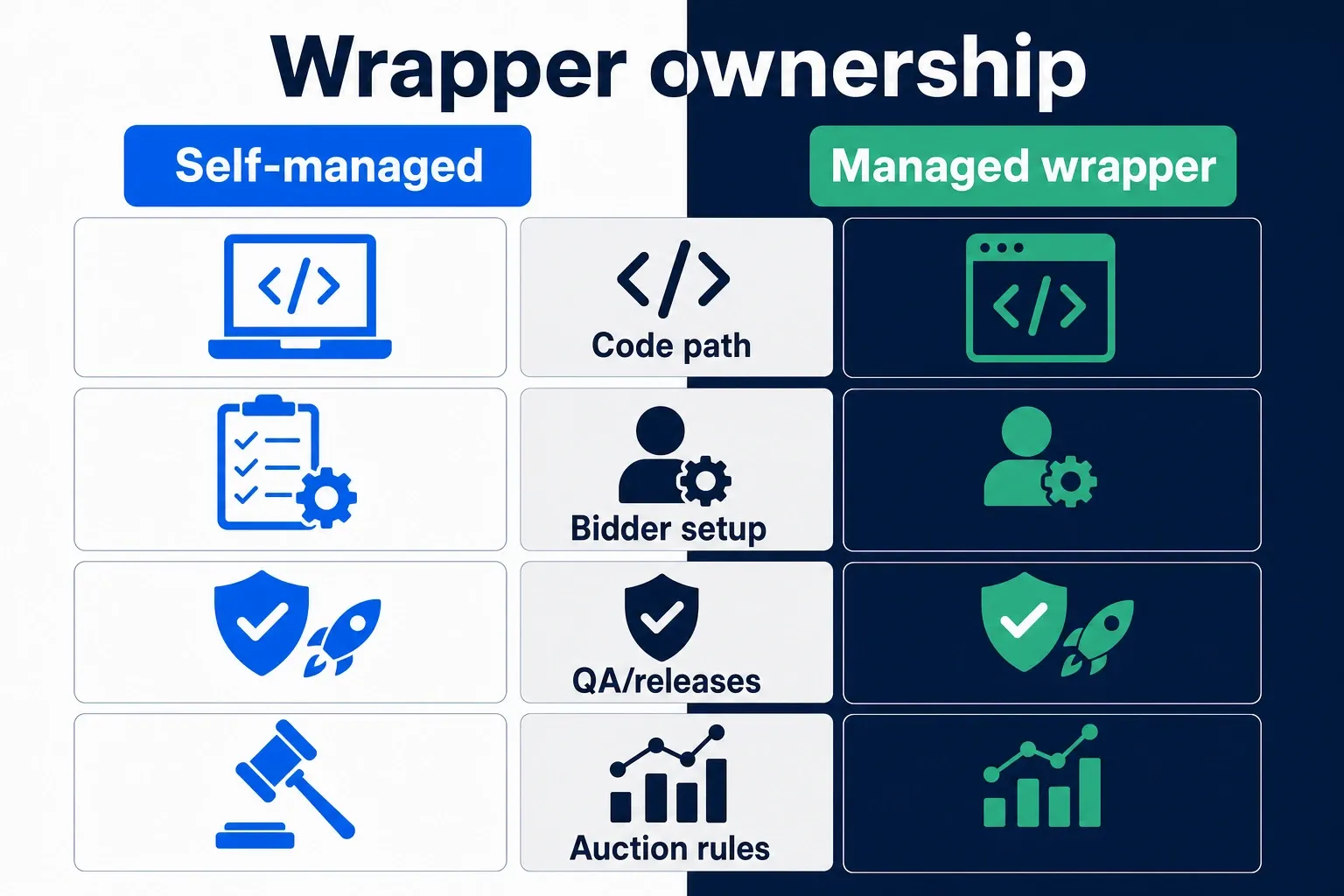
The real comparison is wrapper ownership, not bidder access. With self-managed Prebid.js, your team owns the JavaScript build, bidder configuration, QA, releases, and auction rules. With a managed wrapper, a vendor operates much of that layer. That decision affects revenue operations more than the logo on the wrapper UI. Prebid configuration
Prebid.js is the open-source path most ad ops teams mean when they say they run Prebid. GumGum describes Prebid.js as a free header bidding wrapper originally developed and incubated by AppNexus, and Prebid’s own documentation is still the primary reference for configuration, bidder adapters, modules, and publisher API behavior GumGum Prebid.js docs.
A managed wrapper packages the wrapper code, usually adds a UI or service layer, handles common partner integrations, and may assist with Google Ad Manager setup such as line items and key-values. AdPushup describes the wrapper as the JavaScript publishers place in the page header to run header bidding; the sharper question is who controls that code when the auction breaks AdPushup GAM line items GAM key-values.
The decision boundary
Do not confuse wrapper ownership with bidder strategy. You can add or remove SSPs under either model. The wrapper decision sits one layer above demand: who can change bidder parameters, inspect auction data, coordinate GAM key-values, test modules, and keep the same rules across multiple properties. Prebid bidder adapters Prebid modules GAM key-values
Fit depends on the team that must ship changes. A publisher with one ad ops manager, no front-end engineer assigned to ad tech, and JavaScript releases stuck behind product work needs a different wrapper than a publisher with multiple properties, code review, staging pages, and a programmatic engineer who can own Prebid releases.
Original comparison: the criteria that matter in a wrapper decision
Use this decision matrix before looking at vendor screenshots: if JavaScript changes take more than one sprint, score managed higher; if you need bidder-level parameters, analytics adapters, or custom module testing without waiting on a vendor ticket, score Prebid higher; if GAM naming varies by property, score managed only if the vendor can enforce a shared taxonomy; if you have a weekly release window and staging QA, score Prebid higher. Prebid configuration Prebid analytics GAM key-values
| Criterion | Self-managed Prebid.js | Managed wrapper solution | What it means for ad ops |
|---|---|---|---|
| Control surface | Direct access to wrapper code, modules, bidder configuration, release timing, and analytics hooks; Prebid.js is the open-source baseline associated with AppNexus and the Prebid ecosystem GumGum. | Controls are exposed through the vendor’s UI, service team, or approved configuration layer; some changes may require support tickets or vendor release windows. | Prebid gives you the broadest auction governance. Managed wrappers trade that for guardrails and less internal code ownership. |
| Implementation burden | Requires engineering to deploy JavaScript, maintain ad unit mapping, coordinate Google Ad Manager line items, and test page-level impact. | Vendor usually helps with setup, bidder onboarding, and wrapper configuration; the publisher still needs GAM access, QA, and sign-off. | Managed can shorten time to launch when engineering is scarce. Prebid is cleaner when you already have a release process. |
| Ongoing maintenance | Your team tracks Prebid.js updates, browser changes, bidder adapters, identity modules, and regression testing through your own workflow. | Vendor absorbs part of the update burden and support triage, but you still validate page behavior, reporting, and revenue impact. | Managed reduces ticket volume, not accountability. Someone on your side still owns acceptance testing. |
| Commercial model | No software license for Prebid.js itself, but real cost appears in engineering hours, QA, monitoring, and ad ops time. | May include platform fees, managed service fees, revenue share, or commercial terms tied to demand access. | The cheaper option on paper can be the expensive option if every bidder change waits three sprints. |
| Experimentation speed | Fast if ad ops and engineering can ship safely; slow if every change competes with product work. | Fast for standard vendor-supported changes; slower for custom auction logic, unusual modules, or nonstandard reporting needs. | Prebid usually wins for publishers that test often. Managed wins when the alternative is no testing at all. |
| Best-fit team profile | Mid-to-large publishers with internal ad ops discipline, engineering access, and multiple properties that benefit from standardization. | Lean ad ops teams, publishers without steady engineering support, or teams that need operational coverage more than deep customization. | The fit is about capacity and governance, not ideology. A strong managed setup beats a neglected Prebid deployment. |
Cost and revenue share tradeoffs: where managed wrappers help, and where they quietly tax yield
Total cost of ownership shows up in four places: vendor fees, implementation labor, QA time, and the opportunity cost of delayed auction changes. A zero-license Prebid setup is not zero-cost if every bidder parameter change waits for a product release. A managed wrapper is not cheap if each test requires a support ticket and manual reconciliation in GAM.
- Separate platform cost from labor cost. Prebid.js itself is free, but your internal cost includes JavaScript deployment, bidder adapter work, ad unit mapping, line-item hygiene in Google Ad Manager, analytics wiring, and regression testing. A managed wrapper can bundle part of that labor into a fee or revenue share.
- Treat revenue share as a margin decision, not just a vendor line item. If a managed wrapper removes a two-month engineering delay for a bidder rollout, the commercial tradeoff may be rational. If the same vendor process slows weekly testing on a mature stack, that convenience becomes a tax on yield.
- Price the support function honestly. Setupad describes wrappers as the layer that coordinates multiple demand partners in the automated auction, and that coordination creates real work every time an adapter changes, a bidder times out, or a page template behaves differently than expected Setupad.
- Watch for hidden implementation overhead. Managed does not mean plug-and-forget. You still need GAM order and line-item discipline, consent-state testing, page speed QA, and reporting reconciliation. If your team cannot validate those pieces, you are outsourcing setup without owning performance.
- Value speed differently by portfolio. A single-property publisher may care most about launching cleanly. A multi-property publisher with repeatable templates may care more about pushing one tested change across five sites without waiting on a vendor queue.
- Do not assume more bidders fix a weak commercial model. Gourmet Ads notes that wrappers help manage multiple demand partners and increase competition, but bidder count alone does not solve timeout pressure, low bid density, duplicated paths, or weak floor logic Gourmet Ads.
Control and customization: what Prebid gives you that managed wrappers may limit
Prebid gives you the widest control surface because your team can change the build, bidder adapters, modules, analytics hooks, timeout settings, and release timing directly. Managed wrappers reduce exposure to that complexity. The tradeoff appears when you need a nonstandard test, a fast rollback, or visibility into exactly which configuration changed. Prebid bidder adapters Prebid modules Prebid analytics
- Confirm who can edit bidder configuration. In self-managed Prebid.js, your team can add, remove, or modify bidder adapters through your own workflow. In a managed wrapper, the same change may be available in the UI, handled by support, or blocked if the vendor does not support that integration.
- Check whether timeout logic is exposed or generalized. A mature yield team will not set one timeout forever across every ad unit, device, and property. Managed wrappers often simplify this because simplicity reduces breakage, but simplified controls can limit precise testing.
- Verify analytics access before signing. If you need auction-level diagnostics, adapter-level error patterns, or custom event streams, confirm what the wrapper exposes. A dashboard that shows revenue by demand partner is not the same as raw enough data to debug why a bidder stopped returning bids on one template.
- Map identity and privacy controls to your governance process. Identity modules, consent signals, and partner-specific requirements need clean ownership. Prebid lets you wire and audit more directly; a managed solution can reduce implementation work but may make the actual data flow harder for ad ops to inspect.
- Tie wrapper settings to Google Ad Manager structure. Header bidding changes only monetize cleanly if GAM line items, key-values, targeting, floors, and reporting labels stay synchronized. The wrapper decision should support that operating discipline, not create a second naming system your team has to reconcile manually.
- Separate wrapper choice from client-side versus server-side architecture. Blockthrough’s client-side and server-side comparison is an adjacent decision, not a substitute for deciding who owns the wrapper Blockthrough. A managed vendor may offer both paths, while a Prebid setup can also be extended depending on your technical resources.
- Use control where it changes money. Customization for its own sake adds risk. Customization that lets you isolate bidder behavior, standardize ad units across properties, or run controlled experiments against GAM reporting is where Prebid’s control surface earns its keep.
Technical maintenance burden: who owns updates, debugging, and breakage risk
Wrapper ownership decides who responds when revenue drops after a deploy, a browser update changes auction behavior, or a bidder adapter starts returning unexpected bids. A managed wrapper moves some investigation to the vendor, but the publisher still has to verify delivery in GAM, page behavior, latency, and reporting deltas. GAM reporting
What self-managed Prebid puts on your plate
A self-managed Prebid.js setup needs release governance, not just a GitHub repo. Track the Prebid.js build, module list, bidder adapters, configuration changes, console errors, page timing, and GAM targeting before and after each deploy. If one engineer owns all of that while also shipping product features, Prebid control becomes fragile. Prebid bidder adapters Prebid modules GAM key-values
The maintenance work compounds across properties. The same SSP may need different ad unit codes, size maps, media types, consent handling, or floor interactions on a news site, a commerce property, and a video-heavy property. That is manageable with one naming standard and one deploy path. It gets expensive when each site carries its own wrapper fork. Prebid configuration
What managed wrappers still leave with you
A managed wrapper can reduce daily load by handling adapter updates, common configuration edits, and vendor-side troubleshooting. AdPushup, Setupad, GumGum, Gourmet Ads, Blockthrough, and Epom all publish around header bidding operations for the same reason: the wrapper is not just a tag. It is the auction control layer. AdPushup Setupad GumGum Gourmet Ads Blockthrough Epom
You still own QA. Treat a wrapper change as failed if test pages stop passing expected hb key-values into GAM, if line items no longer match the intended targeting, if console errors appear on core templates, if unfilled impressions move without explanation, or if direct-sold delivery is affected. A vendor can confirm the wrapper fired; only the publisher can confirm it fits the ad stack. GAM key-values GAM line items GAM reporting
Where larger portfolios lean back toward Prebid
Large publishers often lean toward self-managed Prebid when standardization is worth more than outsourced setup. Once you run multiple sites with shared ad products, GAM key-values, price buckets, and reporting conventions, one wrapper pattern across the portfolio can be more valuable than a vendor-managed UI that behaves differently by property. GAM key-values Prebid configuration
Epom reports that header bidding can deliver 20–30% higher ad revenue than waterfall while requiring more technical setup, which is the right reminder for this decision: auction upside comes with operating cost Epom. Your wrapper model has to match the team that can carry that cost without delaying revenue work.
How to choose the right fit by team size and operating model
The right wrapper model removes the current blocker without creating a larger one later. Choose managed if ad tech JavaScript work sits in a backlog, QA coverage is thin, or routine partner changes take too long. Choose self-managed Prebid if vendor permissions, limited logs, or inconsistent cross-property rules are already slowing optimization.
| Team or portfolio profile | Better fit | Why this fit works | Avoid switching if… |
|---|---|---|---|
| Lean ad ops team with limited engineering access | Managed wrapper | Support, hosted configuration, and vendor-led onboarding can move faster than waiting for product engineering to prioritize ad tech work. | Your real issue is weak GAM setup, poor trafficking discipline, or no owner for QA after changes. |
| Mid-sized publisher with ad ops plus part-time engineering | Hybrid path or self-managed Prebid.js | You can keep key auction controls in-house while using outside help for implementation, audits, or selected maintenance tasks. | Engineering access is too unpredictable to support releases, rollbacks, and adapter troubleshooting. |
| Multi-property publisher with shared GAM and repeatable templates | Self-managed Prebid.js | Standardized code, naming, analytics, and release governance can scale better than property-by-property vendor workflows. | Each property runs a different CMS, ad layout, or commercial policy and you lack the process to standardize first. |
| Publisher testing identity, floors, analytics, and bidder rotation frequently | Self-managed Prebid.js | Direct control shortens the loop between hypothesis, deployment, measurement, and rollback. | Your team cannot isolate test variables or reconcile wrapper data with GAM reporting. |
| Publisher prioritizing stability over custom auction design | Managed wrapper | A vendor-operated layer can reduce configuration mistakes and give ad ops a clearer support path. | The vendor cannot expose the controls or reporting needed for your existing optimization roadmap. |
Where switching is the wrong project
Do not switch wrappers just because revenue is soft or the dashboard feels stale. If the real constraint is price floor policy, ad unit structure, consent loss, low-quality demand, direct-sold conflicts, or GAM line-item sprawl, a wrapper migration can burn weeks and leave the actual problem untouched. GAM line items
Run a practical internal test: list the last ten revenue changes your team wanted to make. Mark each one as blocked by engineering, blocked by vendor workflow, blocked by GAM cleanup, or blocked by missing data. If engineering blocks dominate, managed deserves a serious look. If vendor permissions and missing auction detail dominate, Prebid deserves the argument.
Practical checklist before you choose
- Write down who owns wrapper releases, rollbacks, GAM coordination, and QA sign-off. If no name exists for each item, the model will fail regardless of vendor.
- Ask each managed wrapper provider exactly which changes require a support ticket: bidder edits, timeout rules, identity modules, analytics access, floors, and cross-property deployments.
- Audit your current Prebid.js or managed setup for duplicated bidders, stale adapters, inconsistent ad unit names, and line items that no one can explain.
- Price internal labor alongside vendor fees or revenue share. Include engineering time, QA cycles, monitoring, reporting reconciliation, and launch delay.
- Confirm whether your next six months of yield work requires deeper control or faster operational support. That answer matters more than the wrapper brand.
- Keep adjacent projects separate: client-side versus server-side header bidding, timeout tuning, unified auction work, and SPO each deserve their own decision rather than being bundled into a wrapper migration.
Frequently asked questions
Is Prebid always cheaper than a managed wrapper?
FAQ: Is Prebid.js cheaper than a managed wrapper? Not automatically. Prebid avoids wrapper license fees, but the real cost includes engineering time, QA, maintenance, release management, and delayed tests. A managed wrapper can be cheaper in practice when it replaces repeated internal work or moves a rollout out of a stalled product backlog.
Do managed wrappers give up too much control?
FAQ: Can a managed wrapper limit yield optimization? Yes, if the vendor workflow slows bidder changes, custom auction logic, module testing, reporting access, or GAM coordination. The risk grows as your stack becomes more standardized because each exception has to pass through the vendor’s process instead of your own release path. Prebid modules GAM line items
Which option is better for a small ad ops team?
FAQ: Are managed wrappers better for smaller ad ops teams? Usually, yes, when the team has no dedicated front-end engineer and every JavaScript change competes with product work. In that setup, vendor support, packaged integrations, and routine adapter maintenance can matter more than owning every Prebid setting directly.
Can large publishers still use a managed wrapper?
FAQ: Can large publishers use managed wrappers successfully? Yes, but only if the vendor’s workflow, governance controls, data access, and integration limits match how the team operates. Larger publishers often outgrow managed wrappers when they need deeper customization, faster release cycles, or one enforceable standard across every property.
Does this decision affect Google Ad Manager setup?
FAQ: Does wrapper choice affect GAM strategy? Yes. The wrapper changes how you manage auction timing, key-values, line-item coordination, naming discipline, analytics, and fallback behavior inside the broader yield stack. With Prebid, you own more of that logic. With a managed wrapper, some of it sits behind the vendor’s process, so the final recommendation is simple: buy execution help when execution is the blocker; keep Prebid ownership when control and standardization are the blocker. Prebid configuration GAM key-values GAM line items
How we researched this
Sources consulted for this article:
- Prebid vs Header Bidding: What's the Difference? - AdPushup
- What is a Header Bidding Wrapper? - Setupad.com
- Header Bidding 101 | What is Header Bidding? | GumGum | Blog
- What Are Header Bidding Wrappers? - Gourmet Ads
- Header bidding integrations: Client vs. server-side, explained
- Header Bidding vs Waterfall: Two Ways to Optimize Ad Serving