

eCPM vs. CPM: What's the Real Difference for Publishers
CPM prices the deal; eCPM measures the result. For publishers, the useful comparison is net revenue per 1,000 counted impressions after fill, competition, timeouts, deductions, and revenue share. Use CPM for floors, direct rates, and PMPs. Use eCPM to decide whether an ad unit, partner, format, or test actually improved yield.
Key takeaways
- CPM is the buyer-side price metric; eCPM is the publisher-side revenue metric normalized to 1,000 impressions.
- Use CPM for floors, direct deals, and bid setup. Use eCPM to judge yield, compare formats, and review monetization.
- A higher eCPM does not always mean better total revenue if fill drops, passbacks rise, or the impression base changes.
- Compare eCPM only when the revenue inputs and reporting rules are aligned; otherwise you will mix apples and oranges.
- The safest action comes from looking at eCPM alongside fill rate, impressions, and lost opportunity, not by itself.
CPM vs. eCPM: the short version publishers actually need
CPM is the advertiser’s cost per mille: the price paid for 1,000 impressions. eCPM is effective cost per mille, or publisher revenue normalized to 1,000 impressions. Camphouse draws the line clearly: CPM is campaign cost for advertisers, while eCPM measures revenue generated for publishers Camphouse.
That split changes how you read a GAM report. A US$12 CPM sponsorship tells you the contracted rate. It does not tell you what the placement contributed after missed impressions, competing priority, unfilled inventory, capped delivery, roadblocks, or a house line item that filled the slot with no paid revenue.
The reverse holds too. A US$12 eCPM in Google Ad Manager or an SSP report does not mean every buyer paid a US$12 CPM. It means the revenue tied to the counted impressions averaged US$12 per 1,000 impressions under that report’s metrics, dimensions, currency, and time zone rules; Google lists those reporting fields in its Ad Manager reporting tables Google Ad Manager reporting metrics.
The transaction sits on two sides
Buyers use CPM to decide whether the media is worth buying. Publishers use eCPM to decide whether the inventory, demand path, or format is monetizing well enough to keep, adjust, or push down the priority list.
Mediavine puts it in practical terms: CPM is a pricing tool, while eCPM is a measurement tool Mediavine. Inside ad ops, that means CPM belongs in line item setup, rate cards, floors, and PMP negotiation. eCPM belongs in performance review by ad unit, device category, demand channel, and time period.
For a publisher running AdX, header bidding, direct demand, and multiple formats, “what is the CPM?” is usually too narrow. Ask: which source produced the most usable revenue on the same impression base, after the same deductions, during the same date range, in the same reporting system? That is the eCPM question.
Why eCPM usually matters more in yield decisions
eCPM carries more weight in yield decisions because it turns uneven revenue, fill, and impression volume into one comparable unit. MonetizeMore says the publisher-side version plainly: CPM is what an advertiser is willing to pay per 1,000 impressions, while eCPM is publisher earnings per 1,000 impressions MonetizeMore.
Run the math before judging the format. If a sticky footer earns US$300 from 150,000 impressions, its eCPM is US$2.00. If a high-viewability in-article unit earns US$180 from 30,000 impressions, its eCPM is US$6.00. The in-article unit monetizes better per impression; the footer contributes more total dollars. A video unit can show the same pattern in reverse: a high eCPM with limited eligible impressions may look impressive and still add less revenue than a lower-eCPM display slot with scale.
That is why eCPM works across display, video, and app inventory: it gives you one denominator without pretending the placements behave the same. Do not stop there. Segment by ad unit, creative size, device category, country, and demand channel where those dimensions are available in GAM reporting Google Ad Manager dimensions, then check fill, revenue, latency, and user experience before you call the winner.
High CPM does not guarantee high realized yield
A high-CPM line item can still underperform if it wins too few impressions, targets too narrow an audience, or creates opportunity cost against open auction demand. In Google Ad Manager, line item priority and dynamic allocation affect how direct demand competes with AdX and other demand; a broad premium sponsorship can look good on the rate card and still suppress total revenue if it blocks higher-value dynamic demand too often Google Ad Manager line item priorities Google Ad Manager dynamic allocation.
Header bidding needs the same discipline. Suppose Partner A reports US$10 eCPM on 8,000 won impressions: that is US$80. Partner B reports US$4 eCPM on 60,000 won impressions: that is US$240. Partner A is stronger on the impressions it wins; Partner B contributes more revenue and may add auction pressure that forces AdX or another bidder to clear higher. Source-level eCPM is useful. It is not page-level yield.
Where CPM still belongs
CPM still matters when you set floors, negotiate direct deals, evaluate private marketplace pricing, or explain value to a buyer. Freestar notes that CPM is specific to cost per thousand impressions in a CPM buying model Freestar. That makes CPM the right language for pricing mechanics, not the full revenue result.
For floor strategy, CPM is the lever. For performance diagnosis, eCPM is the readout. If you move a floor from US$8 to US$12, the setting changed; the test only worked if net revenue improved after lost impressions and revenue share. Example: US$960 on 120,000 impressions is US$8.00 eCPM. US$900 on 75,000 impressions is US$12.00 eCPM but less total revenue. Higher eCPM did not pay for the lost scale.
How to calculate eCPM across display, video, and app inventory
eCPM is calculated as revenue divided by impressions, then multiplied by 1,000. The formula stays the same across display, video, and app inventory. AppsFlyer defines eCPM as publisher revenue for every 1,000 ad impressions displayed in an app AppsFlyer.
- Start with the formula: eCPM = revenue ÷ impressions × 1,000. If a placement earned US$540 from 90,000 impressions, the eCPM is US$6.00. The math is simple; the hard part is choosing the correct revenue and impression inputs.
- Use the same revenue basis throughout the analysis. Gross revenue, net revenue after revenue share, and payout after platform or managed-service fees are not interchangeable. A header bidding partner’s gross bid value should not be compared against a GAM net revenue figure as if they were the same object.
- Match the denominator to the question. For display, you may use ad impressions served. For instream video, you may need to separate ad requests, filled impressions, starts, and completed ads depending on the report. For rewarded app inventory, the impression count should reflect actual ad displays, not just eligible reward opportunities.
- Keep auction revenue separate from direct-sold pricing. A direct campaign contracted at a US$20 CPM should not be averaged into an auction eCPM analysis unless your question is total inventory monetization. If the question is whether AdX outperformed a header bidding partner, direct revenue belongs outside that comparison.
- Do not mix requests, code-served impressions, and rendered impressions. A lazy-loaded unit with low render volume can look artificially strong if you divide revenue by rendered impressions, then compare it with a unit reported on ad server impressions. The calculation did not change; the denominator did.
- Segment formats before drawing conclusions. Display banner eCPM, outstream video eCPM, instream video eCPM, and app rewarded eCPM answer different operational questions. Roll them together only when you are measuring total business revenue per thousand impressions, not partner performance.
- Recalculate after deductions when the optimization decision depends on cash received. Gross eCPM can help with auction pressure analysis. Net eCPM is better for publisher P&L decisions, especially when different wrappers, SSPs, or managed demand relationships have different commercial terms.
How to compare eCPM across demand sources without fooling yourself
Demand-source eCPM is only comparable when the impression base, time window, and gross-versus-net treatment line up. Gourmet Ads describes CPM as the cost per thousand impressions for a specific ad, while eCPM is more useful for publishers evaluating monetization Gourmet Ads. In practice, do not compare a bidder’s gross bid eCPM against GAM net revenue eCPM unless you adjust for partner fees, passbacks, and reporting scope.
| Comparison area | What to normalize | Where the eCPM can mislead | Operational check |
|---|---|---|---|
| AdX versus header bidding partners | Use the same date range, currency, ad units, and counted impressions in Google Ad Manager and wrapper reporting. | AdX may be evaluated on ad server outcomes while an SSP dashboard may show only won impressions or reported billable events. | Reconcile GAM revenue by yield group or line item with wrapper analytics before changing partner priority. |
| Header bidding partner versus partner | Compare net revenue if your business decision is payout; compare gross bid value only if your question is auction pressure. | A partner with high eCPM on a small number of wins may look better than a lower-eCPM partner that increases bid density across more auctions. | Check bid rate, win rate, timeout rate, and revenue volatility before pausing a partner. |
| Direct deals versus open auction | Separate contracted CPM from delivered revenue and eligible inventory. | A guaranteed campaign can show a strong booked CPM while reducing dynamic allocation opportunities in valuable sections. | Review delivery pacing, priority, sponsorship rules, and the opportunity cost against AdX and header bidding. |
| Private marketplace or preferred deal versus open auction | Compare the PMP’s actual delivered revenue against comparable inventory, not the buyer’s proposed CPM alone. | A preferred rate can look premium but clear only a limited slice of impressions with strict audience or brand-safety rules. | Measure revenue contribution, match rate, and whether the deal displaces higher open-auction clearing prices. |
| Total page monetization versus source eCPM | Keep source-level eCPM separate from page RPM, session RPM, or revenue per visit. | A demand source can improve its own eCPM while total page revenue falls because fill dropped or latency increased. | Pair eCPM with unfilled rate, ad load, viewability, and Core Web Vitals impact before declaring a winner. |
The trap is reading every report as if it uses the same source of truth. Google Ad Manager is usually the system of record for served impressions and line-item revenue, but SSP dashboards can differ because they count different events, apply different time zones, convert currency differently, or handle invalid traffic differently.
Google documents Ad Manager reporting dimensions and metrics separately from discrepancy and invalid-traffic guidance, so anchor audits to GAM reports before changing the stack Google Ad Manager reporting metrics Google Ad Manager reporting discrepancies Google Ad Manager invalid traffic.
Header bidding adds another wrinkle. A bidder can return strong CPM bids and still lose to AdX, lose to a higher-priority direct line item, miss the wrapper timeout, or bid on only a thin slice of traffic. Its reported eCPM may be correct inside that partner’s dashboard and still be the wrong basis for a publisher-wide optimization decision. Compare bidder reports against GAM by date, ad unit, size, device, and won impressions before you cut or promote a partner.
Common mistakes when reading eCPM reports
The biggest eCPM reporting mistakes happen when you use one metric to answer questions it was never built to answer. eCPM does not prove traffic quality, buyer intent, viewability, or long-term yield health. It can also rise for the wrong reason: fewer impressions after an aggressive floor, a blocked low-value country, or an outage that leaves only premium inventory eligible.
- Treating eCPM as a traffic-quality score. A high eCPM on a small audience segment may reflect scarcity, buyer targeting, format mix, or a single campaign, not better users.
- Comparing placements without controlling for context. A sticky unit, an in-article unit, and a refreshed sidebar can have different viewability, render timing, refresh rules, and auction frequency. Their eCPMs are not cleanly comparable until those conditions are separated.
- Mixing advertiser CPM, publisher eCPM, and payout after fees. A buyer’s US$15 CPM, an SSP’s gross eCPM, and your net eCPM after revenue share can all describe the same monetization chain from different points. Use labels that say gross, net, booked, delivered, and paid.
- Ignoring floor effects. Raising a floor may increase eCPM on filled impressions while lowering total revenue because fewer impressions clear. The eCPM line can look better while the bank deposit gets worse.
- Missing timeout behavior in header bidding. A partner that times out often may show decent eCPM when it responds, but it is not competing in every auction. Timeout-adjusted contribution matters more than dashboard eCPM alone.
- Reading bid caching or SPO changes as demand improvement. Supply path optimization can shift spend between paths, and bid caching can change which bid appears in the auction. eCPM may move even when underlying buyer willingness to pay has not improved.
- Averaging formats too early. Mixing display, video, and app rewarded inventory into one blended eCPM hides the actual driver. Segment first, then roll up only for executive reporting or budget-level trend review.
Original comparison: what CPM and eCPM tell you, what they hide, and when to use each
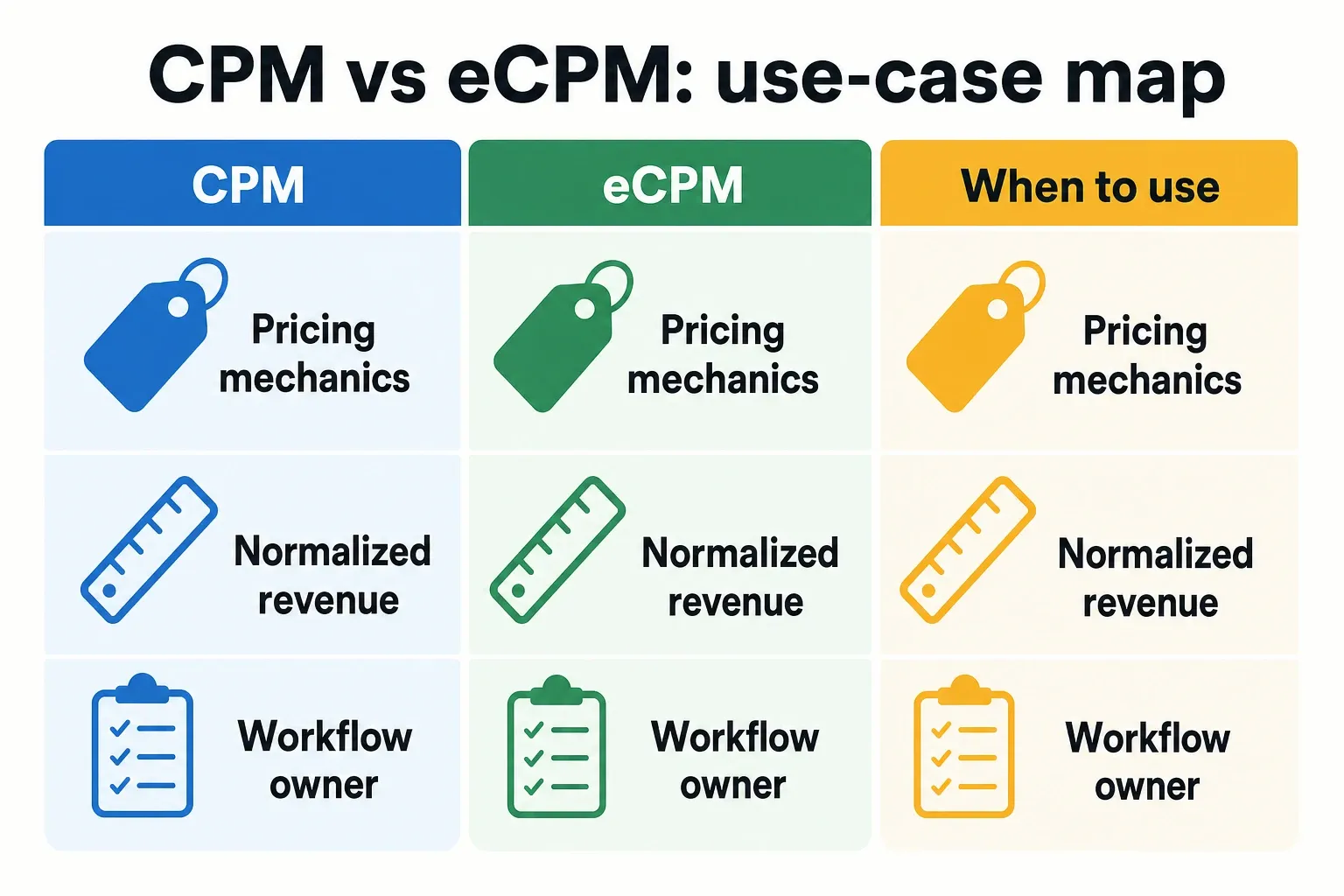
CPM and eCPM should not share the same job. Use CPM for pricing, buying mechanics, floor configuration, and buyer-facing negotiation. Use eCPM for normalized publisher revenue analysis. Then layer in fill rate, total revenue, impression volume, latency, and net payout, because those are the fields that decide whether the change is profitable.
| Metric or context | Owner of the metric | Primary purpose | Formula or reporting context | Where it belongs in the workflow | Most common interpretation mistake |
|---|---|---|---|---|---|
| CPM, cost per mille | Buyer, sales team, or deal owner | Set or communicate the price of 1,000 impressions. | Advertiser cost ÷ impressions × 1,000; Mediavine gives the example of a US$2.25 CPM meaning US$2.25 for 1,000 impressions Mediavine. | Direct deal pricing, PMP setup, sponsorship proposals, floor discussions, buyer conversations. | Assuming a high booked CPM means high publisher revenue after delivery constraints and competing demand. |
| eCPM, effective cost per mille | Publisher, app owner, or yield team | Normalize earned revenue to 1,000 impressions for comparison. | Publisher revenue ÷ impressions × 1,000; AppsFlyer uses this publisher/app-owner framing for in-app inventory AppsFlyer. | Ad unit analysis, format comparison, partner review, revenue trend monitoring. | Treating eCPM as if it explains fill, volume, latency, or user impact without supporting metrics. |
| Advertiser CPM in a buying model | Advertiser or DSP-side campaign manager | Control media cost and buying efficiency. | Freestar notes CPM applies to cost per thousand impressions in a CPM buying model Freestar. | Rate cards, insertion orders, DSP bidding, guaranteed and non-guaranteed deal terms. | Comparing buyer CPM directly with publisher payout without accounting for platform fees, revenue share, or auction mechanics. |
| Publisher eCPM in yield reporting | Publisher revenue operations | Compare revenue performance across uneven impression volumes. | MonetizeMore describes eCPM as publisher earnings per 1,000 impressions MonetizeMore. | Google Ad Manager reporting, AdX review, header bidding analytics, weekly yield meetings. | Optimizing only toward the highest eCPM source instead of the source that lifts total revenue on the same inventory. |
| CPM in deal or floor strategy | Publisher sales, ad ops, and programmatic lead | Set price gates before impressions are sold or auctioned. | CPM is a pricing input; Camphouse separates that advertiser cost role from publisher eCPM measurement Camphouse. | Unified pricing rules, private auctions, preferred deals, direct-sold packages. | Raising floors because filled-impression eCPM improved while ignoring lost fill and total revenue. |
| Blended eCPM across sources | Publisher executive reporting or revenue lead | Summarize monetization across AdX, header bidding, direct, and other demand. | Revenue from selected sources ÷ selected impressions × 1,000; the formula is stable, but the source inclusion rules define the metric. | Monthly business review, property-level comparison, format-level investment decisions. | Using a blended number to diagnose a specific partner, placement, or line item problem. |
The working rule is simple: use CPM when you are setting price, negotiating value, or configuring a floor; use eCPM when you are judging realized revenue. If you are talking to a buyer, CPM is usually the cleaner language. If the discussion is inside ad ops, eCPM is the starting point, then fill, volume, and net payout drive the action.
Checklist before you act on CPM or eCPM
A CPM or eCPM number becomes actionable only after you verify the reporting basis behind it. Before you move a floor, pause a header bidding partner, rewrite a direct package, or call a yield test, check the report source, date range, time zone, currency, revenue basis, impression metric, ad unit scope, device mix, and whether invalid-traffic adjustments are reflected.
- Confirm whether the number is CPM, gross eCPM, net eCPM, booked CPM, delivered CPM, or blended eCPM.
- Use the same time zone, date range, currency, and impression definition across Google Ad Manager, AdX, SSP, and wrapper reports.
- Separate display, instream video, outstream video, app rewarded, and refreshed inventory before comparing performance.
- Check fill rate, unfilled impressions, bid density, win rate, timeout rate, and revenue volatility next to eCPM.
- Do not compare a direct-sold CPM with auction eCPM unless the question is total inventory monetization.
- Measure floor changes on total revenue and eligible impressions, not filled-impression eCPM alone.
- Reconcile source dashboards back to GAM before making partner-level decisions.
- Use CPM for pricing conversations; use eCPM for realized yield analysis; use net revenue when the decision affects cash.
Frequently asked questions
Is eCPM the same as CPM?
No. CPM is the advertiser’s price for 1,000 impressions; eCPM is the publisher’s revenue normalized to 1,000 impressions. A US$12 CPM line item tells you the deal-side rate. A US$12 eCPM in GAM or an SSP report tells you what the counted impressions returned under that report’s rules after delivery, fill, deductions, and revenue share.
Why do publishers care more about eCPM than CPM?
Because eCPM lets you compare ad units, demand sources, and formats on the same revenue basis, even when fill and volume differ. CPM matters in setup and negotiation, but eCPM tells you whether a placement, demand path, or format is monetizing well enough to keep in rotation, cap, troubleshoot, or deprioritize.
How do you calculate eCPM?
Divide revenue by impressions and multiply by 1,000. If a placement earned US$540 on 90,000 impressions, the eCPM is US$6.00. The key is consistency: use the same revenue basis and the same impression count for every comparison, or the number stops being useful.
Can a higher CPM line item still produce lower revenue?
Yes. A higher CPM only helps if enough impressions clear and the line item does not block better demand behind it. If fill is weak, targeting is narrow, the floor rejects too many bids, or the format loses to competing demand in GAM, realized revenue can trail a lower-CPM source quickly.
Should I optimize for the highest eCPM only?
No. High eCPM with weak scale or unstable fill can leave total revenue on the table, especially if it crowds out a more reliable demand path. Treat eCPM as the comparison metric, not the final verdict: confirm total revenue, fill, net payout, GAM delivery, AdX competition, header bidding pressure, and user experience before you change priority or pricing.
How we researched this
Sources consulted for this article: