

Demand Partner Diversification: How Many SSPs Is Too Many
Too many SSPs is the point where the next bidder cannot prove marginal demand after latency, bid overlap, discrepancies, and ad ops time. Prebid.js ships with a 3,000 ms default bidder timeout, so every added adapter is competing inside a finite auction window Prebid timeout guidance.
Key takeaways
- Count SSPs by incremental revenue, not by how busy the wrapper looks.
- If a partner mostly duplicates existing buyers, it needs a stronger case to stay.
- Too many demand partners can raise latency, reporting noise, and management overhead.
- Test new SSPs in a way that isolates lift from auction contamination.
- Prune partners that do not improve net yield on a specific segment or format.
What demand partner diversification should actually do for revenue
Demand partner diversification should raise net auction pressure, not inflate the wrapper. A useful SSP does one of four jobs: reaches buyers your stack misses, strengthens pricing on a specific format, protects a weak geo or device segment, or supports deal paths you cannot run cleanly through AdX, Amazon Publisher Services, or existing open-web partners.
The work is more precise than adding logos. You are looking for unique demand contribution: buyers, deal IDs, formats, or geos your current setup does not cover well. If Magnite, PubMatic, OpenX, and Index Exchange are all bidding on the same U.S. display impressions from the same agency demand, the fourth partner may still matter, but bid volume alone will overstate its value.
Where the ceiling starts to show
Every additional partner creates auction friction. In client-side header bidding, one more adapter means one more network request competing inside the same timeout window. Server-side paths can reduce browser work, but they add their own checks: user matching, endpoint mapping, deal troubleshooting, floor alignment, discrepancy review, and cleaner reporting back to the wrapper.
The ceiling is property-specific. A U.S. news homepage with heavy desktop traffic and multiple above-the-fold units can usually tolerate a broader SSP set than a mobile-heavy article template with short sessions and tight viewability requirements. The same partner can be worth keeping on video, weak on 300x250 display, and harmful on a slow mobile template.
This guide is about partner count and portfolio quality. It does not replace Google Ad Manager line item hygiene, unified pricing rules, refresh policy, or floor testing. Those settings can hide partner problems. They cannot answer the core question: did this SSP add incremental demand after its cost to the auction was counted?
Signs you have too few or too many demand partners
A stack is under-diversified when coverage gaps show up in bid density, deal access, or format-specific competition. It is overextended when added partners increase calls, timeouts, and reconciliation work without changing who wins or what clears. Review the same signals by property, ad unit, device, geo, and format; account-level averages hide bad partners.
- Too few partners: low bid density on important ad units, weak competition outside core U.S. desktop inventory, thin demand for video or native, and revenue dependency on one path such as AdX or a single exchange account.
- Too few partners: strong fill but weak price pressure on high-value inventory, especially when Google Ad Manager reporting shows one demand source winning too often in the same sections, sizes, or devices.
- Too many partners: rising timeout rates, slower auctions, more no-bid clutter, and partners that only appear competitive because they bid frequently on inventory already covered by Magnite, PubMatic, OpenX, Index Exchange, or AdX.
- Too many partners: reporting meetings become archaeology. If your team cannot explain why a partner is in the wrapper, which inventory it is supposed to improve, and what would trigger removal, that partner is no longer being actively managed.
- Watch in practice: bid rate, win rate, timeout rate, revenue per thousand ad requests, unique bidder reach, and whether enabling a partner changes net revenue after latency instead of only adding more bids to the auction log.
- Watch by segment: a partner that looks mediocre sitewide may be carrying a specific app section, AMP template, video player, or Safari audience. Rollups are useful for finance; they are dangerous for pruning decisions.
How to evaluate SSPs by unique demand contribution
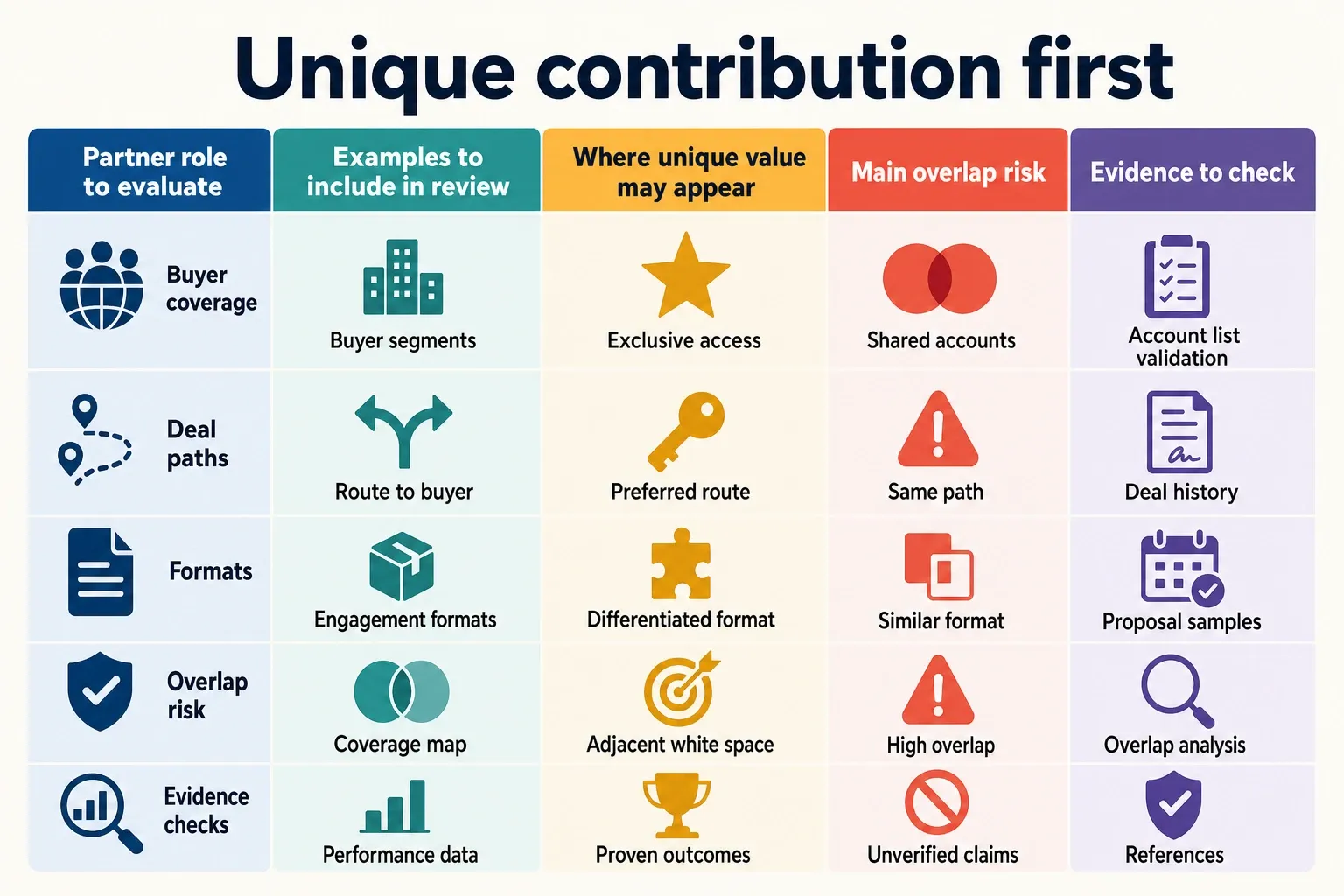
Evaluate SSPs by marginal value because bid volume rewards duplication. Track bid rate as responses divided by eligible auction requests, win rate as wins divided by bids, timeout rate as timed-out calls divided by bidder calls, and revenue per thousand ad requests. Then ask whether the partner improves a segment your current stack was not already covering.
| Partner role to evaluate | Examples to include in review | Where unique value may appear | Main overlap risk | Evidence to check |
|---|---|---|---|---|
| Core open-web exchange coverage | Magnite, PubMatic, OpenX, Index Exchange | Broad display and video demand, agency access, private marketplace paths | Same buyers chasing the same U.S. display impressions through multiple pipes | Prebid adapter capabilities and media-type support in the Prebid bidder catalog |
| Platform or marketplace access | Amazon Publisher Services plus AdX in Google Ad Manager | Demand paths that may not behave like a standard client-side bidder, especially where marketplace participation differs | Treating a platform path as incremental when it is only reshuffling wins from existing demand | APS product scope in Amazon Publisher Services and AdX reporting in GAM |
| Format-specialist demand | TripleLift, Criteo, Equativ | Native, commerce-linked, video, or curated demand that is stronger on selected inventory than across the whole site | Forcing a specialist into every display slot because it performs on one premium placement | Format and product positioning from TripleLift, Criteo, and Equativ |
| Portfolio-specific or direct-seat demand | Existing SSP with dedicated deals, buyer packages, or curation support | Incremental spend tied to your audience, section, or sales package rather than generic open auction demand | Counting deal setup as diversification when the same buyer already has cheaper access elsewhere | Deal IDs, buyer seats, win logs, and GAM revenue by demand channel |
| Low-volume candidate partner | Any new SSP under test | Coverage of a specific gap: mobile web, Safari, international traffic, native, video, or a single property | Low bid volume mistaken for failure before the intended segment is isolated | Segmented test data, not sitewide averages |
Use this as a screening grid, not a logo ranking. Keep a partner that owns a defensible segment, such as U.S. desktop display, mobile web native, video, or a named deal path. Test a partner that has plausible demand but unclear incrementality. Monitor a partner with small value and low cost. Prune a partner with overlap, timeout drag, and recurring ad ops work.
The beginner mistake is chasing bid count because it is visible in wrapper analytics. Incrementality takes more work. Compare what changed after the partner entered the auction: which buyers appeared, which ad units improved, which winner mix shifted, and whether GAM reporting can actually separate the impact through configured key-values and report dimensions Google Ad Manager key-value guidance.
How to test new demand partners without contaminating the stack
A clean SSP test starts with a fixed baseline and a narrow traffic slice. Pick one property, one device class, and a small set of ad units, such as mobile article 300x250s or desktop leaderboard inventory. Hold floors, layouts, consent settings, and refresh behavior steady. Run long enough to include normal weekday and weekend traffic patterns.
- Set the baseline before launch. Pull at least the same metrics you will use after launch: revenue per thousand ad requests, bid rate, win rate, timeout rate, average auction duration if available, unfilled impressions, and GAM revenue by ad unit. Lock the comparison window and note any planned site releases or traffic events.
- Define the success metric in advance. For a display SSP, you may care about net revenue lift on specific units. For a native or video specialist, you may accept lower coverage if the partner improves premium placements. For a new demand path competing with AdX, require evidence that clearing price or fill changed, not just that the partner submitted bids.
- Limit exposure by a clean segment. Use one property, a defined ad unit group, a geo, a device class, or a traffic percentage. Avoid mixing desktop homepage, mobile article pages, and video inventory in one first read. The goal is not a perfect lab test; it is enough separation to prevent the result from being swallowed by portfolio noise.
- Keep the timeout discipline unchanged. Do not give a new adapter a special window unless the test is specifically about timeout settings. If every incumbent has to compete inside the normal Prebid.js auction budget, the candidate should face the same constraint or the comparison becomes biased.
- Check buyer and seat overlap, not only SSP totals. Ask for buyer-level or deal-level context where the partner can provide it, and compare winners against existing SSPs. If the same demand already reaches you through OpenX, PubMatic, Index Exchange, Magnite, or AdX at similar prices, the new partner needs a stronger reason to stay.
- Run long enough to observe a normal traffic mix. A test that only covers one weekend, one homepage takeover, or one news spike can overstate the value of a partner. Expand only after the gain persists across the inventory the partner was meant to improve.
- Decide the next action immediately after the readout. Expand if the partner adds measurable net value in the target segment. Tune if the value exists but timeout or mapping issues are suppressing it. Stop if the result is duplicate demand, operational drag, or no defensible lift.
A practical pruning framework for underperforming partners
Use a control group. If the new SSP runs on every article page, you have no clean read. A better setup is to test on one comparable template or traffic cohort while leaving another unchanged. Before launch, write the keep rule: the partner must improve revenue per thousand ad requests or protect a defined deal path without pushing timeout rate outside the baseline range for that template.
Separate weak performance from weak placement
Start pruning when a partner shows low unique contribution, steady timeout drag, poor inventory fit, or too much support work. The safest cut is not automatically the lowest-revenue partner. It is the partner whose removal is least likely to reduce clearing pressure in a segment that matters, based on a staged disablement rather than a dashboard sort.
Do not judge an SSP only at the account level. A partner can be useful on a video-heavy property, irrelevant on a text-heavy site, and harmful on mobile pages where the auction already has little slack. Portfolio publishers should review partners by property, template family, device type, and format before making a global removal decision.
Cut in stages and watch for regression
Format fit is where named partners should earn their place. TripleLift’s publisher materials emphasize native, online video, and connected TV placements TripleLift publisher solutions. Criteo positions its publisher monetization around commerce media demand Criteo publisher monetization. Equativ, Magnite, PubMatic, OpenX, and Index Exchange may each perform in different pockets, but your deal setup and inventory packaging decide whether that product positioning matters.
A staged removal is safer than a dramatic wrapper cleanup. Disable the partner where it is weakest first: one property, one device class, or one format. Compare revenue per thousand ad requests, fill, timeout rate, bid density, and winner mix against the baseline. If nothing degrades beyond normal variance, expand the removal. If one ad unit regresses, you found the partner’s real use case.
After removal, check whether another SSP picked up the wins, whether AdX gained share, and whether page performance improved enough to matter. GAM will show delivery through the dimensions and key-values you configured, not a perfect explanation of wrapper-level causality Google Ad Manager reporting guidance. The best pruning decision often looks uneventful: gross bids fall, net revenue holds, timeout pressure improves, and the team has fewer exceptions to manage.
A simple decision matrix for your next SSP review
Operational burden belongs in the decision, not in a footnote. A partner that needs constant ad unit mapping fixes, recurring discrepancy investigations, special floor exceptions, or deal troubleshooting can consume more ad ops time than its marginal revenue supports. That time has a cost, especially across multiple properties, Q4 floor changes, and annual contract reviews.
| Review criterion | Keep | Test | Monitor | Prune |
|---|---|---|---|---|
| Unique Demand Contribution | Partner reaches buyers, deal paths, or formats not already covered by AdX, APS, or core SSPs | Potential value exists, but buyer overlap is unproven in the target segment | Some incremental wins appear, but they are inconsistent or seasonal | Bids duplicate existing demand and do not change clearing price or fill |
| Latency Cost | Timeout impact is acceptable inside your normal Prebid.js auction settings | Latency is unknown because the partner has not been isolated cleanly | Timeout rate is creeping up, but revenue impact is not yet clear | Persistent timeout drag outweighs any visible revenue contribution |
| Inventory Fit | Partner performs on the property, device, format, or ad unit it was added to improve | Partner may fit a gap such as mobile web, video, native, Safari, or international traffic | Partner works on one segment but is over-deployed elsewhere | Partner is broadly enabled but lacks a defensible use case |
| Operational Burden | Setup, reporting, discrepancies, and deal support are manageable | Workload is acceptable during a limited trial | Partner requires recurring attention that should be justified by segment value | Mapping issues, reporting noise, or support load consume too much ad ops capacity |
| Removal Risk | Cutting the partner would likely reduce competition in a valuable segment | Risk is unknown, so removal should be tested in a controlled slice | Risk is limited to a few placements that can be protected | Other SSPs or AdX can absorb demand with little expected regression |
| Decision rule | Keep and review on a normal quarterly or seasonal cadence | Test with controlled exposure and a written success metric | Monitor with a deadline and a specific metric that must improve | Prune in stages and watch revenue, fill, timeout, and bid density |
Use a five-part scorecard for every SSP: Unique Demand Contribution, Latency Cost, Inventory Fit, Operational Burden, and Removal Risk. Keep requires a named segment and a metric it protects. Test requires a hypothesis and a control group. Monitor means small value with low cost. Prune means overlap plus measurable drag or support work.
Use the scorecard in the meeting where renewals, wrapper changes, and roadmap asks compete for attention. Put every SSP into one action bucket. If the team cannot name the partner’s unique demand role, the inventory segment it protects, and the metric that would justify expansion, it should not sit in keep by default.
Frequently asked questions
How many SSPs is too many?
You still need context-specific calls. Set the partner ceiling by property using timeout pressure and incremental revenue, not a universal number. Add specialists only where they close a defined gap. Assign an owner for every partner, because an SSP nobody checks for mapping, floors, deal health, and discrepancies is already drifting toward removal.
What matters more than SSP count?
FAQ: How many SSPs is too many? There is no universal count. You have too many when the next SSP adds more latency, overlap, and maintenance than net revenue. Prebid.js uses a 3,000 ms default bidder timeout, which is the practical reminder: every added bidder has limited time to help before it starts hurting the auction Prebid timeout guidance.
Should every property use the same demand partners?
FAQ: Is a smaller SSP stack usually better? Smaller is better only when it keeps the unique demand. A focused group that brings distinct buyers, formats, geos, or deal paths usually beats a larger stack full of overlap. If the partner mostly bids on the same impressions as AdX, Amazon Publisher Services, or existing SSPs, the extra call rarely changes the clearing outcome.
How do I know if a new SSP is working?
FAQ: Should every property use the same SSP list? No. Inventory mix should drive the stack, not a one-size-fits-all partner list. A desktop-heavy homepage can support a wider set of SSPs than a mobile-heavy property with short sessions. The same partner may help on video while slowing a latency-sensitive display template.
When should I remove an SSP?
FAQ: How do you prove an SSP is incremental? Measure it against a baseline and look for net revenue lift after timeout and latency effects, not just more bids. The partner should change who wins, where it wins, or what price pressure you get in a previously weak segment. If it only adds auction log noise, it is not doing enough.