

Client-Side vs. Server-Side Header Bidding: Which One Fits Your Stack
The wrong question is whether client-side or server-side header bidding is “better.” What actually matters is your bidder fan-out, page-speed budget, identity dependence, and ops capacity. Client-side usually gives you more transparency and better cookie access. Server-side takes pressure off the browser. Hybrid works when you need both, assuming your team can keep the split clean.
Key takeaways
- Client-side bidding usually wins on visibility and browser-level identity access.
- Server-side bidding can reduce browser strain, but it shifts complexity into your backend and reporting.
- The right choice depends on bidder count, page-speed budget, and how much ops support you actually have.
- Hybrid setups make sense when you need browser access for some demand and server-side scale for the rest.
- If you can’t monitor match rates, timeout loss, and GAM health cleanly, the architecture choice won’t save you.
How client-side and server-side bidding actually work
Client-side bidding keeps the auction work in the user’s browser. Server-side bidding moves most of the bid-request fan-out to an external server, then passes winning bids into Google Ad Manager. That one architecture change affects latency, match quality, debugging, and who gets stuck untangling the mess when something breaks.
Client-side flow: the browser does the heavy lifting
In a client-side setup, the wrapper loads on the page, reads the ad units, calls demand partners directly, waits for responses, and pushes key-values into Google Ad Manager. From there, GAM runs decisioning, with AdX competing against header bidding demand based on your line items and pricing setup.
You can see the tradeoff right in the browser. AdExchanger describes client-side auctions as using the end user’s browser memory to run auction processes, including bid requests from the publisher site to SSPs. The more memory the auction uses, the more likely the page is to load slowly AdExchanger.
That starts to matter once your wrapper is no longer lean. A page with six bidders, a short timeout, and tightly scoped ad units is one thing. A page with 18 bidders, multiple refresh slots, consent checks, identity modules, analytics adapters, and late-loading content units fighting for main-thread time is a very different machine.
Server-side flow: the browser calls one layer, the server fans out
In a server-side setup, the browser usually makes fewer calls into a server-side layer, and that layer fans out bid requests to demand partners. AdPushup explains the difference clearly: server-side header bidding moves ad requests to a central server instead of the user’s browser AdPushup.
Prebid Server is the common open-source reference point here. Your page still runs wrapper code, but bidder logic, partner adapters, timeout handling, and request routing move away from the front end. That can ease browser strain. It also gives you another system to configure, monitor, and reconcile against bidder and GAM reporting.
The GAM and AdX handoff still has to work. Header bidding still needs to return bids in time for ad server decisioning, and your GAM setup still needs clean key-values, line items or pricing rules, and disciplined reporting. Moving the auction server-side changes the route to GAM. It does not clean up sloppy ad server hygiene for you.
Latency, page speed, and auction performance
Server-side header bidding usually reduces browser pressure, but latency does not disappear. Part of the auction cost moves from page execution to server processing and network routing. So the real comparison is not “fast versus slow.” It is where the delay happens, and whether that delay blocks rendering, bidding, or ad server timing.
| Performance factor | Client-side header bidding | Server-side header bidding | Operational read |
|---|---|---|---|
| Browser work | Higher, because the wrapper sends bidder calls and handles responses in the browser | Lower, because the browser calls a server-side layer that fans out requests | Client-side gets painful as bidder count and wrapper modules grow |
| Network path | Browser-to-SSP calls multiply as partners are added | Browser-to-server call is simpler, but server-to-SSP calls still happen | Server-side reduces visible page fan-out, not total auction work |
| Render impact | Can compete with page scripts, viewability vendors, consent tools, and analytics | Can improve front-end timing if the server layer is close, stable, and well tuned | Server-side helps most when front-end execution is the bottleneck |
| Timeout behavior | Timeouts are easier to observe in browser tools, but slow bidders can still crowd the auction window | Timeouts depend on server configuration, partner endpoints, and routing | Do not migrate without measuring bidder response timing before and after |
| Hybrid trap | Some bidders remain on-page while others move off-page | Two paths can create duplicate complexity if rules diverge | Hybrid only works when each bidder has a clear reason to live in one path |
The common client-side failure mode is simple: partner additions outgrow the page budget. One more SSP can look harmless in a revenue test, but each added adapter may increase request fan-out, response handling, logging, and timeout pressure. Turn the wrapper into a dumping ground for every demand experiment, and performance eventually gets the invoice.
The common server-side failure mode is assuming a cleaner browser trace means the auction is clean. It doesn’t. You can still lose bids to server processing delays, partner endpoint latency, consent-string handling, or misconfigured timeouts. The page may look lighter while auction pressure moves into a layer Chrome DevTools alone cannot inspect.
Blockthrough frames client-side and server-side as different integration types, not as a universal upgrade path. That is the better lens for revenue work Blockthrough. Performance gains only help if the demand you keep is still competitive and the new path is observable enough to troubleshoot.
Cookie matching, match rates, and demand quality
Client-side bidding generally gives demand partners a cleaner browser-level identity path. Server-side bidding can weaken cookie access because another server sits between the browser and the auction. That identity tradeoff can show up as lower match quality, fewer addressable bids, or softer CPMs for partners that still lean heavily on browser cookies.
| Identity factor | Client-side header bidding | Server-side header bidding | What to watch in reporting |
|---|---|---|---|
| Cookie access | SSPs can interact directly with the browser environment | Partners may rely on server-mediated IDs or sync paths | Bid rate and CPM by bidder after migration |
| Cookie syncing | Usually simpler because partners can access cookies more directly | Can be harder because identity has to pass through the server-side layer | Match-rate changes where partners provide that data |
| Bid density | Often stronger for cookie-dependent demand paths | Can decline for partners that lose usable identity signals | Number of bidders returning non-zero bids per ad unit |
| Demand quality | More transparent path for browser-based recognition | Cleaner page performance may come with weaker addressability | Net revenue, not just page-speed improvement |
| Best fit | Sites with valuable cookie-based demand and manageable bidder lists | Sites where browser performance constraints outweigh some identity loss | Partner-by-partner tests instead of a blanket migration |
Pubstack states the identity issue plainly: client-side has an advantage because demand partners can access cookies more easily, which simplifies synchronization, while server-side creates a mediated path Pubstack. For publishers with meaningful AdX and open-market volume, that is not a small detail. It can change bid density.
This is where a server-side migration can look great in a page-speed report and weak in yield reporting. If Criteo, PubMatic, or another SSP loses match quality on a valuable audience segment, the faster auction may not make up for weaker competition. Server-side is not the problem. Moving identity-sensitive demand without partner-level readouts is.
Client-side identity access matters most when revenue is concentrated in repeat users, logged-out but recognizable audiences, or ad units where third-party demand competes closely with AdX. Server-side performance matters more when pages are script-heavy, mobile traffic is sensitive to render delay, or the bidder list has grown past what the browser should carry.
Implementation complexity and ongoing maintenance
Client-side setup is usually easier to inspect. Server-side setup moves complexity into configuration, infrastructure, partner enablement, and reporting reconciliation. The build is only the first cost. The real ongoing burden is keeping bidder rules, timeouts, floors, identity modules, and GAM mappings aligned as the stack changes.
- Wrapper configuration: Client-side wrappers keep more logic on the page, so ad ops and front-end teams can usually see which adapters fire, which parameters are passed, and where the auction stalls. Server-side setups centralize more logic in Prebid Server or a managed equivalent, which is cleaner for the browser but less obvious for anyone troubleshooting from the page alone.
- Debugging visibility: Client-side problems often show up in browser network logs, console output, and wrapper analytics. Server-side problems require access to server logs, adapter status, request payloads, and partner-side diagnostics. If your team depends entirely on browser inspection, server-side will feel like the lights were dimmed.
- Partner onboarding: Adding an SSP client-side can be as simple as adding an adapter, parameters, and GAM mapping, assuming your governance is tight. Server-side onboarding may require adapter support, endpoint configuration, identity sync review, consent handling, and a partner test plan before traffic is meaningful.
- Prebid Server ownership: Prebid Server can move effort from front-end release cycles into infrastructure and partner management. That is a good trade for publishers with engineering support, monitoring, and release discipline. It is a bad trade if nobody owns uptime, versioning, and adapter changes.
- Hybrid maintenance: Hybrid stacks create two operating paths. If floor rules, bidder eligibility, timeouts, or ad unit naming diverge without documentation, your reporting becomes a debate instead of a diagnostic tool. PubMatic’s wrapper guidance treats client-side, server-side, and hybrid as distinct wrapper approaches, and the hybrid option deserves extra governance PubMatic.
- Hidden cost: The hardest part is not getting the first auction to run. It is keeping the setup clean after six months of bidder tests, consent updates, price-floor changes, page template changes, and GAM trafficking edits. Architecture multiplies maintenance when ownership is vague.
Which setup fits your traffic profile and tech resources
Client-side fits stacks that need transparency and strong browser-level demand access. Server-side fits stacks where browser pressure is the bottleneck. Hybrid fits mature teams that can assign bidders by role instead of preference. Your traffic profile should make that call before vendor promises or internal architecture opinions do.
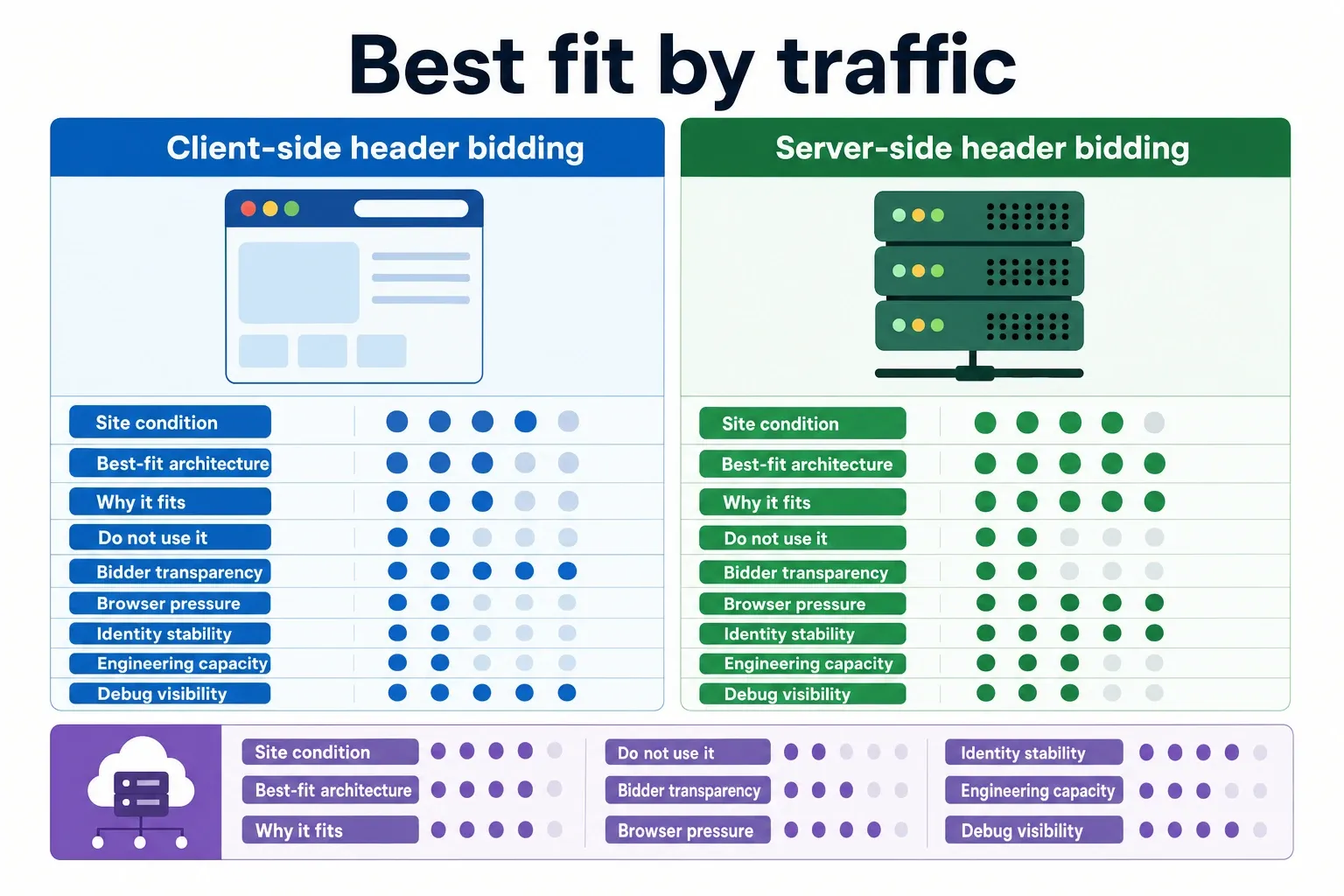
| Site condition | Best-fit architecture | Why it fits | Do not use it if |
|---|---|---|---|
| Moderate bidder count, clean page templates, limited engineering support | Client-side | You keep direct visibility, simpler partner debugging, and stronger cookie access | The wrapper is already hurting page timing or mobile UX |
| Large properties with heavy bidder lists and strict speed targets | Server-side or hybrid | You reduce browser fan-out and move repeatable auction work off the page | Your team cannot monitor the server layer or reconcile partner reporting |
| High dependence on cookie-based open-market demand | Client-side or selective hybrid | Browser-level identity access may protect bid quality for key SSPs | You are migrating all demand server-side without partner-level match and CPM checks |
| Multiple properties with different templates and performance constraints | Hybrid | You can keep identity-sensitive bidders client-side and move lower-risk demand server-side | You lack naming standards, bidder governance, or a single owner for GAM mappings |
| Lean ad ops team with scarce engineering bandwidth | Client-side, kept disciplined | Fewer infrastructure dependencies and easier page-level inspection | The bidder list keeps growing without performance budgets |
| Advanced stack with wrapper analytics, server monitoring, and release process | Server-side or hybrid | You can manage the added layer and test bidder placement intentionally | The migration is being used to avoid cleaning up old wrapper and GAM problems |
For a mid-to-large U.S. publisher, the decision often starts with bidder count and page sensitivity. A news article page with recirculation modules, video, consent tooling, and multiple measurement tags has less room for browser-heavy bidding than a lighter reference page with fewer third-party scripts. The same auction architecture can behave very differently across properties.
Engineering bandwidth is the constraint planning decks tend to underplay. Server-side looks clean because it reduces page noise, but someone still has to own adapter updates, deployment controls, logging, partner tests, and data discrepancies. If that owner is missing, a disciplined client-side cleanup may be safer than a migration.
The practical tradeoff is match quality versus front-end overhead. If your revenue team cannot afford to lose addressability for specific SSPs, keep those paths client-side until testing proves otherwise. If the page cannot carry the current auction without hurting render timing, offload the least identity-sensitive demand first and measure the revenue delta by bidder, ad unit, device, and property.
A practical selection checklist for your stack
A useful architecture decision scores five stack-fit criteria: bidder fan-out, browser performance sensitivity, identity dependence, engineering capacity, and troubleshooting tolerance. Put that checklist in the planning doc before migration, not after revenue shifts and nobody can agree whether latency, cookies, or configuration caused it.
Stack-fit checklist
- Bidder Fan-Out: Count active bidders by page type, not just in the wrapper repository. If the same template regularly calls a long list of SSPs across display, video, refresh, and sticky units, server-side or hybrid deserves a test. If the list is short and curated, client-side may be the cleaner operating model.
- Browser Performance Sensitivity: Flag templates where ad scripts compete with heavy editorial modules, video players, commerce widgets, or measurement tags. If render timing is already fragile, reduce browser work before adding demand. If the page has room and revenue depends on direct bidder access, avoid moving demand only for architectural neatness.
- Identity Dependence: Identify which partners rely on browser-level recognition and which bidders perform acceptably with server-side identity paths. If cookie-based demand drives meaningful CPM pressure against AdX, move selectively. A blanket migration is risky unless partner reporting confirms match quality holds.
- Engineering Capacity: Name the team that will own Prebid Server configuration, monitoring, release changes, and incident response. If the answer is “ad ops will figure it out,” stay client-side or use a managed path with clear service responsibilities. Server-side without ownership becomes a black box during revenue drops.
- Troubleshooting Tolerance: Decide how much opacity your team can handle. Client-side lets you inspect more from the browser; server-side requires comfort with logs, request IDs, adapter behavior, and partner escalation. If your organization needs fast bidder-level diagnosis, do not move critical demand off-page until observability is in place.
Decision rules to apply
- Stay client-side if bidder count is controlled, browser performance is acceptable, cookie-based demand is important, and your team values page-level debugging over infrastructure abstraction.
- Move server-side if browser workload is the constraint, bidder fan-out is high, your engineering or vendor support is real, and you can monitor auction health outside the browser.
- Run hybrid if some bidders need browser-level identity while others can be offloaded, and your team can maintain separate rules without corrupting GAM reporting or partner comparisons.
- Pause the architecture change if you cannot measure bidder response, bid rate, CPM, match quality where available, timeout behavior, and GAM delivery by path. Without instrumentation, client-side versus server-side becomes guesswork with a cleaner diagram.
- Treat declining match quality after migration as a red signal, not a temporary nuisance. If bid density or CPM softens for a key SSP, either adjust the identity setup, move that partner back client-side, or isolate the issue before expanding server-side traffic.
Pick the architecture your team can actually run under pressure. For most mature publishers, the winning setup is not pure ideology. Keep identity-sensitive, high-value demand where it performs. Offload browser-heavy or lower-risk demand where page speed needs relief. And do not expand hybrid until reporting, ownership, and GAM hygiene can prove what changed.
Frequently asked questions
Is server-side header bidding always faster than client-side?
No. Server-side usually cuts browser work, but you can still lose time to extra network hops, server processing, and partner endpoint latency. It may look lighter in DevTools while the auction delay simply moves off the page and into another layer you still have to monitor.
Does client-side header bidding get better match rates?
Usually yes. Client-side gives demand partners more direct browser-level cookie access, which makes identity matching and sync cleaner for partners that still rely on it. That can translate into stronger addressability and less friction in the bid request flow, especially for bidders sensitive to browser-side identity signals.
When does server-side header bidding make the most sense?
It usually fits larger sites with heavy bidder fan-out, tighter page-speed budgets, or limited tolerance for browser-side overhead. If your wrapper is crowded with SSP adapters, refresh slots, consent checks, and analytics, moving some of that load server-side can buy you breathing room without forcing you to cut demand.
Can you run a hybrid header bidding setup?
Yes. A hybrid setup is common when you need browser-side transparency and cookie access for some demand, but also want server-side offload for performance or scale. The key is keeping the split clean so you can debug latency, identity loss, and GAM reporting without guessing which path caused the problem.
How we researched this
Sources consulted for this article:
- AdExplainer: Client-Side vs. Server-Side Header Bidding: What’s The Difference? | AdExchanger
- Client-side vs. Server-side Header Bidding: What to Choose?
- Header Bidding Demystified: Client-Side vs. Server-Side | Criteo
- Header bidding integrations: Client vs. server-side, explained
- How to choose between Prebid server-side & client-side - Pubstack
- Header Bidding Wrappers: 6 Questions Publishers Need to Ask