

Bid Caching in Header Bidding: What It Is and When to Use It
PubMatic has a full “7 myths” post on bid caching for a reason: it changes what buyers believe they’re bidding on. In bid caching header bidding, an earlier bid gets stored and reused in a later auction, usually to cut latency or preserve demand. Use it only on repeatable inventory, where freshness, consent, and buyer expectations are under tight control.
Key takeaways
- Bid caching works best on repeatable inventory, not one-off pageviews with changing context.
- The main tradeoff is latency relief versus applying an older bid to a new impression.
- Infinite scroll and refresh-heavy placements are the clearest use cases, if the reuse window stays tight.
- A sloppy cache window can create stale bids, reporting noise, and buyer trust problems.
- Measure lift against freshness, win rate, and revenue per session, not just page speed.
What bid caching header bidding does at the auction level
Bid caching changes the auction state because a bid from one opportunity carries into a later one instead of making every eligible demand partner price the next impression from zero. What gets cached is usually a bid response tied to a user, placement context, price, and time window. It’s not some magic bucket of guaranteed revenue.
The normal flow is straightforward: your wrapper sends the bid request, bidders answer, Google Ad Manager gets the key-values, one ad wins, and the losing demand goes away unless something saves it. With caching, one or more losing bids can be held for a later eligible ad opportunity. OKO describes the pattern the same way: one bidder wins while other bids are saved and applied to a later request OKO.
Cached bid versus fresh auction
A fresh auction asks the market to price the exact opportunity available right now. A cached bid reuses a price from an earlier auction, within whatever rules the bidder, SSP, or wrapper allows. That gap matters. The second impression may have different scroll depth, viewability odds, consent status, page context, or competing demand.
Headerbidding.co presents bid caching as a speed tactic in ad tech, and that’s fair, but speed is only part of the call. The real tradeoff is latency relief versus demand freshness: you may cut auction work, but you may also be applying an old signal to a new impression Headerbidding.co.
Where the cached object can sit
The cached bid can sit bidder-side, wrapper-side, or in another implementation-specific store. Don’t let that turn into a broad client-side versus server-side architecture argument. The useful operational question is tighter: who controls the reuse rules, who records the reuse event, and who can show the bid was still eligible when it served?
That control point changes how you debug. If the wrapper decides reuse, ad ops can usually inspect timing, placement, and key-value behavior closer to the page. If the SSP or bidder handles it upstream, you need clean reporting fields and explicit commercial agreement language, because GAM will mostly show the resulting line-item competition, not the reasoning behind the cached state.
Where bid caching makes sense: infinite scroll and refresh-heavy placements
Bid caching is easiest to defend when the same user session creates repeated, similar ad opportunities in a short window. Infinite scroll, timed refresh, and high-latency repeat auctions are the practical candidates. One-and-done pageviews with volatile context usually don’t justify the extra auction-state complexity.
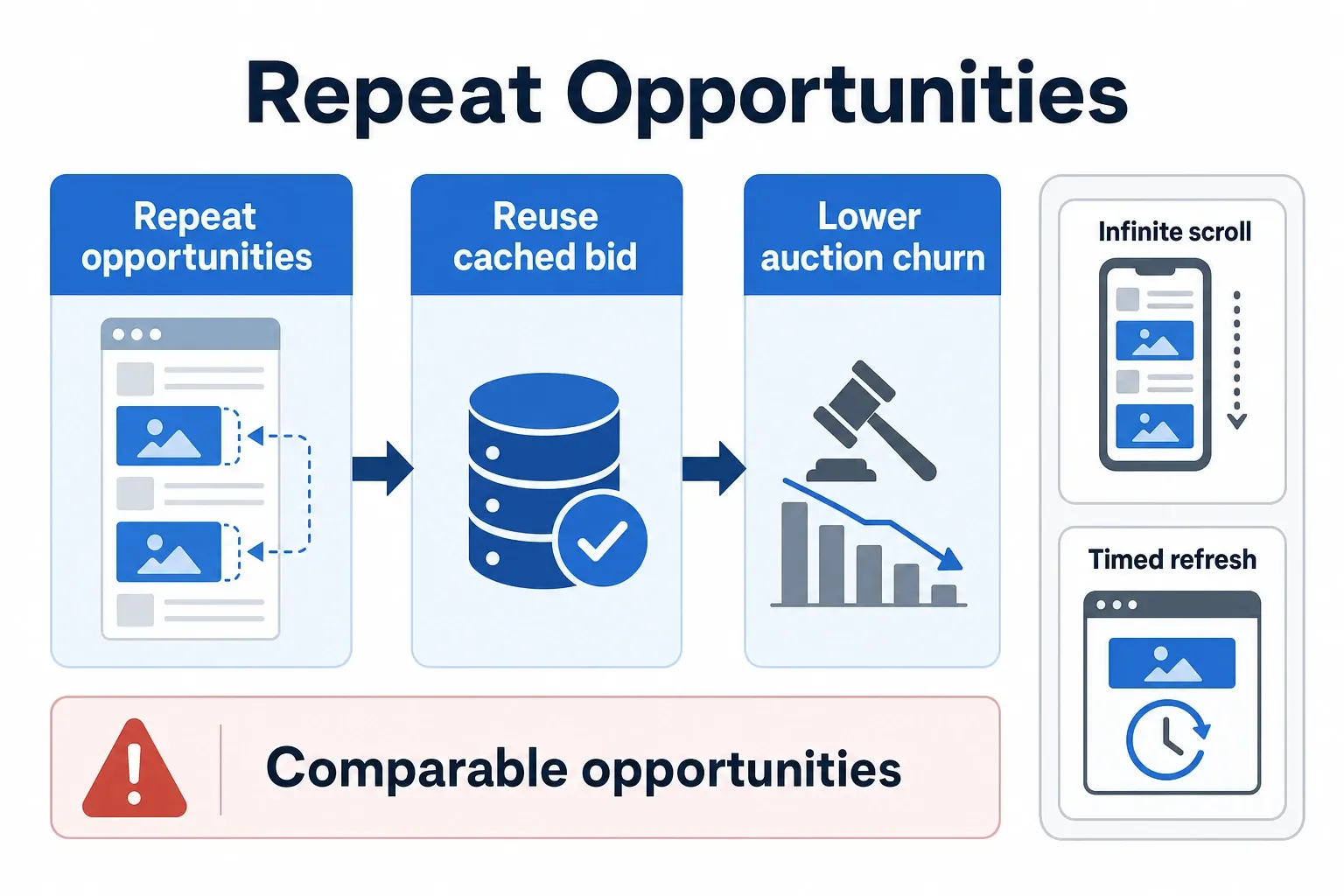
- Infinite scroll feeds: Use bid caching only where scroll depth creates multiple comparable opportunities in the same session. A feed page that loads another ad every few screenfuls gives you a plausible reuse case because the user, content environment, and session intent may remain close enough for a short cache window.
- Refresh-heavy placements: Consider it for auto-refresh units with stable timing, consistent viewability rules, and clean separation between refresh events. A 30-second refresh slot behaves differently from a lazy-loaded article slot; the refresh cadence should drive eligibility, not a sitewide default.
- High-latency pages: Test it where repeated auctions add visible delay or hurt interaction quality. Core Web Vitals will not tell you whether the bid was fair, but they can expose whether repeated auction work is contributing to page experience problems you need to reduce.
- Low-value reuse cases: Avoid caching on pages with only one meaningful ad opportunity per session. If the user lands, scans, and exits, there is no repeatability to harvest, so you take on stale-bid and audit risk without much operational upside.
- Volatile audience segments: Be careful on traffic where user state changes quickly, such as logged-in transitions, subscription walls, commerce-intent pages, or major content-category jumps. The later impression may not represent the opportunity the buyer priced.
- Strong direct-demand competition: Do not let cached programmatic bids interfere with sponsorships, roadblocks, or high-priority direct campaigns in GAM. If direct demand has strict placement or timing expectations, cached open-market pressure can make troubleshooting harder without improving yield quality.
AdPushup’s explanation focuses on a lost bid being used in a later auction, sometimes without the buyer expecting that reuse. That’s why the strongest publisher use case is narrow: repeated inventory that stays materially similar, not a blanket monetization shortcut across every ad unit AdPushup.
Choosing the right cache window for your inventory
The safer cache window is the shortest one that still covers the next legitimate repeat opportunity. Start with scroll depth, refresh cadence, and session length. Then let consent status, buyer expectations, and auction volatility override the setting when the risk profile changes.
| Cache window | Freshness risk | Operational fit | Inventory pattern | Override signals |
|---|---|---|---|---|
| Short | Lowest, because the bid is reused only near the original auction state. | Best default for cautious tests where you need proof before expansion. | Fast infinite scroll, near-term lazy loading, or short refresh intervals. | Use when CMP status may change, when page context shifts, or when buyers have strict placement expectations. LinkedIn’s critique of bid caching focuses on the gap between what buyers believe they bid on and where the bid is later applied LinkedIn. |
| Medium | Moderate, especially if the session remains on the same content type. | Useful when repeat opportunities are predictable and reporting can isolate reused demand. | Longer article sessions, feed consumption, or refresh placements with consistent timing. | Shorten if auction volatility is high or if GAM reporting shows cached bids competing differently by ad unit depth. |
| Long | Highest, because the later opportunity may no longer resemble the priced impression. | Only defensible with explicit partner rules, strong logging, and low context drift. | Narrow cases with long sessions and stable page state; not a sitewide setting. | Avoid when consent, audience status, content category, or buyer eligibility can change during the session. Medium’s data-processing discussion highlights why reuse raises control questions around how ad data is applied later Medium. |
The publisher decision framework
Use four named criteria before you allow bid caching header bidding on a placement. The goal is to approve a specific inventory behavior, not to give a vendor feature a global green light across the stack.
- Inventory repeatability: Confirm the same session produces multiple comparable ad opportunities. Infinite scroll and refresh units can qualify; isolated article pages usually do not.
- Freshness tolerance: Decide how much context drift the buyer can reasonably absorb. Same user and same page section are safer than a new page, new category, or new logged-in state.
- Cache horizon: Set the reuse window from the next expected opportunity, not from a revenue target. If the next eligible slot appears quickly, a short horizon wins even if a longer one produces more cached matches.
- Compliance sensitivity: Treat consent, data-processing purpose, and partner notice as hard gates. If your Consent Management Platform can change state mid-session, cached bids need suppression rules tied to that change.
A practical rule: shorten the cache window whenever the next impression is less predictable than the one before it. Give up some reuse early, before you create a reporting pattern that looks good in aggregate but can’t be defended at the buyer, consent, or placement level.
What can go wrong: stale bids, buyer trust, and compliance exposure
The main failure mode is simple: a valid bid gets used in an invalid context. Once a bid is reused against a different opportunity, your stack has to prove the price, user state, placement, and consent conditions were still eligible. Otherwise, a revenue lift can hide a demand-quality problem.
- Check for stale demand before looking at revenue lift. A cached bid can make a later auction look healthier while hiding the fact that the buyer priced a different moment. Compare reused-bid performance by placement depth, refresh count, and page type instead of only blended CPM.
- Define buyer expectations in commercial terms. PubMatic argues that bid caching is often misunderstood, which is exactly why publishers should not rely on assumptions. If an SSP or bidder allows caching, document whether reuse is disclosed, limited by time, and visible in reporting PubMatic.
- Put consent and data-processing gates ahead of yield rules. If the CMP records a consent change, do not carry a previously eligible bid into a later impression unless the implementation explicitly revalidates that state. IAB Tech Lab standards and Privacy Sandbox changes both push the market toward clearer signals; cached auction state should not become a workaround for weak signal handling.
- Separate cache ownership from campaign troubleshooting. Assign one owner for configuration, one owner for revenue QA, and one owner for privacy review. If everyone can enable a cache rule, no one can explain a buyer complaint three weeks later.
- Log the reuse event, not just the served impression. You need timestamp, original ad unit, later ad unit, bidder, price, consent state, and cache age. Without those fields, a cached bid is almost impossible to audit after it enters GAM competition.
- Create a review trigger. Revisit cache behavior after major layout changes, CMP updates, SSP changes, Privacy Sandbox-related identity tests, or a new refresh policy. A cache rule that was reasonable on the old feed can become reckless after the product team changes slot timing.
How to measure whether bid caching helped or hurt
Measure bid caching by session-level yield and demand quality, not a single CPM line. The feature can raise apparent competition while damaging buyer confidence, page behavior, or downstream fill. Your test needs placement segmentation and a holdout that isolates the inventory actually using cached bids.
- Track fill, match rate, revenue per session, and refresh-level CPM together. If CPM rises but match rate falls, you may be concentrating spend from fewer buyers rather than improving the auction.
- Separate first impression, lazy-loaded impression, and refreshed impression performance. Bid caching header bidding should prove its value on the repeat opportunity, not borrow credit from premium first-view inventory.
- Segment by device. Mobile infinite scroll has different timing pressure than desktop article pages, and latency relief may matter more on slower connections or heavier templates.
- Segment by session depth. A cached bid used on the second ad opportunity is not the same risk as a cached bid used after several scroll events, a category change, or multiple refreshes.
- Watch page-quality indicators alongside revenue. Core Web Vitals, ad render timing, viewability, and user engagement can reveal whether auction reduction helps the page or simply shifts the bottleneck elsewhere.
- Run a clean rollout test. Pick eligible placements, cap the cache window, hold back comparable traffic, and keep GAM price rules, refresh rules, and SSP partner settings stable during the test window.
- Read buyer response, not only publisher dashboards. If an exchange, agency, or direct programmatic buyer flags unexpected placement behavior, treat that as a measurement input. A short-term revenue gain that damages demand trust is not a win.
A rollout pattern that avoids false positives
Start with one repeatable placement family, like infinite scroll article bodies or a defined refresh unit group. Don’t mix homepage, article, gallery, and video-adjacent slots in the same first test. The average will bury the placement that actually changed the result.
Keep the first test boring. Use a conservative cache window, exclude consent-unstable sessions, and require logs that separate cached bids from fresh bids. If your only proof is a blended revenue dashboard, you haven’t measured bid caching. You’ve measured a stack change with unknown causes.
The decision is practical: use bid caching where repeat opportunities are predictable, the cache horizon is short, and the reuse event can be audited. Reject it when the next impression carries a different buyer meaning than the original bid.
- Verify the placement has repeatable inventory: infinite scroll depth, refresh cadence, or another clear second opportunity.
- Set the cache window from observed session behavior, then shorten it for volatile context, consent changes, or buyer restrictions.
- Confirm the CMP state is rechecked before reuse, not assumed from the original auction.
- Require logs for original auction, reused auction, bidder, price, cache age, ad unit, and consent state.
- Keep GAM rules stable during testing so price-floor or priority changes do not contaminate results.
- Measure revenue per session, fill, match rate, refresh-level CPM, page quality, and buyer feedback together.
- Roll out by placement family, not sitewide, and schedule a review after layout, SSP, CMP, or Privacy Sandbox-related changes.
Frequently asked questions
Does bid caching header bidding increase revenue?
It can, but only in the right inventory patterns. If the same bid can be reused on repeat opportunities and the cached window stays fresh enough, you may pick up incremental revenue and cut auction waste. On volatile inventory, the stale-bid risk usually outweighs the upside, so the gain is often small or negative.
Is bid caching the same as ad refresh?
No. Ad refresh creates a new impression opportunity; bid caching reuses a prior bid for a later one. They can complement each other on repeatable placements, especially in refresh-heavy setups, but they solve different problems and should be evaluated separately.
When should publishers avoid bid caching?
Avoid it on inventory where user state or demand changes quickly, such as subscription flows, commerce-intent pages, or major content shifts. It also makes little sense on pages with only one meaningful ad opportunity, or where direct-sold and sponsorship demand already performs cleanly without extra auction-state complexity.
How long should a bid cache last?
There is no universal number. The right duration depends on refresh cadence, session length, and how quickly the bid becomes stale for that placement. For fast-moving inventory, a short reuse window is safer; for stable repeat opportunities, you can usually tolerate a bit more time if the buyer rules allow it.
Does bid caching raise compliance concerns?
Yes, it can, especially if cached bids are reused without clear consent handling and documented internal rules. Treat it as an ad-stack data-processing decision, not just a performance tweak, and make sure your CMP logic, buyer expectations, and policy language all line up before you turn it on.
How we researched this
Sources consulted for this article:
- Bid Caching in Ad Tech: Benefits, Challenges & Future
- Bid Caching: Busting 7 Myths | PubMatic Industry Insights
- Much ado about bid caching - LinkedIn
- Bid Caching Explained (+5 Myths About the Practice)
- Ad-Tech: Bid Caching, Data Control, and Data Processing - Medium
- Bid Caching explained: What Bid Caching means for publishers | OKO