
Attribution in Programmatic Advertising: What Publishers Need to Know
Gourmet Ads recommends reconciling ad server logs, programmatic buying data, web analytics, and customer data systems instead of trusting one platform metric. For publishers, attribution in programmatic advertising should start there: prove delivery from your systems, map conversion credit from the buyer’s systems, then compare the rules before you debate performance.
Key takeaways
- Your ad server proves delivery, not final conversion credit.
- Last-click and view-through answer different questions, so don’t use either in isolation.
- Attribution settings can change partner-reported CPA and ROAS without changing delivery.
- Disputes get cleaner when you compare windows, deduping rules, and identity gaps.
- Use logs, analytics, and buyer data together before you change floors, budgets, or renewals.
A publisher-first comparison of attribution signals
The strongest attribution evidence depends on the question. Google Ad Manager and raw ad server logs are best for delivery: order ID, line item ID, ad unit, creative, impression, click, timestamp, and revenue. Advertiser analytics and CRM systems sit closer to conversion truth. Disputes get easier when you stop asking which dashboard is right and ask which system is qualified to prove each event.
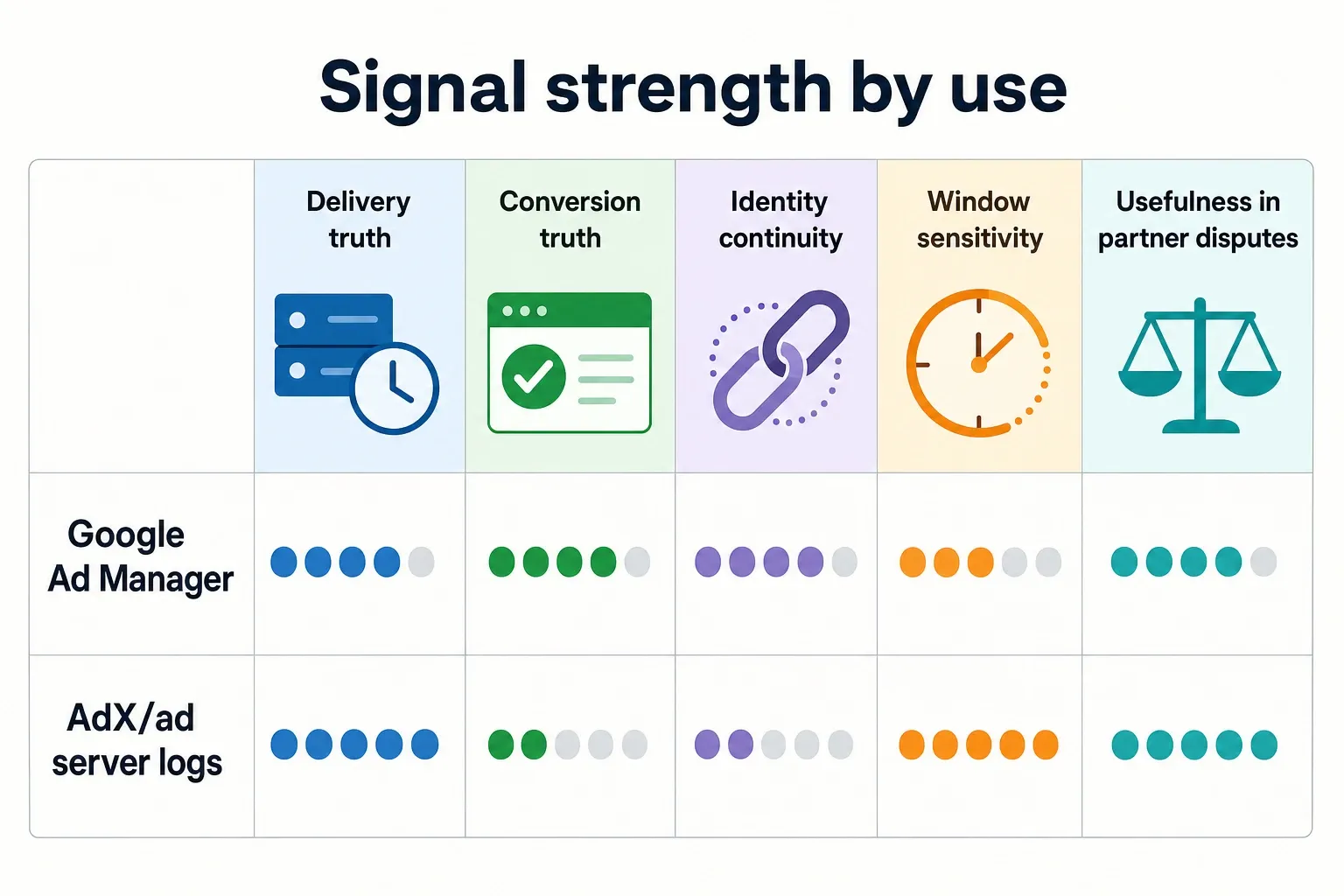
| Signal source | Delivery truth | Conversion truth | Identity continuity | Window sensitivity | Usefulness in partner disputes |
|---|---|---|---|---|---|
| Google Ad Manager, AdX, and ad server logs | High. They can show ad unit, line item, creative, timestamps, rendered impression signals, click records, and fill behavior inside the publisher stack. | Low to medium. They prove exposure and clicks, not whether the advertiser later assigned credit. | Limited to available identifiers, request metadata, and click/impression events. They do not see the full buyer journey. | Low for delivery, high for click-to-conversion arguments because the partner may apply a different lookback window after your event. | Very high for delivery disputes. Use them to prove whether the impression or click happened before debating attribution. Gourmet Ads explicitly points to ad server logs as part of a unified attribution view Gourmet Ads. |
| DSP-reported conversions and programmatic buying data | Medium. DSPs can show bids, wins, spend, creative, and modeled performance from the buyer side, but they do not replace publisher delivery logs. | Medium to high for the buyer’s own rules. Stronger if conversion tags, click IDs, and impression IDs are complete. | Usually stronger inside the DSP’s identity graph than in publisher analytics, but it can weaken across browsers, devices, and logged-out traffic. | Very high. A 1-day post-click window and a longer post-view window can change reported CPA, ROAS, and conversion volume without changing delivery. | High if the partner exposes settings. Low if the partner only sends a summary slide with no timestamp logic or attribution model. Growth Channel separates post-click and post-view analysis as distinct programmatic measurement views Growth Channel. |
| Google Analytics and publisher web analytics | Medium for on-site engagement after the click: sessions, landing pages, source parameters, and user behavior on your properties. | Low to medium unless the conversion occurs on your site or the advertiser shares event data. Google Analytics will not magically see a retailer’s private checkout. | Depends on tags, consent mode, UTMs, click IDs, and whether the user returns through a trackable path. | Medium. Session and campaign attribution can disagree with ad platform windows, especially when the user comes back later through search, email, or direct traffic. | Useful for checking click quality and landing behavior, not for granting conversion credit by itself. Riccardo Guggiola frames attribution as rules for assigning value to touchpoints, which is exactly where analytics rules can differ from media rules Riccardo Guggiola. |
| CRM, CDP, and customer data systems | Low for media delivery unless linked back through IDs, click IDs, or clean-room matching. | High for actual customer outcomes: lead status, purchase, subscription, renewal, or pipeline stage. | Potentially high for known users, weaker for anonymous readers and unlinked devices. | High. A CRM may credit the campaign based on lead creation date, opportunity date, or purchase date, not the impression date. | Strong for conversion reality, weak for proving which ad exposure deserves credit. Gourmet Ads includes customer data systems in the unified dashboard approach for comparing attribution models Gourmet Ads. |
| Advertiser conversion tags and event logs | Low for publisher delivery because they fire after the user reaches the advertiser environment. | High if tags fire correctly on the desired event and the conversion definition is stable. | Depends on cookie availability, tag implementation, consent, and whether the event can be tied to the media touchpoint. | Very high. Tags may fire inside the window for one platform and outside the window for another. | Critical for proving the event existed, but not enough to settle credit allocation. Pathlabs’ useful caution is blunt: some advertising impact can be measured, but not everything is measured accurately Pathlabs. |
| Multi-touch or modeled attribution platform | Low to medium. It usually ingests delivery data rather than generating it. | Medium to high when conversion feeds are clean, but outputs depend on model assumptions. | Varies by identity graph, integrations, and data freshness. It can improve continuity or create a false sense of precision if IDs are sparse. | High because model weighting and lookback rules decide how much credit moves away from the final click. | Useful for strategy, risky for billing disputes unless inputs and weights are visible. Cometly positions attribution around identifying what drives pipeline, which is valuable only when the tracked events and channel mappings are clear Cometly. |
Why attribution looks different on the sell side
Publisher-side attribution is different because your stack sees the media event before it sees the business outcome, if it sees the outcome at all. An impression can serve correctly, a click can be logged, and conversion credit can still go to paid search, email, direct traffic, or another programmatic partner because the advertiser’s attribution model controls the final credit assignment.
Use a concrete reconciliation file before a renewal discussion. Pull from Google Ad Manager: order ID, line item ID, ad unit, creative ID, device category, impression count, click count, date, and revenue. Pull from the buyer: campaign ID, conversion event, event timestamp, post-click conversions, post-view conversions, lookback window, deduplication rule, and credited channel. If those fields do not line up, you do not have a performance dispute yet. You have a measurement-spec problem.
Delivery truth is not conversion truth
Delivery truth tells you whether the ad request, impression, creative, click, or revenue event happened under the campaign rules you sold. Google Ad Manager reporting and log-level exports are built for that operational layer; GA4 attribution reports are built to assign conversion credit across user interactions after measurement and attribution settings are applied Google Ad Manager Help About attribution and attribution models in GA4. Keep them as separate ledgers.
A programmatic guaranteed campaign can deliver exactly as trafficked and still look weak in the advertiser’s dashboard. The buyer may use a narrow conversion window, the user may convert on another device, or the final recorded click may come from a brand search ad. Your delivery data is not automatically wrong. The conversion model is applying rules your ad server does not control Google Ad Manager Help GA4 attribution settings.
Where the gaps usually come from
The practical reconciliation sequence is simple: match campaign IDs and dates first, compare delivered impressions and clicks second, then inspect conversion rules third. Do not start with CPA. Start with event eligibility. A conversion can disappear from one report because of window length, identity matching, browser limits, cross-device behavior, or deduplication, even when the impression count is unchanged.
One buyer may count 7-day post-click conversions and 1-day view-through conversions. Another may give credit only to the last paid click. A CRM may wait until a lead reaches a sales-qualified stage before value appears. Same media plan, different scoring rules. Write those settings into the recap before anyone uses CPA, ROAS, or conversion volume to argue for pricing.
Use that framing at the start of the conversation. You are not trying to settle a Google Analytics versus DSP versus CRM fight. You are identifying the delivery ledger, the conversion-event ledger, and the attribution rule set. Once those are named, the remaining question becomes narrower: did the campaign fail, or did the buyer score it under a different measurement design?
Last-click vs. view-through: what each model actually tells you
Last-click and view-through answer different questions, so either one will distort programmatic performance if you use it alone. Last-click is stricter about user action and tends to favor lower-funnel channels. View-through can show exposed converters, but it can also over-credit passive impressions when frequency is high, viewability is not checked, or the window is loose.
| Model | What it tells you | Where it helps | Where it misleads |
|---|---|---|---|
| Last-click attribution | The final measurable click before conversion receives credit. | Useful when the campaign is built for immediate response, the landing path is short, and click IDs are preserved. | It can understate display, CTV, audio, and high-impact placements that create demand but do not capture the final click. |
| Post-click attribution | A conversion receives credit if it happens after a campaign click within the advertiser’s lookback window. | Good for judging whether clicks from a placement are turning into later action, especially for lead forms, trials, and checkout paths. | It still ignores people who saw the ad but returned through another channel without clicking. |
| View-through attribution | A conversion receives credit after an impression, even if the user did not click, usually within a defined post-view window. | Useful for upper-funnel display and video where clicks are not the only signal of influence. | It can inflate value if the campaign reaches people who would have converted anyway or if frequency is high near purchase. |
| Post-view attribution | A narrower implementation of view-based credit tied to impression exposure rules and a defined conversion window. | Helpful when the advertiser wants to measure exposed converters separately from click-driven converters. | Dangerous as a primary KPI if viewability, frequency, and deduplication rules are not visible. Growth Channel’s post-click versus post-view split is a practical way to keep these readings separate Growth Channel. |
For a publisher, the important move is to ask which model is being used before reacting to the number. A partner claiming performance from view-through conversions is making an assisted-exposure argument. A partner proving post-click conversions is making a response argument. Those claims should not trigger the same renewal language, floor decision, or inventory allocation.
The buying objective should set the proof standard. If the campaign is a retargeting push tied to a promotion, post-click evidence should carry more weight. If it is premium display against an endemic audience, view-through can be useful, but only when the report also shows frequency, viewability basis, window length, and deduplication against other paid media.
How attribution changes demand partner reporting
Attribution settings can change partner-reported CPA, ROAS, and conversion volume even when impressions, clicks, spend, and inventory mix stay flat. That reporting impact matters because it affects budget allocation, floor pressure, renewal language, and requests for more scale. Treat the attribution settings as commercial terms, not as a footnote in the performance deck.
View-through credit can make upper-funnel inventory look stronger
Programmatic partners selling premium reach may rely on view-through credit because a display impression can assist a later conversion without receiving the click. That can be a valid read. It can also make a broad campaign look efficient when the lookback window is long or the audience already had purchase intent before the exposure.
For publisher-side evaluation, ask three questions before accepting view-through results: was the impression measured as viewable, how was frequency capped or reported, and was the conversion deduplicated against search, social, affiliate, email, and other programmatic partners? If the partner cannot answer those questions, treat view-through reporting as directional, not as a standalone reason to change floors or grant preferred access.
Lookback windows can move the internal scorecard
A lookback window is one of the easiest ways for two dashboards to disagree. A conversion outside a 1-day window but inside a 7-day window may be counted by one system and ignored by another, even when both systems are applying their configured rules correctly. GA4 explicitly lets properties manage attribution settings, including conversion windows, which is why you need the setting, not just the final number GA4 attribution settings.
That difference runs straight into CPA and ROAS. If the advertiser’s DSP reports more conversions under a longer post-view window, the channel can look efficient enough to scale. If the advertiser’s analytics team uses a shorter or stricter attribution setup, the same spend can look marginal. The fix is not to average the reports. It is to document the window used for each read.
Modeled credit changes who gets budget protection
Multi-touch and modeled attribution can move value away from the final click and toward earlier programmatic exposures. That can help publishers when inventory supports research, product discovery, or consideration before the user converts elsewhere. The key is to separate the business argument from the math: modeled credit may be useful, but only if the buyer can explain what went into it.
The risk is opacity. If a partner cites modeled attribution but cannot explain inputs, weights, exclusions, and deduplication, do not treat the output as hard truth. AI Media Group argues for more data-driven attribution across the customer journey, but the publisher-side discipline is unchanged: inspect the assumptions before accepting the conclusion AI Media Group.
This is where revenue teams can get boxed in. A partner may point to modeled results to push for lower floors, preferred access, or more volume. Do not answer with “we disagree.” Ask for the exact rule set behind the claimed lift: eligible events, attribution model, lookback windows, deduplication hierarchy, excluded channels, and whether conversions are post-click, post-view, or both.
How to handle attribution disputes with advertisers and partners
Attribution disputes should start with model alignment, not dashboard defensiveness. Put the four required terms in writing before the next QBR or renewal call: conversion definition, attribution model, lookback window, and deduplication rule. If any term is missing, pause the performance argument and request the measurement spec. Without it, a CPA comparison is usually comparing two different scoring systems.
- Lock the conversion definition first. Specify whether the event is a purchase, lead, subscription start, app install, qualified opportunity, or another action. Also confirm whether cancellations, duplicate leads, test orders, and internal traffic are excluded.
- Document the attribution model and window. Ask whether the partner is using last-click, post-click, view-through, post-view, multi-touch, or modeled credit. Get the exact lookback period and whether click credit overrides impression credit.
- Request the data source behind the claim. A summary number is not enough. Ask for the reporting system, click and impression timestamp logic, conversion timestamp logic, time zone, deduplication rules, and whether Google Analytics, a DSP report, a CRM, or a customer data platform is the source of record.
- Reconcile delivery before credit. Pull your Google Ad Manager reports, AdX data where relevant, and raw ad server logs for the campaign dates, line items, creatives, ad units, and deal IDs. Confirm that the campaign delivered what was bought before discussing whether it drove the buyer’s outcome.
- Match event timing where possible. Compare impression timestamps, click timestamps, landing-page sessions, and conversion timestamps. If a claimed conversion happened before the first eligible impression or outside the agreed window, the dispute is no longer philosophical.
- Isolate the failure mode. Classify the discrepancy as tracking loss, identity mismatch, cross-device gap, tag failure, deduplication difference, or model-choice difference. Escalate only after you know which bucket it belongs in.
- Negotiate the adjustment against evidence. If delivery is clean but conversion credit is weak under the advertiser’s model, do not concede makegoods automatically. If your tags, macros, or click tracking broke, own the operational failure and limit the adjustment to the affected segment.
Tools and checks to cross-check attribution claims
Publisher reconciliation matrix: Google Ad Manager or ad server logs are the delivery source of record for order ID, line item ID, ad unit, creative ID, impressions, clicks, timestamps, and revenue; use them to prove what served, not who gets conversion credit Google Ad Manager Help.
AdX and programmatic reports help validate auction demand, buyer activity, clearing price, and revenue, but they still do not prove advertiser-side conversion credit Google Ad Manager Help.
GA4 or advertiser analytics should be used for onsite events, source and medium, campaign parameters, event names, transaction IDs, and attribution settings About attribution and attribution models in GA4.
Viewability evidence should reference the measurement standard used; for display, the IAB/MRC guideline is commonly summarized as 50% of pixels in view for at least one continuous second IAB/MRC Display Viewable Ad Impression Measurement Guidelines.
CRM or customer-data systems are best for lead status, opportunity stage, customer IDs, and offline revenue, but only after you map timestamps and IDs back to the campaign.
- Google Ad Manager: confirm line item delivery, creative serving, ad unit mapping, impression timestamps, clicks, deal IDs, and any pacing or targeting issue that could explain underdelivery or poor exposure quality.
- AdX and programmatic buying data: compare auction activity, demand source, buyer, deal performance, clearing behavior, and bid landscape against the partner’s claim that scale or access is the issue.
- Ad server logs: use raw event-level records when a dispute depends on timing, eligibility, or whether a click or impression existed before a claimed conversion.
- Google Analytics: check landing-page sessions, UTMs, source and medium values, bounce behavior, and whether paid traffic is being overwritten by direct, organic search, email, or another campaign tag.
- Customer data systems: verify whether the advertiser’s business event exists and whether the event date matches the media window. This is especially important for lead-gen campaigns where the valuable event may occur after the form fill.
- UTM and click ID checks: look for broken UTMs, inconsistent naming, stripped click IDs, missing macros, redirect chains, and click trackers that fail on mobile or in privacy-restricted browsers.
- Conversion tag checks: confirm that tags fire on the intended event, not on a confirmation page refresh, test page, intermediate step, or unrelated site action outside the expected window.
- Viewability and exposure checks: identify whether the attribution claim depends on viewable impressions, non-viewable served impressions, high frequency, or post-view credit from broad reach inventory.
- Identity checks: validate whether the claim relies on cookies, hashed emails, logged-in users, clean-room matching, modeled conversions, or cross-device attribution. Each one changes how much confidence you should place in the match.
- Controlled test setup: when the discrepancy stays unresolved, narrow the analysis to one demand partner, one page group, one deal ID, one creative set, or a shorter conversion window. Cleaner scope usually beats a larger argument.
What you still have to decide
Set your attribution stance before the next dispute, not while renewal pressure is already on the call. Make Google Ad Manager or your ad server logs the source of record for delivery if the question is whether inventory served as sold. Require line-item configuration, timestamps, creative IDs, ad units, and event counts. Summarized partner reporting should not override operational logs without a documented reason.
Decide which conversion model you will accept by buying objective. Use post-click evidence for direct-response claims tied to a form fill, transaction, trial start, or offer page. Use view-through as assisted evidence for upper-funnel and consideration buys, but only with declared window length, viewability basis, and frequency handling. Use modeled attribution only when the partner exposes enough settings to make the result auditable.
Use this decision rule. Accept the buyer’s conversion read when delivery matches, tracking is intact, the attribution settings were agreed before launch, and the disputed outcome is conversion credit rather than serving accuracy.
Defend publisher delivery when GAM logs, line-item setup, and timestamps show the campaign served according to the deal but the buyer’s model credits another channel. Rerun the campaign, or at least rerun the measurement read, when the parties used different conversion definitions, lookback windows, tags, deduplication rules, or identity assumptions.
Commercial action such as makegoods, floor changes, preferred access, or added scale should follow the cause of the discrepancy, not the loudest dashboard.
Frequently asked questions
What is attribution in programmatic advertising?
Attribution in programmatic advertising is the process of assigning conversion credit across programmatic touchpoints so you can judge which impressions, clicks, or channels influenced the outcome. For publishers, the operating version is narrower: your ad server can prove delivery, while the buyer’s analytics, DSP, or CRM decides whether that exposure receives paid conversion credit Gourmet Ads.
Why do publishers and advertisers see different attribution numbers?
Publisher and advertiser attribution reports differ because they often use different conversion windows, identity rules, deduplication logic, and data sources. A publisher may see clean delivery in Google Ad Manager or log files, while the advertiser’s system may credit paid search, email, another device, or a different programmatic partner. The reports can both be internally consistent and still disagree.
Is last-click attribution enough for programmatic?
Last-click attribution is usually not enough for programmatic display or CTV because it favors the touchpoint that gets the final recorded click. It is useful as a strict baseline for direct-response activity, but it can miss assist value from impressions that influenced research or consideration. Use it with post-view or modeled reads only when the buyer can explain the settings.
What should I ask a partner in an attribution dispute?
Ask the buyer for the attribution model, lookback window, deduplication rules, conversion definition, event timestamp logic, and source of conversion data. Also ask whether the report includes post-click, post-view, or both. Those settings can change the reported result even when delivery, spend, creative, audience, and inventory mix are identical.
Which data should publishers trust most?
The clean operating rule is this: use ad server logs for delivery truth, analytics for onsite behavior, CRM or customer-data systems for downstream business events, and partner reports only after you reconcile model and window differences. Google Ad Manager and your logs show what actually served. The buyer’s conversion platform shows what received credit. Do not let one dashboard stand in for the whole transaction.
How we researched this
Sources consulted for this article:
- Programmatic Attribution Modeling Explained | Gourmet Ads
- Programmatic Advertising Attribution: A Complete Guide - Cometly
- AI-Powered Attribution for Smarter Programmatic Advertising
- Programmatic Ads Attribution: Post-Click vs Post-View
- Understanding Attribution Models - Riccardo Guggiola
- What is Attribution in Digital Marketing? | Pathlabs